Lisa Jarvis: A cancer vaccine is closer than ever
Published in Op Eds
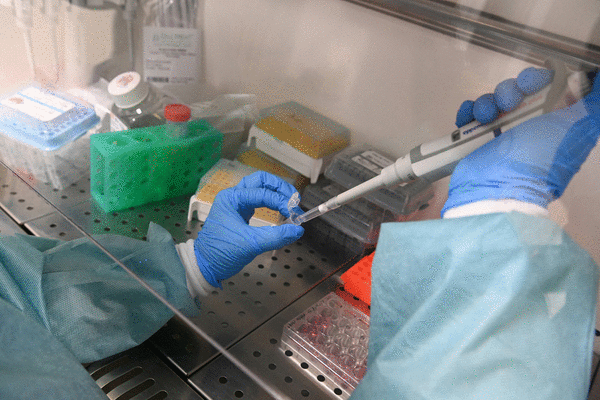
Scientists are on the cusp of fulfilling a decades-long quest: to use vaccines to teach the immune system to spot and destroy cancer cells.
News that an mRNA cancer vaccine developed by Merck & Co. and Moderna Inc. kept melanoma from returning in a large, late-stage trial marks a critical next chapter for a technology beleaguered by post-pandemic political backlash and years of false starts before then.
The concept of cancer vaccines has been kicked around for over a century, and in the past 20 years, we’ve seen countless hopeful headlines about promising early-stage treatments. None of it panned out. Coaxing the body into fighting its own battles turned out to be a lot harder than it sounds.
mRNA is finally moving the field beyond the “hope” and “promise” phase. Merck & Moderna’s Phase 3 study combining the personalized mRNA-based vaccine intismeran with the immunotherapy Keytruda is offering the evidence needed to prove that cancer vaccines really can work.
There’s still plenty to do to show their potential extends beyond melanoma and into other kinds of cancer. But there’s enough data out there now to get excited, as reflected by Moderna’s stock price, which more than doubled on Wednesday. Success in this late-stage trial was critical to proving that mRNA is more than just a one-trick pony for combatting infectious diseases. (To be clear, it has been a stunningly effective one-trick pony that benefitted billions of people around the world coming out of the COVID-19 pandemic.)
Long before the word “COVID” had entered the modern lexicon, companies developing mRNA technology were focused on its potential in cancer. In fact, Merck and Moderna have been working together to develop bespoke cancer vaccines for more than a decade.
The design of such a vaccine sounds straightforward. Scientists genetically sequence a patient’s tumor to pinpoint the mutations driving their cancer. Strands of mRNA carrying the instructions for building those mutated proteins are then packed inside a vaccine (intismeran contains mRNA strands that encode for up to 34 of them). Think of it like handing immune cells a series of mugshots of the enemy so they know exactly whom to attack — not only in the near term, but ideally for years to come.
That’s the bigger dream of cancer vaccines, that patients could be spared the constant anxiety their disease could at any moment roar back. Finally, that feels much closer to reality, but just how close remains to be seen. Merck and Moderna delivered their results via press release, and didn’t include numbers to show the magnitude of intismeran’s benefit to patients.
Still, what we know so far is impressive. Adding the vaccine to treatment with Keytruda lengthened the time before people’s melanoma returned, as well as the time before tumors appeared in other parts of the body. And in June, the companies reported results from a smaller study that followed patients for five years and found intismeran and Keytruda lowered the chances of melanoma returning or metastasizing by 49% compared to Keytruda alone.
Moreover, Keytruda, which has become the standard of care in melanoma since its arrival in 2014, has already greatly improved and extended people’s lives. The cancer vaccine “hurdled an already high bar,” said Michael Postow, chief of melanoma service at Memorial Sloan Kettering Cancer Center. “That’s quite a big achievement.”
Merck plans to share the full data from the intismeran study at an upcoming medical meeting or in a journal, and oncologists will comb through it to understand not only how much longer it can keep cancer from recurring or spreading, but whether certain patients fare better than others. They will also be looking for clues about how the vaccine fits into current treatment strategies.
In the short time since Merck and Moderna began this late-stage study of intismeran, melanoma treatment has continued to evolve. For years, patients would have surgery to remove their skin cancer and then receive an immunotherapy to help keep the disease at bay. But researchers recently found that it’s more effective to start immunotherapy before surgery. Oncologists are looking for hints that the addition of the vaccine to post-surgery immunotherapy offers an even bigger improvement, said Postow, who was an investigator in Merck’s late-stage trial.
A more existential question is whether mRNA-based vaccines can have the same impact on other types of cancer. Melanoma is considered one of the lower-hanging fruits for immunotherapies because the tumors are littered with mutations, making them easier for the immune system to recognize as different from healthy cells and go on the attack. While some other cancers are known to be similarly sensitive to treatment with immunotherapy — lung, kidney and certain kinds of colon cancer, for example — the approach hasn’t been universally successful.
Still, oncologists hope cancer vaccines, when added on top of other therapies, could boost the immune system enough to make a real difference for patients. Merck and Moderna have gone all in on testing the theory, investing in a swath of late-stage studies in lung, bladder, kidney cancers. And others are tackling typically tough tumors, like pancreatic cancer, with encouraging results, albeit from very small studies.
Of course, the other question hanging over this otherwise good news is whether it will convince the many medical science skeptics and conspiracy theorists that mRNA isn’t so nefarious after all. The culture wars over the technology have already put progress in cancer treatment at risk. It took decades to get to this week’s advance. It’s time to put aside unfounded political rhetoric so that patients don’t have to wait so long for the next one.
_____
This column reflects the personal views of the author and does not necessarily reflect the opinion of the editorial board or Bloomberg LP and its owners.
Lisa Jarvis is a Bloomberg Opinion columnist covering biotech, health care and the pharmaceutical industry. Previously, she was executive editor of Chemical & Engineering News.
_____
©2026 Bloomberg L.P. Visit bloomberg.com/opinion. Distributed by Tribune Content Agency, LLC.





















































Comments