Commentary: Boeing can turn its latest problem into its next growth spurt
Published in Op Eds
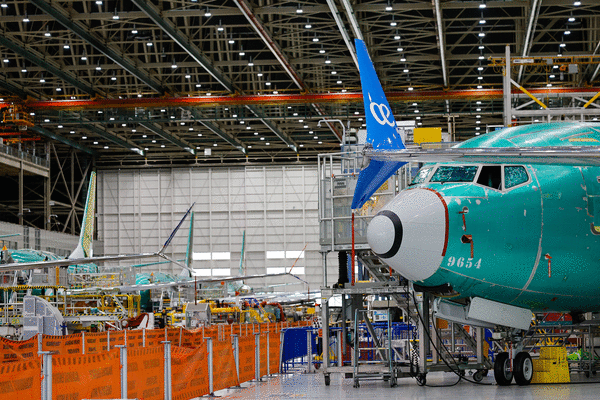
Boeing’s latest figures reveal an industrial paradox. The company ended the second quarter late last month with a record backlog of about $715 billion in outstanding orders, including for more than 6,200 commercial aircraft. That’s not as encouraging as it sounds, though, because its central problem is not how to sell more planes. It is how to build the ones it has already promised — a problem now more daunting than ever.
That distinction matters because the geography of aviation is changing. Boeing is still an American industrial champion, regulated in Washington and built largely around a U.S. production system with suppliers and operations across the country, including in Long Beach, El Segundo and Huntington Beach. South Carolina is Boeing’s supplier of network and satellite technology, while the commercial assembly is in Washington state. But much of the growth on which the company’s commercial future depends will come from somewhere else.
India is the clearest example. Boeing forecasts that airlines in India and South Asia will need nearly 3,300 new aircraft by 2044. Passenger traffic in the region is expected to increase by about 7% a year, while the commercial fleet grows from fewer than 800 aircraft to almost 3,000. Nearly 9 in 10 of the new planes are expected to be single-aisle jets serving domestic and regional routes.
These rosy forecasts should be treated as the estimates of an interested manufacturer. But the forces behind them are difficult to dismiss. Higher incomes, airport investment, the expansion of low-cost carriers and a gradual shift from rail to air travel in Asia are creating a much larger market. Flying is becoming a routine form of transport for hundreds of millions of people rather than a privilege reserved for a narrow elite.
Large aircraft orders from Indian airlines are therefore more than headline-grabbing purchases. They are commitments about routes that have yet to open and passengers who may be flying for the first time.
This is where Boeing’s production difficulties acquire a global significance. A delayed delivery does not simply postpone revenue for the manufacturer. It can disrupt an airline’s fleet plan, prevent it from opening a route, complicate crew recruitment and training, and leave expensive airport capacity underused. The faster an airline grows, the more damaging uncertain delivery schedules can be.
The same logic applies beyond India. Gulf carriers continue to use long-haul fleets to connect Europe, Asia and Africa. Saudi Arabia is investing in aviation as part of its effort to diversify beyond oil. In Indonesia and the Philippines, air transport is especially valuable because geography makes many overland journeys difficult. Across these markets, dependable aircraft supply is part of economic infrastructure.
Boeing is consequently facing a more demanding version of what might otherwise look like an enviable problem. Airlines want its products. The combined Airbus and Boeing order book reached almost 17,000 aircraft by the end of June, illustrating not weak demand but a worldwide shortage of manufacturing capacity.
Boeing itself delivered 314 commercial aircraft in the first half of 2026, up from 280 in the equivalent period of 2025. That is evidence of improvement, but it remains only one stage in a much longer recovery.
The 737 Max safety crisis of 2018 and 2019 showed that a full order book cannot compensate for failures of engineering, quality control and corporate judgment. Airlines may not abandon a manufacturer immediately, particularly in a market dominated by two large suppliers. But they can change the composition of future fleets, demand financial compensation or become more reluctant to build expansion plans around uncertain delivery dates.
This is why the conventional debate about Boeing is too narrowly American. Washington matters greatly: Certification, regulatory oversight, trade policy and government contracts all influence the company. So do the skills and culture of its workforce in Seattle and elsewhere. But public policy cannot manufacture credibility on Boeing’s behalf. Credibility accumulates one safely completed aircraft and one punctual delivery at a time.
India will be an especially revealing test. Its airlines need large numbers of aircraft, but they also need predictability. Their ability to transform orders into functioning networks will depend partly on whether manufacturers can honor production schedules over many years.
Boeing’s future will affect Southern Californians more directly than most other Americans. Los Angeles remains one of America’s aerospace centers, home to manufacturers, engineering firms, defense contractors, research institutions and tens of thousands of highly skilled workers.
When Boeing wins contracts, increases production and invests in innovation, the benefits extend far beyond its own Washington facilities. A stronger Boeing opens more opportunities for the next generation of engineers, technicians, innovation and overall economic growth — especially in Southern California.
For more than a century, Boeing has been a symbol of American ingenuity, helping connect the world and strengthen national security. Since the McDonnell Douglas merger in 1997, Boeing has also repeatedly been a corporate embarrassment as it has fallen short of its own historically high standards in pursuit of quarterly profits. Its next chapter should be a renewed commitment to excellence at home and to restoring public trust internationally. If Boeing gets that right, the rewards will be shared widely, across the U.S. economy and abroad.
____
Bruno S. Sergi is an instructor at Harvard University’s sustainability and global development practice graduate programs.
_____
©2026 Los Angeles Times. Visit at latimes.com. Distributed by Tribune Content Agency, LLC.





















































Comments