Commentary: The Iran war should be the end of the Jones Act
Published in Op Eds
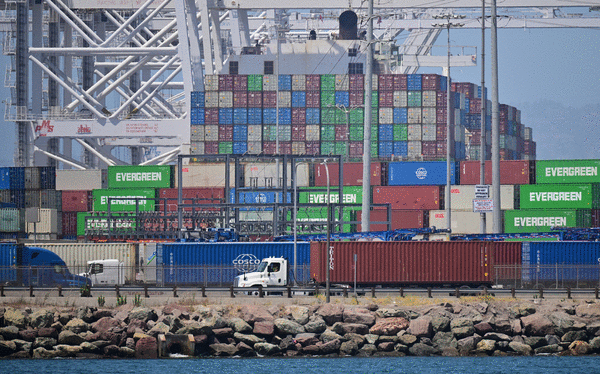
The Iran war has provided at least two clear economic lessons. It has exposed the steep costs of being reliant on fossil fuels, highlighting the need for countries to diversify their homegrown energy sources, including solar and wind power. And it has shown what U.S. commerce could look like freed from the Jones Act, one of the most counterproductive protectionist measures of the last century.
The law, part of the Merchant Marine Act of 1920, requires vessels carrying cargo between American ports to be built, owned, flagged and predominantly crewed by Americans. To illustrate the problems this causes, consider this: A foreign-flagged ship coming from Asia can unload its goods at a West Coast port, but it cannot then pick up American-made goods and unload them at Honolulu — or any other U.S. city. The act costs Hawaiian families $1,800 a year, according to one study. Alaskans and Puerto Ricans get walloped, too.
The act is not just a problem for those outside the continental U.S. All Americans pay for the inefficiencies it foists upon the shipping industry. By eliminating foreign competition for domestic shipping, the act drives up prices for consumers and harms U.S. producers and workers. It is, in effect, a national sales tax, including on gasoline.
Although the act is supposed to stimulate the U.S. shipbuilding industry, that hasn’t happened. The U.S. has only 92 oceangoing ships that are compliant with the Jones Act, down from 193 in 2000, nowhere near enough to handle the amount of internal trade Americans do. As a result, the amount of cargo being shipped between U.S. ports is about half of what it was in the 1960s, even as loads have dramatically increased on trucks, rails and barges.
Nor has the act revived employment in the U.S. shipping industry — job numbers have been stagnant for decades. Instead, it creates a drag on employment and production in other sectors of the U.S. economy, by raising prices. And it gives our competitors an edge, since shipping costs for imports can be lower than for goods made in the U.S.
Proponents of the law also claim it strengthens national defense by ensuring the production of merchant ships that could be used during wartime, but that hasn’t happened, either. The industry now produces an average of only three ships a year — at a cost four to five times higher than our competitors’.
The war with Iran has given us a partial reprieve from the harms of the act. Shortly after launching airstrikes in March, the White House offered an exemption from the law for ships carrying hundreds of different energy and petroleum products, as well as fertilizers. The results have been both eye-opening and unsurprising.
The waiver resulted in far more domestic fuel shipments. In just the first 50 days under the waiver, Gulf Coast suppliers shipped four times more energy products to the West Coast by water than they did in all of 2025 (excluding renewable diesel), because there are now far more ships available to make the voyage. Similarly, jet fuel flowed from New Jersey to California for the first time in two decades.
Puerto Rico, which normally has to import liquid propane gas from distant locations like Equatorial Guinea because there are no suitable carriers in the Jones Act fleet, has already brought in more than twice as much propane from the U.S. mainland as it did over the previous two decades combined — great news for American suppliers and workers.
Although it’s hard to measure the exact impact of the waiver on fuel prices, there is no question it has helped restrain them, mitigating the worst of the nation’s energy crunch. And it’s not just energy that is flowing more freely.
Fertilizer and fertilizer components sailed from Morehead City, North Carolina, to New Orleans — and from Puerto Rico to Texas — for the first time. Other long-dormant domestic trade routes have also reemerged.
Contrary to the fears of protectionists, the waiver has not harmed the U.S. shipping industry, and the benefits to Americans have been tangible.
The waiver has been extended once and is now slated to expire on Aug. 16. At a minimum, it should be extended again.
Better still, Congress should vote to repeal the act — or at least relax its requirements. Members of Congress who claim to be serious about affordability ought to be leading the charge.
In recent decades, presidents in both parties have suspended the act during crises because it’s a roadblock to commerce, a burden on American businesses and a harmful tax on consumers. It shouldn’t take another war to convince Congress to lift it for good.
____
Michael R. Bloomberg is the founder and majority owner of Bloomberg LP, the parent company of Bloomberg News, and the founder of Bloomberg Philanthropies.
©2026 Bloomberg L.P. Visit bloomberg.com/opinion. Distributed by Tribune Content Agency, LLC.





















































Comments