Editorial: Pollsters blew it in the lead-up to Michigan, the hottest primary in 2026
Published in Op Eds
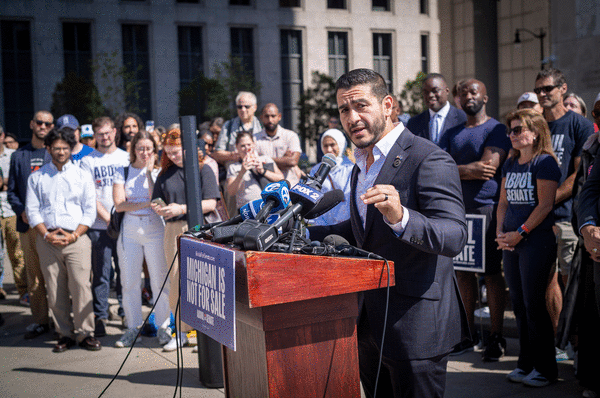
A week ago, Emerson College released a poll of likely Democratic primary voters in Michigan that had progressive firebrand Abdul El-Sayed leading U.S. Rep. Haley Stevens by 15 percentage points in the race for U.S. Senate.
Emerson was just one of many polling outfits that forecast a likely blowout in the primary, but it was the one with the best reputation. Emerson, for example, had Donald Trump and Kamala Harris tied at 49% apiece on the eve of the 2024 election. Trump ended up winning the popular vote with 49.8%. Emerson was similarly and impressively accurate in the 2020 presidential contest, having Joe Biden leading Trump by 4.2 points on election eve; Biden ended up winning by 4.4 points.
So what happened in Michigan?
The far-left El-Sayed beat the moderate Stevens, but by just a percentage point with 99% of the vote counted, according to the Associated Press. Instead of the runaway win for El-Sayed, the race turned out to be a nail-biter whose outcome couldn’t be determined until the morning after election night.
We’re filled with dismay at the hard left turn the Democratic Party has been taking in this primary season, and El-Sayed’s narrow win is still a win. It’s shocking that a candidate who calls Israel “an apartheid state” (think about that for a moment), backs Medicare for All and supports a dizzying array of tax increases, among plenty of other offerings from the Bernie Sanders price fixe, is the nominee of the Democratic Party in a state that voted for Trump in two of the past three elections.
But, still. This was a monumental miss by pollsters, one that likely dampened turnout in what was the nation’s marquee race in the Democrats’ intraparty battle over the party’s future direction.
It’s to the credit of pragmatic Michiganders that so many came out to vote for Stevens despite being told in effect that the hottest race on the ballot was all but over. An impressive 1.5 million Democrats cast their ballots in the primary.
To an extent, we’re sympathetic with Emerson and the like. Polling has become considerably more complex in an age where far fewer of us pick up the phone if we don’t recognize the number. The alternative to calling voters, online polling, risks capturing enthusiasm more than it reflects opinion.
Is that what happened in Michigan? Supporters of El-Sayed, given his crusading platform, naturally tended to be more vocal than those favoring Stevens. Projecting a message of being reasonable and results-oriented doesn’t typically lead to lots of emotional displays and fierce online battles.
We should add here that the polls were considerably more accurate in the lead-up to Illinois’ contentious Democratic primary back in March. In the days before the balloting, the polls generally captured the surge (and the JB Pritzker money) that propelled Lt. Gov. Juliana Stratton to her victory over U.S. Rep. Raja Krishnamoorthi in the race to succeed retiring U.S. Sen. Dick Durbin — coincidentally also a race that pitted someone far to Durbin’s left against a moderate more in his mold.
What did pollsters do right in Illinois that they failed to do in Michigan? The profession ought to analyze whether there were key differences in approach.
Despite pollsters’ poor showing in Michigan, public polls aren’t going away anytime soon, nor do we think they should. They perform a useful service, particularly in helping to winnow large candidate fields — a function that surely will be necessary for the coming presidential primaries.
But when it comes to forecasting elections, American voters should take a cue from Michigan voters and treat polls as fallible and capable at times of being dramatically wrong. Trump’s improbable rise to political dominance, which polls failed to register in the lead-up to the 2016 election, is a clear testament to that reality, and now Michigan has shown how similar head fakes can occur on the left.
The message should be clear. Vote. Your vote counts — and sometimes far more than you think it will.
___
©2026 Chicago Tribune. Visit at chicagotribune.com. Distributed by Tribune Content Agency, LLC.

















































Comments