Commentary: What Pope Leo XIV really asks us to do with AI
Published in Op Eds
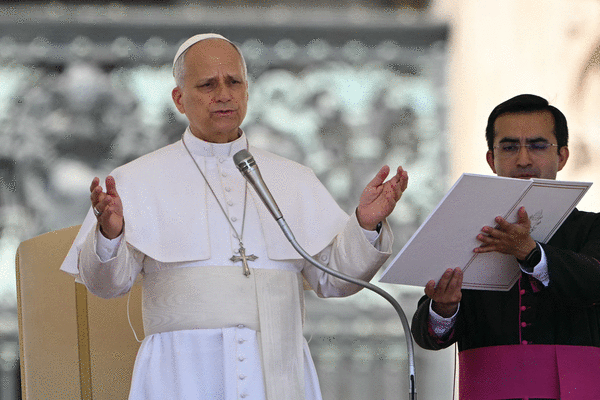
Pope Leo XIV’s first encyclical, “Magnifica Humanitas,” has been widely characterized by the media as the Catholic Church’s landmark alarm bell about the perils of artificial intelligence. But it would be a mistake to reduce the encyclical to a warning about AI and its impact on humanity alone. More broadly, the pope frames the AI revolution as full of peril and some promise, with core questions at the center from the perspective of those on the peripheries of our society:
• Will AI be placed in service to humanity or in service to further concentrate wealth and power?
• Will AI cause further loss to our sense of humanity? Will it bring us further from the flesh (ourselves and our fellow human beings) or closer to the flesh?
For the pope, there are three basic pathways to dignity that are exacerbated and threatened by what’s now being referred to as the “fourth industrial revolution.”
First, the pope instructs us to be guided by faith and spirituality, not as a rigid set of rules, rituals and regulations, but as a constantly evolving practice that helps us see our lives and the world through a lens of love and kinship. It’s a phenomenon that is solely in the domain of humans, not machines.
He suggests that tending to our inner world through faith and spiritual practices helps us interpret reality in all its depth and provides us “the criteria for recognizing what humanizes or dehumanizes and what liberates or oppresses in ever-changing situations.”
Second, the pope invokes perhaps the most glaring limitation of AI: our urgent need to act together in the real world. For Catholics and other faith groups, there is a common understanding that our nation is facing a deep moral crisis, with migrant families treated like criminals, racial and gender discrimination on a dramatic rise, and attacks on our democracy and voting rights unseen in more than 50 years.
The challenges around immigration, bias and democracy have haunted the world for thousands of years, though they’ve taken on a new, modern dimension. And it requires us to be active in the public square, allowing ourselves to be instruments of a God who is always near to people. The pope says “solidarity is expressed when each person, both individually and collectively, takes part in the life of the community — by staying informed, engaging with others, making their voice heard and contributing to public decisions and choices.”
Over the past year, we have been witnesses to an extraordinary movement of people and leaders of all faiths leading an effort to confront federal immigration agents and push for pastoral access to detainees at holding facilities, standing in communion and fellowship with men, women and children who are being robbed of dignity and agency.
Through hundreds of public vigils and marches, we have galvanized and captured the moral curiosity of millions of people, helping to trigger a turning point against this inhumanity. And our efforts are working. Recently, U.S. Immigration and Customs Enforcement reversed itself on the procurement of 11 detention warehouses, a signature initiative of the administration’s mass deportation efforts.
It’s why there was extra significance this July Fourth when the American pope visited the Italian island of Lampedusa to pay tribute to migrants who crossed the Mediterranean. During the memorial, he called for better treatment of immigrants by Western nations.
And we have to do our part, and heed the pope’s call to remain visible in our neighborhoods, aligned with brethren of other faiths and all who hear the urgent moral calling in our society, especially the threat to democracy and voting rights that will almost certainly manifest this fall.
Finally, AI is accelerating one of the world’s most serious imperatives: the rapid, growing consolidation of wealth and power. Indeed, our economy functions only as the result of choices made by people in positions of power. The pope laments how our economy is causing so many to struggle to survive. And he puts a challenge to all of us to labor for a moral economy.
“AI tends to amplify the power of those who already possess economic resources, expertise and access to data,” Leo writes.
Unless AI is reined in, not just as yet another threat to our collective humanity, but as a tool for the further enrichment of the world’s wealthiest people, we could face a calamity that robs billions of people of economic justice.
As the first pope from the United States, Leo instills hope in us at a time when moral leadership is desperately needed in our country and in our world. His young papacy has inspired many to deepen their faith and spiritual journeys, to summon the courage to bear faithful witness to the pain of our time, and to work for a reordering of human relationships and a restructuring of our economy.
He is helping us rediscover the treasure that is Catholic social teaching. And he is challenging us to keep choosing to attend to reality and humanity, with all its beauty and tragedy, and do what no code or prompt could accomplish: Take responsibility for the lives and wounds of our brothers and sisters and put AI in service to our human experience and relationships.
____
Joseph Tomás McKellar is executive director of Catholics in Communion and PICO California, the state’s largest religious organizing network.
___
©2026 Chicago Tribune. Visit at chicagotribune.com. Distributed by Tribune Content Agency, LLC.


















































Comments