Jackie Calmes: The nonsense of deporting immigrants who came legally and do much-needed work
Published in Op Eds
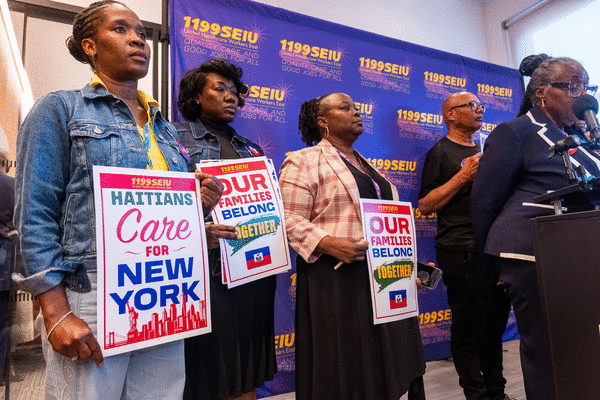
As of this week, with a green light from the Supreme Court's right-wing supermajority, President Donald Trump is free to mount his long-promised mass deportation campaign in earnest. His Homeland Security Department notified employers last week that about 350,000 Haitian immigrants no longer are protected, triggering mass layoffs. His blood-stained Immigration and Customs Enforcement agency has plans, CBS News reports, to begin sweeping them up.
But contrary to Trump's reckless rhetoric, neither the Haitians nor another 1 million targeted immigrants from a dozen other nations are here illegally — at least they weren't until the administration revoked their legal status after the Supreme Court's go-ahead last month. On Wednesday, a federal district judge reluctantly made it official. All have been legal residents, many for years, under the 36-year-old humanitarian program granting temporary protected status to people who've fled countries roiled by war, natural disasters or other extraordinary crises. The protected status beneficiaries have been vetted, paid fees and gotten revetted every 18 months to keep a work permit and ensure they've steered clear of crime.
As that description suggests, we are not talking about deporting "the worst of the worst," as Trump contends ad nauseum.
We are talking about law-abiding essential workers, many with U.S.-born children. And to make matters worse, these workers are being deported from a nation with an aging population and labor shortages. These are people who take jobs that many Americans won't do, like bathing, diapering, feeding and generally keeping company with elderly citizens who need care and companionship. People who — if moral and humanitarian considerations aren't enough for you — are crucial to the economies of many states, notably red ones including Florida and Ohio.
We're talking about schools' cafeteria workers and janitors, and the people who clean toilets and wheel disabled passengers to their flights at airports. Haitian workers at Fort Lauderdale-Hollywood Airport burst into tears when they were told to turn in their badges, the Washington Post reported Friday. We're also talking about doctors, engineers and other well-educated professionals.
Like Fritz Emmanuel Lesly Miot, a Haitian in California who was the name plaintiff in the lawsuit against Trump's effort to rescind protected status before its planned sunset and who was spotlighted by Justice Elena Kagan in a scathing dissent against the Supreme Court majority's decision.
As Kagan recounted, Miot has lived in the United States for more than 15 years, since an earthquake in 2010 devastated Haiti and its economy and exacerbated political and gang violence that persists to this day. Miot works in a lab researching Alzheimer's disease, thanks to his temporary protected status work permit. He also has Type 1 diabetes, an easily treatable disease here but potentially "a death sentence" in Haiti, Kagan wrote, "given that country's collapsed health-care infrastructure." Unless kidnappers in Haiti get him first, as Miot fears.
Something must be done for the hundreds of thousands like him, and can be. The House in April passed a bipartisan bill to extend protected status for Haitian migrants for three years. But two weeks ago, Republicans in the Senate blocked it. Even if the measure were revived and passed, Trump presumably would veto it.
Still, should the president maintain his xeonophobic, racist and economically foolish stance, he could at least delay deportations, allowing both the targeted employees and their employers the time to adjust, as numerous business groups for healthcare providers, small manufacturers, restaurants, hotels and other service industries have begged the administration to do. The National Restaurant Assn. warned in a letter to Homeland Security Secretary Markwayne Mullin: "Many affected employees are long-serving, legally authorized workers who are central to restaurant operations. Their departure could remove a substantial share of the local hospitality workforce overnight."
But consideration for real-life consequences is not how MAGA rolls. As the Trumpian truism goes, cruelty is the point — especially when it comes to immigration.
Trump ally Sen. Eric Schmitt of Missouri, one of the Senate's most far-right Republicans, heartlessly harrumphed in what passed for Senate debate: "America is not a global refugee camp.… America is our home, and when houseguests become squatters, you don't delay enforcement. You call the sheriff and you send them home."
And in doing so, you've shot yourself in the foot, economically.
In contrast with the likes of Trump and Schmitt, Ohio's Republican Gov. Mike DeWine has been making the economic as well as moral case for holders of temporary protected status and Haitians in particular since 2024. That's when he publicly refuted the idiotic campaign claims of Trump and running mate JD Vance, then a senator for Ohio, about Haitians in struggling Springfield, Ohio. "They're eating the dogs," Trump blurted in the nationally televised presidential debate against Kamala Harris that September. "The people that came in, they're eating the cats. They're eating — they're eating the pets of the people that live there."
Neither global mockery nor the homegrown rebukes from DeWine and other Ohio officials and local police stopped Trump's and Vance's hateful lies. And now that they're president and vice president, an offensive against the Haitians as well other foreigners with protected status is apparently underway. DeWine, courageously, is still speaking out in the small hope of stopping it.
Last week the governor told CBS News that deporting Haitians from Ohio — sending them "back to hell" — would be "a blow" to the state: "They came there because there were jobs that were not being filled by other people."
But, DeWine added, the issue is bigger than the Haitians in Ohio: "The massive deporting of people, you're going to see it all over the country."
Nationwide, he said, over a third of the workers tending to people in long-term care facilities or in homes are immigrants. Once they're deported, he predicted, "You're not going to be able to find people to replace them, frankly."
People like Augustine, who out of fear gave the Washington Post only her first name. Until this week, she cared for nine residents at a Dobbs Ferry, N.Y., nursing home. One called Augustine "my daughter."
That elderly woman loses a lot, thanks to Trump. She and the entire country.
____
Bluesky: @jackiecalmes
Threads: @jkcalmes
X: @jackiekcalmes
©2026 Los Angeles Times. Visit at latimes.com. Distributed by Tribune Content Agency, LLC.





















































Comments