Commentary: Heat waves show climate change is here
Published in Op Eds
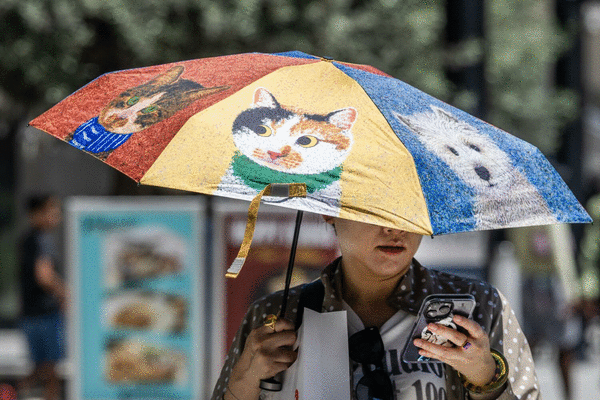
A few weeks ago, my daughter and I went to Paris to visit family and celebrate her high school graduation. As a marine scientist working on the front lines of climate and oceans, I was hoping for a break from the doom and gloom. Instead, I found myself inside the biggest climate story of the year.
We knew it would be hot, over 90 degrees. When I checked the forecast before we left, I told my daughter to pack shorts and tank tops. But we were not prepared for what followed — a 10-day inferno.
On June 24, the day after we arrived for a 16-day visit, France hit its hottest national average on record. This was heat unlike any I’d ever experienced — hotter than the Sinai in Egypt, where I took a diving trip with my father after high school; hotter than Miami, where I did my graduate studies in marine policy; hotter than New York City in the summer, where I grew up. The heat did not even let up at night. It was still in the 90s well after 9 p.m., and buildings built to hold in the warmth in winter quickly turned into ovens.
That week, France recorded its hottest day ever, then broke that record again the next day. The Louvre and the Eiffel Tower restricted visiting hours. We heard about young men drowning in the Canal Saint-Martin, steps from my aunt’s apartment, where we had watched crowds gathered on the banks for days, as the death rate in the city rose 62% over a six-day period, mostly among older people.
Across the channel, London was having its own reckoning with the European heat dome. A London Climate Action Week panel on adapting to extreme heat was canceled— the venue, like most buildings in the city, had no air conditioning, and organizers couldn’t risk going forward with the event, an irony that was profoundly disturbing.
Europe is warming faster than any other continent, and France’s June temperatures blew past what even the most radical climate models had recently projected.
Meanwhile, the ocean off my home coast in California had been quietly running its own fever. Scientists in La Jolla had already logged 36 days of record-breaking water temperatures this year, a marine heatwave building since the summer before, with no El Niño effect to blame. Scientists are now watching a potential Super El Niño forming in the Pacific, which could drive even more heat into the ocean system.
A few days after I returned home, I surfed my favorite local spot. The cold, foggy morning — complete with what we call “fog rain” — was a blessed relief after two weeks of sweating in France. But the water felt unsettlingly warm. Normally the cold seeps through your wetsuit the moment you paddle out, and numbs your hands. This time, it felt almost tropical.
And, again this summer, smoke from wildfires in Canada has blanketed major U.S. cities in hazardous air; it’s one more sign of the fires, floods and heat now compounding across the country.
Over the past decade, Northern California has lost 95% of its kelp forests, largely due to marine heatwaves, the ocean’s version of the heat I’d just experienced in France. As a diver and surfer, I’ve watched kelp forests disappear in front of my eyes for the past 10 years. It’s what drove me to work on a documentary about it, Sequoias of the Sea.
Every second breath we take comes from the ocean. It absorbs the bulk of the excess heat we generate, and buffers the extremes we’re now living through.
The ocean, in short, is the best climate solution we have. But, tragically, Congress is now gutting the agency that protects it. The National Oceanic and Atmospheric Administration is facing its second straight year of billion-dollar cuts, including to the marine sanctuaries and fisheries science that keep our coastal waters and ecosystems healthy.
Climate change isn’t coming. It’s here and millions of people are experiencing it in their daily lives. Get involved in your local climate organization. Insist on climate sanity. Vote for the ocean.
____
Natasha Benjamin is a marine scientist and documentary filmmaker. She is the associate director of the ocean conservation organization Blue Frontier. This column was produced for Progressive Perspectives, a project of The Progressive magazine, and distributed by Tribune News Service.
_____
©2026 Tribune Content Agency, LLC.





















































Comments