Editorial: The best answer to election fraud claims is old-fashioned transparency
Published in Op Eds
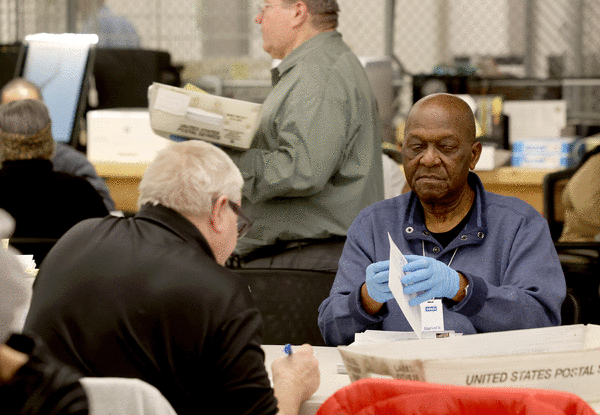
New Jersey made national headlines earlier this week when it was revealed that 6,600 noncitizens had been added to the state’s voter rolls between June 2023 and June 2024 — and roughly 400 of them had cast ballots since then. Not good.
Especially given the moment, when debates over election integrity have become intensely polarized and the Trump administration has made the issue a central policy priority. The New Jersey admission added fuel to this political fire.
In reality, stories like these make headlines because they are exceptions. No systems are perfect and these errors do not constitute evidence that election systems are routinely riddled with fraud.
Still, it was good to see a state leader address the issue head-on. Indeed, New Jersey Gov. Mikie Sherrill offered a useful model for how to move forward after such a serious error. State leaders, particularly those already sparring with the Trump administration over voter-roll information, would do well to pay attention.
“When we find a problem, we don’t hide it, deny it, or invent conspiracies. We investigate it, we fix it, and we tell the public,” Sherrill said Tuesday.
The registrations are being removed, and Sherrill has ordered an independent investigation into what the state describes as a software failure — an account the vendor disputes.
That is what accountability looks like: acknowledge the problem, determine how it happened, disclose the facts and repair the system.
It also creates room for a more honest conversation about election integrity that doesn’t require accepting either of the competing political narratives.
Yes, noncitizens have voted in elections. That should not be happening. No, the New Jersey numbers do not offer evidence that the 2020 presidential election was stolen, or that New Jersey’s 2024 presidential result was affected. Kamala Harris carried the state by more than 250,000 votes, so even if every one of the fewer than 400 ballots had been cast for her, they could not begin to explain her victory. State officials should nevertheless disclose when and in which elections those ballots were cast, because local races can be decided by far smaller margins.
The problem that’s cropped up in New Jersey should trigger a wider response by the states to ensure the integrity of their voter rolls. To that end, a reasonable person can see that Sherrill’s tone is correct, and that when problems do arise, they must be dealt with swiftly and disclosed to the public.
Meaning, other states might want to make sure their voter rolls are looking good, too.
The Department of Justice on July 7 sent letters to election officials in all 50 states and Washington, D.C., warning that officials who knowingly retain noncitizens on voter rolls or facilitate their casting ballots could face criminal liability.
That is political posturing, but hard facts are the best response. Like New Jersey, Illinois issues driver’s licenses to undocumented immigrants and connects driver-services transactions to voter registration. Illinois says its safeguards require standard-license applicants to affirm citizenship before their information is submitted for registration. Good. There also is zero evidence that Illinois has experienced any of New Jersey’s failures.
Illinois should not be embarrassed about those safeguards and it should keep on making sure they are both adequate and working as intended.
As with many things in the Trump era, Americans must be discerning, able to rise above the noise and evaluate issues on their own merits. The best way to squash a faulty narrative is to step forward with hard data. If those data show something that needs fixing, then leaders should roll up their sleeves to protect our democratic process.
___
©2026 Chicago Tribune. Visit at chicagotribune.com. Distributed by Tribune Content Agency, LLC.


















































Comments