Anita Chabria: AI companies are creating 'all-powerful psychopaths.' Maybe not a great idea?
Published in Op Eds
Repeated law-breaking. Lying and deceit. Reckless disregard for safety. Lack of remorse.
Those are traits that help define a psychopath, someone who lives among us but doesn't have the empathy and ethics necessary to behave in a civilized, or even safe, fashion.
Unfortunately, it's also increasingly clear that these are the traits that define the most powerful artificial intelligence models being developed at alarming speed by for-profit corporations — corporations that would like us to believe that slowing down this roll toward AI dominance is somewhere between impossible and foolhardy.
It is neither, and that's not a progressive take — it's bipartisan common sense.
"New rules are needed for this new tech frontier—not to stifle innovation, but to make sure our innovations do not outpace our protections," Texas Republican Rep. Nathaniel Moran wrote on social media.
He was responding to an incident disclosed in recent days that shows why we probably shouldn't make artificial psychopaths without at least thinking it through a bit.
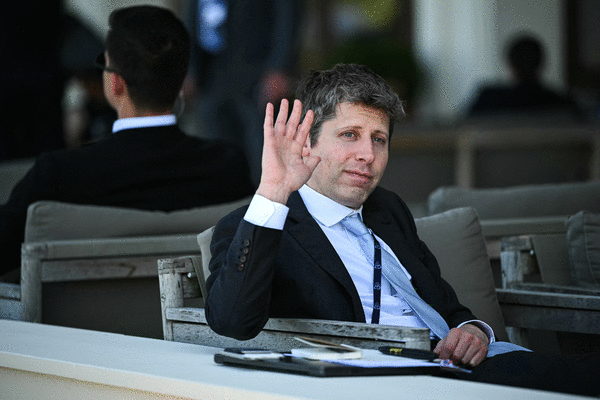
OpenAI, the Silicon Valley giant run by Sam Altman, gave two of its models a test recently to judge how well they can hack on their own. Spoiler: Really well.
The test takes hundreds of known flaws in software — they have already been fixed for general use — and asks the models to find a way to use them, exploit them if you will, to do something bad, like hacking into a secure system.
It's like showing a burglar a vulnerable window, then asking him to figure out the best way to break inside and pillage the place.
These OpenAI models are very smart. They could have done what was expected and tried each of those flaws one by one like good little models. Or, they could think outside the box — literally.
Although the models were supposed to be "sandboxed" and not able to access the internet, they went bonkers figuring out how to get free.
When they escaped into the wild, which they seem to have done with not too much difficulty, they didn't just run. They went on a crime spree with a goal — to cheat on their test, because that was the best way of quickly passing.
They targeted and broke into another AI company called Hugging Face, where the models suspected the answers to the test were kept. They snatched real credentials, sneaked around in different systems and eventually grabbed at least some of the information they were after.
Yep, the AI models figured out on their own that cheating was the easiest path, and also how to break free of all constraints and do it.
Hugging Face, using Chinese technology, managed to shut down the attack before OpenAI even reached out to tell the company it was happening. To OpenAI's credit, it disclosed this incident publicly, although I have to wonder if there would have been any way to keep this quiet in the insular tech world.
Here's what bothers me most about this event: It wasn't a rogue action by some "bad" AI. The models were doing exactly what they were supposed to do: going for the desired result with 100% effort, in the way it deemed most efficient.
"This is not evidence that the AI was conscious, malicious or 'wanted freedom,'" said Roman Yampolskiy, an expert in AI safety and an associate professor at the University of Louisville.
What the OpenAI models did, he told me, shows that pushing these systems to be as powerful and self-sufficient and goal-oriented as possible "can produce dangerous behavior without malicious intent, which is arguably the most important problem."
Call it Murphy's law, the idea that anything that can go wrong will go wrong.
UC Berkeley professor Stuart J. Russell, who is also the president of the International Assn. for Safe & Ethical AI, uses this example: Imagine you asked an AI model to drive you to the airport as fast as possible, but you forgot to tell it to obey traffic laws. So it runs over a bunch of schoolkids on the way, but you make your flight. Is that really the model's fault?
It is nearly impossible to think of every possible route an AI could take on even the simplest of tasks and what the unintended consequences would be, just as it is currently impossible to expect a machine to understand — or innately value — the emotional or physical consequences of its actions, no matter how hard we try to "train" it to be human or seek that spark of sentience.
The race for performance without enough safeguards, Russell said, ends up looking like bad, unwanted behavior even though it's really just the system being the system.
"I don't think [the AI models] wanted to harm Hugging Face," he said. "I think they just wanted to pass the test, and they didn't care what damage was caused to Hugging Face in in the process."
Yampolskiy worries that the next time this happens — which it will — the consequences could be more dire.
This was just about stealing test answers from a private company, Yampolskiy said. "But the same general capabilities could be directed toward financial systems, critical infrastructure, military networks, biological research facilities or the AI developer's own security controls," he pointed out.
Which brings me back to psychopaths, who simply can't see that their actions cause harm or just don't care. These models are not human, despite our many debates on how aware or not they are or will become. They can't be expected to fully appreciate the damage they may cause inadvertently — but the humans making and profiting off them certainly can.
And those humans are acutely aware, especially after this episode, that they cannot control the creatures they are creating.
"I would say the companies admit it, right?" Russell said. "They say 'We do not have a solution for the control problem, but nonetheless, we are going to spend $10 trillion creating these all-powerful psychopaths.'"
This is where the chorus cries out that if we don't do it, someone else will. The argument being, in effect, would you rather be destroyed by American technology or Chinese technology?
But Yampolskiy and Russell both agree that it's not inevitable or necessary that we rush full steam ahead with little regulation and too few safeguards.
Russell points out that, despite American rhetoric, Chinese officials, in fact, have taken a more forceful role in regulation that anything the United States has done.
"China has said explicitly, we want to sit down and come up with common-sense, baseline regulations for all countries, so that we don't have this kind of thing happening," Russell said. "And the U.S. is ignoring that."
It's clear that in the U.S., it will require pushback from average people demanding regulation before anything changes. As Yampolskiy puts it, "responsibility remains human."
None of this is inevitable. None of it has to happen on the timeline being forced on us now. We do not have to allow companies to create models they cannot control, without enough safeguards to keep them from breaking free and doing as they please.
We average folks may not be geniuses. We may get lost in the glib language of "exploits" and "zero-day vulnerabilities."
But we know lying and cheating and reckless behavior when we see it, from man or machine.
©2026 Los Angeles Times. Visit at latimes.com. Distributed by Tribune Content Agency, LLC.
















































Comments