Commentary: Get off your high (Trojan) horses about 'The Odyssey'
Published in Op Eds
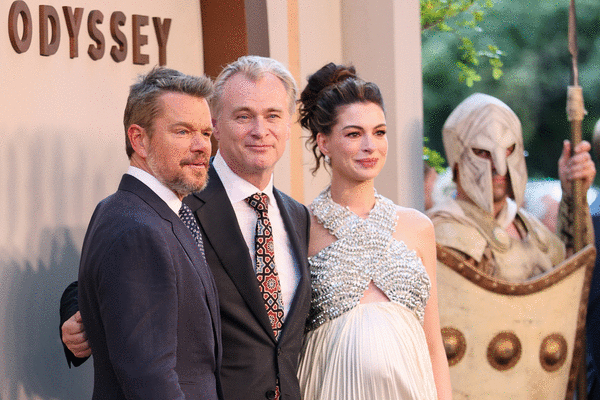
There’s been a lot of online discourse about how unfaithful Christopher Nolan’s film adaptation of “The Odyssey” is, how part of the movie was shot in northern locations such as Iceland and Scotland and how, God forbid, a Kenyan woman was cast as Helen of Troy. But as a classics major, I think all of that is OK, maybe even good: The new “Odyssey” film is a representation of how classics, the academic discipline that studies Homer’s epic, is changing — or how it still needs to change.
The classics as a discipline are facing funding cuts at universities because of dwindling enrollment rates. At my home institution of the University of Chicago, admissions to our classics Ph.D. program have been paused, and the future of our graduate program is still unclear.
There is a snobbish attitude that any mass media depiction of the classics is inherently inferior to serious academic study, which disregards the influence such depictions have on the public. Rick Riordan’s “Percy Jackson and the Olympians” book series is an adaptation of the Greek myths for a younger audience. Those books deviate from the myths, but they have been impactful on the classics field; they have introduced so many people to these Greco-Roman stories. Many of my former classmates still identify as demi-gods and half-bloods, citing the series as the reason they’re even in this major. Consider the logic behind general education requirements: They are a way to introduce students to a multitude of subjects.
I recall professors from another institution complaining about the general education courses they taught to nonmajor students. They felt like the students weren’t enthusiastic enough about the subject and also implied that the material had to be dumbed down for these students and that these students somehow were inferior because of their lack of knowledge about Greco-Roman culture. Frankly, if I were a nonmajor student, I wouldn’t be enthusiastic about their class either! An introduction to the subject may promote later, more serious, study of the classics.
Nolan’s “Odyssey” serves the same purpose.
It introduces viewers to the classics and includes the basic outline of a mythologically steeped epic with minimal changes. Most of the changes Nolan has made allow for people with no knowledge of the classics to understand the plot. In the film, Menelaus tells the story of the Trojan horse, whereas in the epic, he assumes the reader already knows it. Also, nuance is removed from figures such as Agamemnon, turning the complicated character into a Darth Vader-like villain and allowing “Odyssey” newcomers to better understand who they should root for. At the same time, viewers are expected to know basic facts, such as who the Greek Pantheon is and what they are supposed to represent. Ultimately, people who are interacting with this epic for the first time don’t feel patronized.
After watching the film, some viewers may look into the Homeric epics or perhaps late Bronze Age military history. The film isn’t meant to be a graduate course on “The Odyssey,” with all of the nuances and intensive interaction with scholarship, but rather an introduction to the classics meant to arouse interest in the field. So stop arguing about how the plumed helmets are historically inaccurate or how Zendaya’s eye color is the wrong color for Athena!
There’s also a high horse that individuals studying the classics need to dismount in regards to nonmajor students taking classes in the field. Looking down on people who are not as well-versed in stories told thousands of years ago is downright unacceptable. It shouldn’t be an exclusive club one has to get into in order to study the classics. The classics are already having a hard time with course enrollment, so there needs to be less of a standoffish response to mass media depictions. It’s off-putting for those who may want to learn more but feel (perhaps justifiably so) that they would be judged if they did.
Also, those who study the classics need to accept that depictions of our field are not going to be 100% accurate, and the general public also needs to acknowledge that a cinematic adaptation may not be entirely representative because it involves artistic license.
Nolan, for one, does not elaborate on Circe’s rape trauma; instead, he treats it like a throwaway line. And he fits Penelope back into her mold as “faithful Penelope,” Odysseus’ loving wife. It’s OK that he doesn’t necessarily elaborate on these powerful women because this is filmmaking, but it’s still a significant change, so let’s not act like it isn’t. But it makes for good cinema, and this is an adaptation of “The Odyssey,” not a museum reproduction of what a recitation of “The Odyssey” would have looked like.
Nolan’s “Odyssey” reflects inaccuracies and changes from the original text, but as a classics student, I don’t think that there’s anything wrong with that.
____
Abigail AuYeung is a second-year student at the University of Chicago pursuing study in the classics.
___
©2026 Chicago Tribune. Visit at chicagotribune.com. Distributed by Tribune Content Agency, LLC.




















































Comments