Commentary: Meta abandons its AI-generating tool, but public-safety guardrails are needed
Published in Op Eds
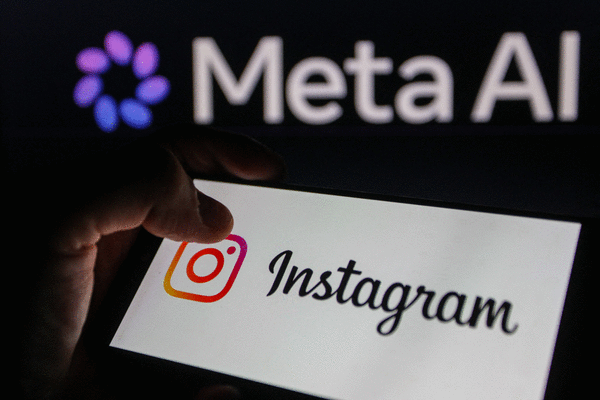
Meta recently introduced a new AI feature on Instagram—then removed it after sharp public uproar. The tool, part of its latest Muse Image model, allowed users to generate AI images using content from public Instagram accounts.
The element that incensed users most was that all public users were automatically opted into allowing their images to be used for AI generation. No pop-ups like a cookie notice or push notification appeared. To opt out, Meta required users to hop through numerous account setting steps.
Many Instagram users were alarmed that this update didn’t require their consent. In addition to everyday users, online privacy advocates criticized Meta for the feature. The actors’ union SAG-AFRA urged members to immediately opt-out to protect their name, image, and likeness.
As it was removing the feature in the face of public backlash, Meta issued a statement saying its intent was “to give people control over whether their public content could be referenced in this way.” However, a hidden opt-out mechanism hardly sounds like giving people control, and referring to AI impressions of real people and events as references is a deceptive spin.
Requirements surrounding opt-in and opt-out mechanisms are a key component of data privacy legislation—an item Congress has yet to address decisively. The absence of clear data privacy protections becomes more prevalent in instances like this one by Meta.
To be clear, using public images to create AI images was not Meta’s invention. Downloading or otherwise saving online images, then uploading them to an image generator to create an AI image, is nothing new. Nor is depicting real people and events through artistic imagery.
For example, the ability to manipulate images through Adobe Photoshop has long existed, but how and whether to regulate photoshop isn’t debated in the public square.
Meta’s update wasn’t a new technological function but rather a feature that reduced the friction it took to create AI impressions of real people and events.
AI exacerbates the concerns with realistic AI impressions, known as deepfakes, because it is much easier and cheaper to create them, and the skillset required is a much lower bar when using AI tools than with traditional image-editing applications such as Photoshop or GIMP.
Creating deepfakes is an ongoing problem. The TAKE IT DOWN Act, signed into law in 2025, was in response to the growing trend of creating and distributing sexually explicit deepfakes that cause emotional, reputational, and even physical harm for victims.
In this law, the line in the sand for prohibited deepfakes is nonconsensual sexual images, but the public reaction to Meta’s move suggests consent in general, also outside of sexual contexts, is an important metric.
Aside from consent, another cause of the latest uproar was the frustration that Instagram would facilitate a mechanism for users to copy and replicate original content. User-generated content on social media is protected by copyright law, to an extent. For example, one could not use another person’s content for a commercial purpose without their consent. However, Instagram’s terms of services state that users grant the company license to use their content.
This includes, to quote the policy, “non-exclusive, royalty-free, transferable, sub-licensable, worldwide license to host, use, distribute, modify, run, copy, publicly perform or display, translate, and create derivative works of your content.” In essence, Meta acted within its rights to provide an AI image-generator using content found on the platform.
Many overlook these terms of services since the platform is technically free to use, and perhaps until this latest controversy, it was unclear how exactly Meta exercised their license.
Without meaningful guardrails including for data privacy, social media platforms and AI companies will continue to push the bounds as far as possible. Consumers were lucky in this instance that outrage led to a swift reversal within the bounds of the free market. Next time, consumers may not be so lucky.
____
Annie Chestnut Tutor is a Policy Analyst in the Center for Technology and the Human Person at the Heritage Foundation.
_____
©2026 Tribune Content Agency, LLC.


















































Comments