Commentary: The war of words is won by he who is punched last
Published in Op Eds
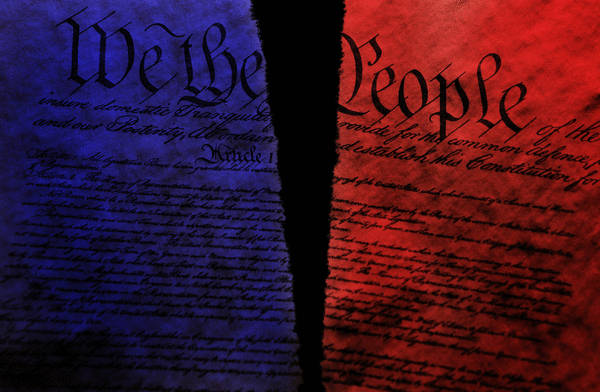
Americans have stopped arguing to persuade; they argue to wound. Every news cycle is a fresh exchange of blows, and every blow lands on a citizenry that has forgotten what the original fight was even about. The country has split into two armies, each convinced it is fighting defensively, each convinced the other side started it.
Researchers keep measuring the damage. Partisans increasingly describe the other side as a threat to the nation’s survival. They marry across party lines less often, befriend one another less often, and would rather not live next door to people who vote differently. The sorting is nearly complete, and the hostility deepens with each cycle.
Here is the uncomfortable part: both sides are correct about the other. The left threw a punch; so did the right. That is how a feud works. Cause and effect blur until all that remains is the punching. Ask any partisan why they swung last and the answer never changes: they were provoked, they were responding, they were defending themselves. Retaliation feels like justice, which is precisely why it never stops.
Consider boxing. In the ring, two trained fighters can trade leather until the final bell, and the judges still need a scorecard to tell anyone who won. Outside the ring, in political life, there are no judges, and there is no final bell. There is only the next round, and the round after that, with the entire country absorbing body shots it never agreed to take.
So here is a claim that will sound like surrender to almost everyone who reads it. The war of words will be won by whoever is willing to be punched last. One side has to absorb the final offense and refuse to offend back. One side has to let the insult hang in the air, unanswered, and walk away while the other arm is still cocked.
Refusing to swing back is the hardest discipline a fighter ever learns. Anyone can throw a counterpunch. The body does it on reflex, before the mind votes. Choosing to lower one's hands while an opponent is still swinging takes a strength that retaliation has never once required. It looks like weakness from the cheap seats. It is the opposite.
History already ran this experiment. The most durable moral victories of the last century, from Mahatma Gandhi’s independence movement to the American civil rights movement, were won by people who trained themselves to take the blow and hold their ground without returning it. The photographs of human beings absorbing violence without answering it changed more minds than any counterstrike ever could. Those movements took the last punch on purpose, and the watching public scored the fight for them. Restraint, broadcast widely, did what aggression never could.
The tribe that keeps score keeps fighting forever. The tribe that stops keeping score wins the country. Whichever side a person belongs to, the path to victory runs straight through that side’s own restraint. The opponent’s defeat was never the real prize. Self-command was. A movement that can govern its own reflexes can eventually govern a nation, because it has demonstrated the one thing voters quietly crave in an age of noise, which is the ability to stay calm under fire.
There is a deeper reason this works: polarization feeds on symmetry. Each side needs the other to keep swinging, because every incoming punch justifies the next outgoing one. Remove one fist from the exchange and the entire machine loses its fuel. The aggressor swinging at empty air does not look heroic. He looks unhinged, and the audience notices. Provocation only reads as strength when it provokes a response. Denied that response, it curdles into something the public finds embarrassing to watch.
This is not a call for cowardice or for abandoning conviction. A person can hold a position with total firmness and still decline to return an insult. Firmness of belief and restraint of temper are entirely compatible, and the combination is far more formidable than rage.
The choice is stark. The country can keep trading blows until the final bell that is never going to ring, or one side can drop its hands first and let the other throw at empty air until it tires. The first move belongs to whoever is brave enough to look weak in order to make the nation strong.
____
ABOUT THE WRITER
Nafees Alam is a professor in social work at Boise (Idaho) State University. He wrote this for InsideSources.com.
_____
©2026 Tribune Content Agency, LLC.


















































Comments