Michael Hiltzik: Trump greenlights California's dumbest water project
Published in Op Eds
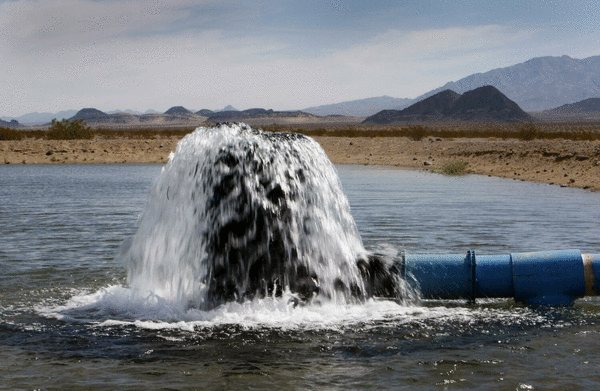
On July 9, the Trump administration delivered a gift to Cadiz Inc., a politically well-connected firm that has been trying for decades to win approval for a scheme to pump water out of the Mojave Desert and market it to water agencies across the Southland.
The administration approved the company's application to convert an abandoned 220-mile oil and gas pipeline crossing the desert to carry water instead. Susan Kennedy, the chief executive of Cadiz, called the approval "a pivotal milestone" that would enable the project to move into its construction stage.
Here's betting that Kennedy's statement was somewhat premature. The project still faces significant opposition from environmentalists, local Indian tribes and the state of California. It has been declared ready to go — and declared dead, too — so often that it could serve as a character in a zombie movie or streaming series.
Indeed, this is the second time that Trump has greenlighted this project. He did so in 2019, but his decision was overturned during the Biden administration; Trump's most recent approval overturned that action — but there's no promising that the next president, whoever that is, won't overturn this one.
I've been covering the Cadiz project for nearly 25 years, starting in 2002; I take credit for helping to put the kibosh on a proposal for the Metropolitan Water District, which supplies water to 13 million Southern California residents, to partner with Cadiz.
In fact, there's reason to wonder whether Cadiz itself still wants to do the project, even though in the past it described it as its potential corporate lifeblood.
Last year Cadiz reported that nearly 90% of its revenue stemmed from the sale of water filtration equipment manufactured by ATEC, a Hollister firm it acquired in 2022. That segment is its only profitable operation, though the $2.5 million in operating income the unit produced in 2025 was swamped by losses in its other operations — mostly the sale of fruits and vegetables grown on its desert tract — producing an overall loss of $25.6 million. The company has never reported a profit.
Kennedy told me this week that she now sees the water treatment business as "the future of our company — an enormous market opportunity." She said "demand for filtration is skyrocketing," with cleansed stormwater "the biggest source of new water supply." Cadiz has doubled its manufacturing capacity for the equipment, and "we expect to double again." The company has also signed an agreement to produce hydrogen at its desert site by installing a solar array for power.
Meanwhile, Cadiz is taking steps to hive off the infrastructure it has planned to use for its water project, mostly two unused pipelines, into a special purpose subsidiary. These entities are typically aimed at insulating the parent company from the risks and liabilities of a speculative investment.
In this case, Kennedy told me, the idea is to open the water project more broadly to outside investors.
In practice, that means that the pipelines Cadiz proposes to use to transport desert waters to urban, industrial and agricultural users would fall into the hands of private equity firms, which haven't been known as a class for their devotion to the public interest. Cadiz would end up with a minority stake in the pipelines, Kennedy says.
Transporting water out of the desert faces so many headwinds that it may make more sense to divest the business and shift over into less controversial enterprises, like filtering poisonous minerals out of reclaimed stormwater and producing hydrogen.
It's worth reacquainting ourselves with the company's discreditable history. The Cadiz project was the brainchild of British-born Keith Brackpool, who had a checkered record as an investment promoter. As I wrote in 2002, he pleaded guilty in London in 1983 to criminal charges that included dealing in securities without a license.
Brackpool's pitch was that by stockpiling water from the Colorado River under the Cadiz sands in years when a surplus was available and delivering it during droughts, the company could assuage the supply crisis confronting Southern California.
I wrote years ago that the project boasted "a sort of shimmering authenticity" — if one didn't look too closely. Yes, the state faces a long-term water shortage. But the problem is that there's no surplus water in the Colorado available for California. Cadiz has never made a conclusive case that it could withdraw as much water from its desert tract as it proposed without draining its underground aquifer to a dangerous level or causing its contamination with carcinogenic minerals.
After he started pitching the project in the mid-1990s it began to look as though the company's principal asset was political juice. Former Rep. Tony Coelho, an important Democratic Party fundraiser, served on the Cadiz board. Cadiz and Brackpool were leading campaign contributors to former Gov. Gray Davis, who was thought to be the source of pressure on the Metropolitan Water District to make a deal with Cadiz. Brackpool hobnobbed with former Los Angeles Mayor Antonio Villaraigosa, who received campaign contributions from him and Cadiz. (Brackpool is no longer associated with Cadiz.)
Kennedy herself had been associated with Cadiz since before she became chief of staff to former Gov. Arnold Schwarzenegger in 2005. Before her appointment, and while she was serving on the state Public Utilities Commission, the firm paid her $120,000 in consulting fees. In 2009, Schwarzenegger endorsed the water scheme as "a path-breaking, new, sustainable groundwater conservation and storage project."
For years, Cadiz shares traded as a sort of plaything for water investors hoping for a big score over the horizon — what craps players call "betting on the come." In this case the bet is on the distant prospect that government approvals would eventually make the project real.
For these players, the investments tended to be cheap compared to the potential gains. The largest shareholder of Cadiz, with a 35% stake, is Netherlands-based Heerema International Services, a global industrial infrastructure company. Its holding is worth about $115 million at the current stock price — peanuts for a company that collects revenue of about $5 billion a year.
Then there's Trump. In March 2017, his Interior Department reversed two Obama administration rulings that had blocked Cadiz's ability to use a 43-mile pipeline to carry water from the desert to Southern California users. Biden's Interior Department canceled those rulings. The July 9 action applies to a separate 220-mile pipeline.
In its recent ruling, the Interior Department's Bureau of Land Management stated that the pipeline conversion would have "no significant impact ... on the quality of the human environment" and therefore no environmental impact statement was even needed.
Environmental groups and other plaintiffs who have been fighting the project are "looking at all our options" for legal challenge, says Ileene Anderson, a senior scientist at the Center for Biological Diversity, a plaintiff in lawsuits challenging the project. "I haven't seen anything to persuade me that there's not going to be any environmental damage," she says.
When I spoke with Kennedy in January 2024, a few weeks after she took over as Cadiz CEO, she acknowledged that the company's name had become a "poison pill." Her plan was to "change the company so people think about it differently."
At that time, this amounted to refocusing its water supply program on serving users in San Bernardino County rather than urban users throughout Southern California. The idea was to counteract what she called a "political" claim that its goal was to drain the desert to "fill swimming pools in L.A."
Kennedy didn't mention ATEC then, but she talks about it today with unalloyed enthusiasm. Indeed, she asserted that the water filtration and hydrogen production businesses together could use as much of the company's available water as it would pipe miles across the desert.
Kennedy is correct to maintain that government, which once built Hoover Dam, the Central Valley Project and Glen Canyon Dam as crucial pieces of our water infrastructure, "has gotten out of the business."
But it's wrong to say that it's because government can't afford such projects. Ceding them to private equity is a choice. Given Americans' dependence on water as a life-giving commodity, do we really want to establish private firms as toll-takers on the water highway, permitted to charge what they wish to maximize their profits? Cadiz may be beating a path to that future, but it may not be a happy journey.
____
©2026 Los Angeles Times. Visit at latimes.com. Distributed by Tribune Content Agency, LLC.




















































Comments