Lisa Jarvis: Extreme heat is a fact of summer. Its health harms don't have to be
Published in Op Eds
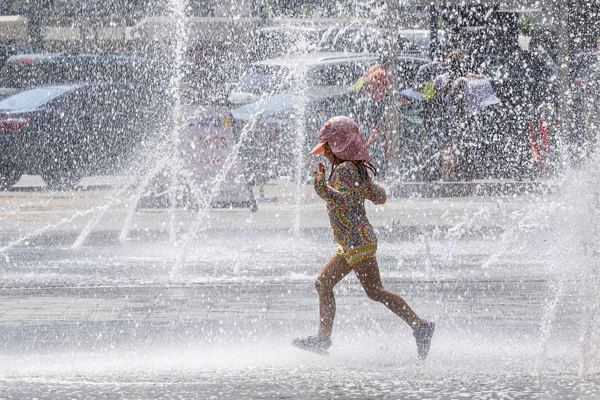
As yet another heat dome settles over part of the U.S., a depressingly predictable news cycle is unfolding. This week, the headlines will warn of dangerously high temperatures; next week, they’ll chronicle the human toll.
Even more depressing: That won’t capture the full force of the heat’s devastation. The deaths reported will surely be a vast underestimate. And most people will never see their local emergency rooms straining to respond to an influx of patients suffering from heat-related illnesses.
The dangerous consequences of extreme heat seem to have become just another fact of summer (and in some parts of the country, of spring and early fall). And while there are encouraging signs that newer initiatives can prevent the worst when people face heat-related health crises, we haven’t done enough to prevent those crises in the first place.
For researchers, a central challenge is figuring out how to convince people they’re at risk — and then get them the right kind of supports to do something about it.
When temperatures rise dangerously, “The number one thing you’ve got to do is get (vulnerable people) out of the heat,” says Jennifer Vanos, the director of Arizona State University’s Human Biometeorology Lab, which studies ways to mitigate and adapt to extreme heat. “It sounds simple, but it’s not.”
Much of the research on extreme heat to date has focused on health risks, the best ways to cool people down, the thresholds at which different groups are in danger, and improving forecasts. That work is still crucial. But more attention — and funding — should go toward finding evidence-backed ways to reach the most vulnerable people and persuade them to act when temperatures rise.
Surveys suggest Americans are slowly becoming more tuned in to the health effects of extreme heat. Yet too many still underestimate the risks in their own communities and, crucially, the danger to themselves.
“A fundamental challenge is most people just don’t think heat’s a risk — and if heat is a risk, it’s somebody else that’s at risk, it’s not me,” says Kristie Ebi, an epidemiologist at the University of Washington who studies global warming’s impact on human health. She compares the communication challenge to what society was up against with cigarettes decades ago: What warning label can convince people to pay attention?
When it comes to extreme heat, the specifics of the message may be less important than who delivers it. As one environmental health researcher after another reminded me, the biggest lesson of the historic 1995 heat wave in Chicago — which cost more than 700 lives — was that social connection is a powerful health intervention. When families, neighbors and community members check on people, it saves lives.
Community organizations and public health officials in cities like Chicago have organized formal check-ins for seniors when dangerous heat sets in. Those play an important role in ensuring everyone stays safe. But more should be done to identify effective ways to help at-risk people — whether that’s through app alerts, phone trees, reminders from healthcare providers or pharmacists, or other helpful outreach — before it’s too late.
One recent study explored whether existing services can be leveraged to protect low-income seniors from the heat. Researchers used insurance claims data to look at whether people enrolled in both Medicare and Medicaid fared better if they were getting weekly visits from home health aides before a heat wave hit.
The findings might at first look disappointing. The weekly check-ins didn’t seem to lower the number of emergency room visits among the elderly. But Hyunjee Kim, a health economist at Oregon Health and Science University who led the work, hypothesizes that people had been more aware of their risk because of the visits and so sought care early — and while it didn’t lower the burden on the healthcare system, it might have lowered the heat’s impact on someone’s health.
More importantly, Kim’s work points to other interventions worth testing. Those home health aides weren’t necessarily trained to address heat — for example, to check if seniors’ air conditioners were working or remind them that their medications made them more vulnerable. But if aides did receive some basic training, could it prevent more hospitalizations and deaths? Researchers need more new ideas for how to reach people before a crisis — as well as the funding to test them.
Getting to evidence-backed solutions tailored for specific communities will take time. The good news is that, until then, there are simple ways to lower the health burden of extreme heat. Anyone living in a place where extreme heat is increasingly common — at this point, that’s most Americans — should keep in mind that they can directly help protect the most vulnerable. If you’re sitting somewhere in the AC at this moment while the outside sizzles, consider checking on your older neighbors. That small act could make a huge difference.
_____
This column reflects the personal views of the author and does not necessarily reflect the opinion of the editorial board or Bloomberg LP and its owners.
Lisa Jarvis is a Bloomberg Opinion columnist covering biotech, health care and the pharmaceutical industry. Previously, she was executive editor of Chemical & Engineering News.
_____
©2026 Bloomberg News. Visit at bloomberg.com. Distributed by Tribune Content Agency, LLC.




















































Comments