Commentary: A war we cannot win -- and a lesson America should have learned long ago
Published in Op Eds
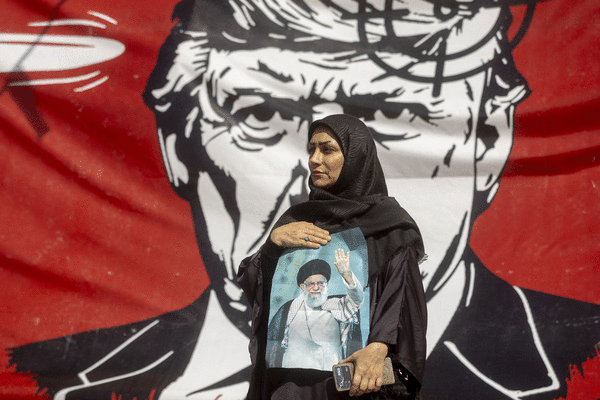
The conflict between the U.S. and Iran has escalated into open confrontation, with operations intensifying near the Strait of Hormuz. What began in early 2026 as tit‑for‑tat exchanges has hardened into a grinding confrontation — one driven less by strategic necessity than by presidential ego and the fantasy of dismantling Iran’s Islamic Revolution. It is a war shaped by one man’s impulses, not by national deliberation. And it is a war the United States cannot win.
The question that echoes is simple: Did the United States learn nothing from Vietnam?
Back then, Washington believed overwhelming military power could bend another nation’s political identity to American will. Leaders assumed that superior firepower, economic pressure, and righteous rhetoric would force capitulation. Instead, the United States found itself trapped in a conflict defined by miscalculation, hubris, and a catastrophic misunderstanding of the nature of national resistance. Today, President Donald Trump is repeating that same mistake — with Iran becoming the proving ground for an old and dangerous delusion.
In fact, we are seeing this dynamic play out globally. Much like Russia’s catastrophic miscalculation in Ukraine, the U.S. is falling into the trap of assuming that technical military dominance equates to political control. Both conflicts reveal the persistent arrogance of great powers that underestimate the will of nations they view as "lesser" military adversaries. They ignore that resistance is rarely just about hardware; it is about the deep historical and cultural roots that bind a population against outside intervention.
This is particularly true regarding Iran. To view this conflict purely through the lens of modern military capability is to ignore a national psyche forged in centuries of struggle against external domination. Iran’s resistance is not merely a product of the current regime; it is a manifestation of a long history of national identity defined by defiance of outside interference. When great powers fail to respect the cultural and historical weight of this resolve, they almost always fail to achieve their political objectives.
The Trump administration’s circumvention of Congress has deepened the danger. By repeatedly bypassing the legislative branch on war powers, the president has triggered legal battles over whether military engagements can be sustained without explicit congressional authorization. This pattern of executive overreach cuts directly against the checks and balances the founders designed to prevent unilateral wars of choice.
This isn't just about foreign policy; it is a profound threat to domestic democratic health from foreign influence. When a president normalizes the launch of unilateral war-making, the precedent bleeds into domestic governance. We see the cost in the erosion of public debate on matters of peace and war, and in the dangerous conflation of foreign conflict with domestic election rules.
As Democracy Docket has noted, the administration has used "foreign interference" — including threats from Iran — as a pretext to restrict voting machines and ban mail‑in ballots. The message is clear: if the executive can bypass democratic consent abroad, it is only a matter of time before the same impulse erodes democratic processes at home.
To reclaim our republic, we must move beyond critique and toward concrete action.
First, Congress must reassert its constitutional authority over war powers. This requires not just rhetoric, but the immediate exercise of the power of the purse to demand transparency and force a legislative debate on the scope of current operations. Lawmakers must initiate rigorous oversight hearings that compel the administration to justify its strategy beyond broad, ideological claims.
Second, citizens must elevate this issue to a top-tier civic priority. Reclaiming our war powers requires a robust public-pressure campaign. Americans should demand that their representatives make their stance on unilateral war-making a central issue in the coming legislative cycle. When we demand that our local representatives publicly sign onto resolutions requiring congressional authorization for any military engagement, we force the conversation back into the daylight of democratic deliberation.
This November, the midterm elections represent more than a choice between parties; they are a referendum on the Trump administration's right to act without consent. When voters head to the polls, they are not just selecting representatives; they are demanding a check on executive overreach, the restoration of the Election Assistance Commission, and an end to using foreign conflict as a pretext to weaken our domestic voting infrastructure.
This moment demands a shift from passive observation to active engagement. The Trump administration’s approach to Iran — its reliance on threats, its misreading of resistance, and its conflation of foreign policy with domestic election tampering — is what happens when leaders forget that power must be tempered by wisdom.
The founders built a republic on the understanding that the strength of a nation lies not only in its armies, but in the resilience of its people and the integrity of its institutions. Vietnam taught us that wars built on ego and historical blindness end in tragedy. Ukraine is teaching Russia that lesson now. And Iran is teaching us that same lesson again. We have the tools to stop this drift; the only question is whether the American public has the will to use them.
_____
Hugo Balta is the executive editor of The Fulcrum and the publisher of the Latino News Network
_____
©2026 The Fulcrum. Visit at thefulcrum.us. Distributed by Tribune Content Agency, LLC.

















































Comments