Ronald Brownstein: The Supreme Court is enabling red states and limiting blue ones
Published in Op Eds
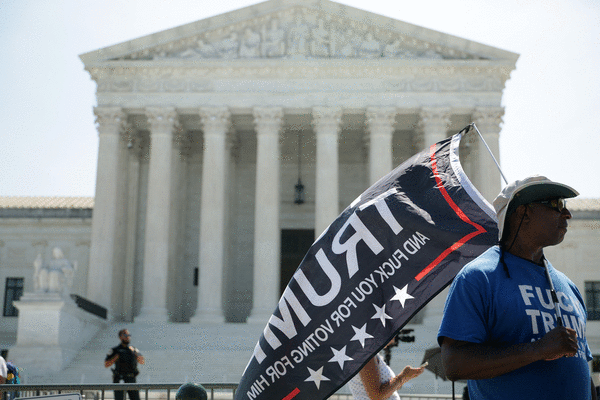
For years, the Republican-appointed majority at the U.S. Supreme Court has allowed red states to limit rights prized by liberals, including access to abortion, LGBTQ protections and voting rights. Simultaneously, the majority has repeatedly overturned blue-state laws that conservatives say infringe on the rights they prioritize, including religious liberty and gun rights. Call it situational federalism.
This two-track approach to states’ rights, which continued this year, is steering the U.S. back toward a pre-1960s world where your liberties depend on your zip code — though with a clear tilt in favor of conservatives.
From the mid-20th century until the early years of the 21st, Washington steadily raised the floor of civil liberties guaranteed nationwide and limited states’ capacity to restrict them. Congress contributed to this “rights revolution” with landmark laws (the Civil Rights and Voting Rights Acts in the 1960s, Title IX in the 1970s, the Americans with Disabilities Act in 1990). But the Supreme Court was the decisive force with its titanic rulings ending school segregation; invalidating state bans on contraception, interracial marriage and abortion; and authorizing same-sex marriage nationwide.
In mirror image, the contemporary court is reversing the rights revolution. In a procession of landmark decisions, the Republican-appointed justices have provided red states a green light to roll back rights that rankle conservatives while limiting blue states’ ability to legislate their own values.
“We are obviously dealing with a Supreme Court… that seems much more inclined to let conservative states legislate and advance conservative priorities as they see fit and are much more skeptical about progressive states,” says Nick Brown, the Democratic attorney general of Washington.
The court’s just-completed session deepened this divergence. The six Republican-appointed justices outvoted the three Democratic appointees to uphold red-state laws prohibiting transgender girls from participating in school sports. Earlier, in the Callais decision, the same alignment further retrenched the VRA and empowered Republican-controlled Southern states to rapidly erase Black voters’ influence over the U.S. House. (That erasure will likely result in the largest-ever loss of Black representation in the House — exceeding the greatest single-year reduction even during the violent dismantling of Reconstruction in the 1870s.)
Meanwhile, the same six justices overturned a Hawaii law barring gun owners with a concealed carry permit from bringing their weapons onto private property without permission from the owners.
“The Supreme Court… is deferring to the political process when the political process is producing conservative results,” says Erwin Chemerinsky, the dean of the University of California at Berkeley law school. “But there’s no deference to the political process when it is producing liberal results that the court wants to strike down.”
This contrast has been sharpening for years. An early milestone was the 2013 Shelby County decision written by Chief Justice John Roberts. In that ruling, the court effectively invalidated the Voting Rights Act’s cornerstone provision requiring states with a history of discrimination to receive “preclearance” from the federal government before changing their voting laws. Republican-controlled states responded with a wave of statutes making it more difficult to vote.
Equally momentous was the 2022 Dobbs decision from the GOP-appointed justices which overturned the national right to abortion; virtually all red states have banned it since. In 2025, the justices upheld state laws barring gender-affirming care for transgender minors, the predecessor to last month’s ruling allowing state transgender sports bans. Virtually all Republican-controlled states have adopted both restrictions.
The court majority has looked far more skeptically on blue-state laws that conservatives dislike. As in this year’s Hawaii case, the majority cited the Second Amendment in 2022 to strike down New York’s limits on handgun ownership. (The court will hear challenges to semiautomatic weapons bans in Illinois and Connecticut next year.) In 2023, the majority barred colleges from considering race as a factor in admissions, a practice that public universities in more blue states than red ones had adopted to counterbalance racial discrimination. The court also overruled a Maine law in 2022 that barred taxpayer money from being used to pay for religious education. It was another 6-3 ruling.
The majority has also repeatedly blocked blue-state laws and policies intended to promote LGBTQ inclusion. The court cited religious freedom in a 2025 decision allowing parents to opt out of an LGBTQ-friendly elementary school curriculum in Maryland and free speech in 2023 to exempt a web designer who didn’t want to serve same-sex couples from Colorado’s anti-discrimination law.
By the same logic of those rulings, the GOP-appointed majority should be sympathetic to the legal challenges advancing through lower courts against red-state laws censoring what classroom teachers can say about race, gender and sexual orientation — and supportive of parents who want to opt out of Texas’ recent moves to require public schools to display the Ten Commandments and teach Bible passages.
But liberals aren’t holding their breath.
“I think you are going to see this court continuing to stop progressive-leaning policies where there is an argument on infringement of religious liberty and allowing for what you are seeing in Texas and other places,” Brown, the Washington AG, predicts.
All signs suggest this court majority is not done enabling red states — or hobbling blue ones.
_____
This column reflects the personal views of the author and does not necessarily reflect the opinion of the editorial board or Bloomberg LP and its owners.
Ronald Brownstein is a Bloomberg Opinion columnist covering politics and policy. He is a CNN analyst and the author or editor of seven books.
_____
©2026 Bloomberg News. Visit at bloomberg.com. Distributed by Tribune Content Agency, LLC.





















































Comments