Mary Ellen Klas: Lindsey Graham's death deprives the GOP of its whisperer-in-chief
Published in Op Eds
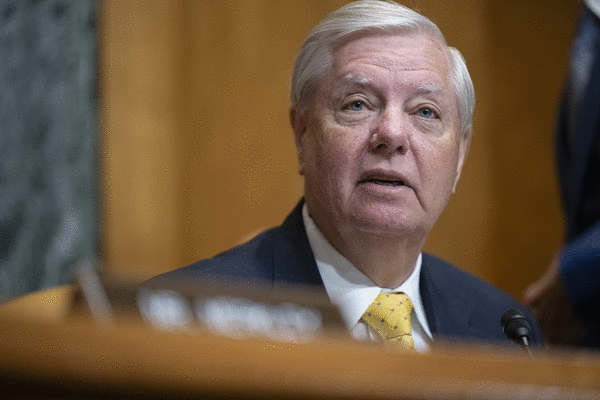
No matter what you thought of South Carolina Senator Lindsey Graham’s politics, his sudden death on Saturday deepens a void in an institution badly in need of more people willing to build relationships across the aisle.
Graham died of complications from heart disease after returning from a trip to Ukraine, where he and a bipartisan group of senators announced last week they had reached a deal on new sanctions on Russia. He had been seeking a fifth Senate term. Now, South Carolina’s governor will appoint an interim senator to serve the remaining five months of Graham’s term, and Republicans will hold a special primary in August to pick his replacement on the November general election ballot.
In this hardened political climate, it’s safe to say, there will be no true replacement.
Graham was a political pragmatist and master strategist who could bend and morph to remain in power and advance his chief interests – which for him centered on foreign policy and national security, particularly the defense of Israel and Ukraine.
Nothing demonstrated that more than his transition from outspoken critic of President Donald Trump in 2016 and in much of Trump’s first term to one of his strongest allies. Case in point: He was so visibly shaken after the January 6, 2021, insurrection that Graham declared, “Count me out. Enough is enough.” Five years later, he called Trump “the greatest president of all time.”
For many Democrats and Republican Trump critics, Graham’s transformation epitomized the opportunistic sycophancy to which many Republicans succumbed. But for others, including those I spoke with who have either studied Graham’s rise or worked with him, it was strategic.
“Lindsey Graham put a priority on relationships, so that when it was time to get around a table when the stakes were high, they were comfortable enough to do whatever needed to be done,” Rob Godfrey, a longtime Republican strategist in South Carolina, told me.
Godfrey recalled how Graham was a member of several Senate “gangs,” the bipartisan coalitions that emerged to break the impasse over judicial nominations during President George W. Bush’s second term (Gang of 14), to tee up a promising immigration reform (Gang of Eight) and to pass gun control legislation (Gang of 20).
Graham explained his transition to journalist Mark Leibovich in a 2019 profile: “This is to try to be relevant,” he told him. “I’ve got an opportunity up here working with the president to get some really good outcomes for the country.”
By 2025, Graham was playing golf with Trump weekly and making frequent visits to the White House. When the president announced he wanted to abandon Ukraine, Graham spent the next 18 months persuading him that America would be safer if it remained engaged.
Graham was a reliable Republican vote, but he also worked across the aisle, building relationships in his travels abroad with Democrats, whom he would entertain with his jokes and stories.
Senator Adam Schiff, a Democrat from California, told NBC on Sunday that he and his Senate colleagues, as well as leaders “around the world understood how close he was to the president. Many of us considered him the Trump whisperer.”
New Jersey Senator Cory Booker talked about working with Graham on criminal justice reform and surging internet access to the Iranian people. Despite their political differences, Graham was his “most unexpected friend in the Senate,” he said.
Minnesota Senator Amy Klobuchar said Graham helped her on bills to protect Afghan refugees and repeal the law that gives tech companies a shield from legal liability. “Lindsey had a zest for life and the Senate that made you want to get to work on a bill with him or at least debate him,” she said in a Facebook post.
Even Trump acknowledged Graham’s relationship skills. “If I had a really big problem with a certain Democrat, he would work it out,” Trump told CNN on Sunday. “That’s something most Republicans couldn’t do.”
But putting country over party wasn’t always easy, recalled Katon Dawson, former chair of the South Carolina Republican Party. Despite his conservative voting record, Graham’s willingness to work with Democrats on issues such as immigration and climate change often drew rebukes — and primary challenges — from other Republicans in the state.
“By dancing with the other side, it was hard on him,” Dawson told me. “But, if it was ‘good for South Carolina and the nation,’ he was willing to take the heat from the loud and very few who did not like his style.”
Dawson said that his only complaint with Graham was “he did not ever explain why he brokered deals and what South Carolina got for it,” adding “it was a lot.”
Graham’s stature as a Senate power broker, his solid constituent services and his advocacy for government spending in his small state (such as the Port of Charleston and the state’s military bases) inoculated him from the blowback generated by his maverick moments, explained Gibbs Knotts, political science professor and provost at Coastal Carolina University.
Now, Knotts told me, “I don’t see anybody else in the Senate who can speak out against the president but also continue to maintain a really close relationship with him. He definitely leaves a big void.”
He’s right. The Senate returns this week from recess down two GOP members. Before Graham’s death, Senator Mitch McConnell was hospitalized last month after suffering from a fall and becoming unconscious.
With such a slim majority, the party’s Senate agenda is hamstrung. Republicans also are hoping to vote on the nomination of Todd Blanche, Trump’s pick for attorney general. And as chair of the Senate Budget Committee, Graham would have played a key role in resolving the chamber’s budget reconciliation bill and managing Trump’s obsession with passing the voter suppression bill known as the SAVE Act, which lacks the votes to overcome a filibuster.
Whisperers may be quiet, but you know when they’re no longer in the room.
_____
This column reflects the personal views of the author and does not necessarily reflect the opinion of the editorial board or Bloomberg LP and its owners.
Mary Ellen Klas is a politics and policy columnist for Bloomberg Opinion. A former capital bureau chief for the Miami Herald, she has covered politics and government for more than three decades.
_____
©2026 Bloomberg News. Visit at bloomberg.com. Distributed by Tribune Content Agency, LLC.





















































Comments