John M. Crisp: There's a better way to make America more religious
Published in Op Eds
Last month, the Texas State Board of Education adopted a required reading list that includes Bible stories and scriptures at every public-school grade level, from kindergarten through high school. In first grade, for example, students will learn about Jonah and the whale.
OK. Everybody should know the story of Jonah and the whale. Father Mapple has barely hoisted and stowed his rope ladder in his ship-shaped pulpit in Chapter 9 of “Moby-Dick” before he begins his sermon thusly: “Beloved shipmates, clinch the last verse of the first chapter of Jonah—‘And God had prepared a great fish to swallow up Jonah.’”
Jonah and the whale make appearances throughout “Moby-Dick,” as does Noah’s ark, references that would puzzle readers who have never heard of Jonah and Noah.
How did you learn about Jonah? Probably the same way I did, in Sunday School. We learned these stories in a religious context. In my case, we were meant to understand that Jonah was literally swallowed by a great fish and spent three days and three nights therein “until the Lord spoke to the fish, and it vomited Jonah onto dry land.”
Other faiths see the story in allegorical terms, a parable meant to teach lessons about obedience and repentance.
How will a first grader see it, as it’s taught alongside Jack and the Beanstalk and The Little Engine That Could? And how will her teacher explain to an inquisitive student the differences among these stories without providing religious instruction of some sort? It’s a lot for a first grader—and for her teacher.
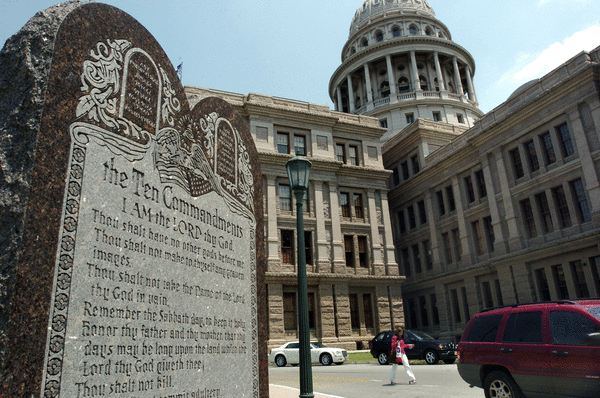
But this is the least of the problems presented by required Bible reading in public schools. Given that Texas already requires all public schools to prominently display copies of the Ten Commandments in every classroom, critics see required Bible readings as one more attempt by conservative religious forces to blur or destroy the principle that keeps government out of religious instruction.
Critics argue convincingly that Bible readings and the posting of the Ten Commandments are thinly veiled efforts to promote Christianity, at the expense of students who are Jewish, Muslim, Hindu, Sikh or of no religion, at all.
In fact, preparing students to read “Moby-Dick” may not be the first priority of the Texas Board of Education, after all.
But Christians, if you want our nation to be more Christian, there’s a better way: Start by supporting more Christ-like political leaders.
It’s odd: Faith is almost a prerequisite for election in our country. We’ve elected a few Jews and Muslims, but generally we require candidates to be professing Christians. Atheists need not apply.
But once they’re elected, we don’t care much about how they behave. For example, is President Donald Trump Christ-like? Is he humble or meek? Does he love his enemies? Does he turn the other cheek? Does he welcome the stranger? Does he forgive? Is he guilty of adultery? Does he lay up his treasures in Heaven?
The Bible says, “Judge not, that ye be not judged.” But it also says, “Ye shall know them by their fruits.” None of this means Trump is a bad president, but it’s a stretch to suggest that he exemplifies a Christ-like man.
Since we’re talking about Texas, it’s worth noting that religious Texans of all stripes have a say this November in whom my home state sends to represent us in the U.S. Senate:
On one hand, there’s James Talarico, a professing Christian and seminarian whose faith seems authentic. His record and his current life appear to be so blameless that the most vicious slander against him that Republicans can come up with so far is that he is a vegan in meat-loving Texas. (Apparently, this is not true.)
On the other hand, Christians can choose Ken Paxton, who has been indicted for securities fraud and impeached by his own party for obstruction of justice, bribery, retaliation and misuse of office. His wife divorced him on “biblical grounds,” that is, adultery.
So, Christians, if you want America to be more Christian, start at the ballot box, not in the schools.
____
ABOUT THE WRITER
_____
©2026 Tribune Content Agency, LLC




















































Comments