Editorial: A democracy, if we can keep it
Published in Op Eds
A republic, if you can keep it,” Benjamin Franklin famously responded when asked by a Philadelphia socialite what it was that he and the other Founders had wrought.
Her question, and his answer, in the 1787 conversation framed the choice for the emerging new country as being between republic and monarchy. Today, in some quarters, the choice is presented differently: We’re a republic, not a democracy, goes a politically fashionable trope that happens to be both factually inaccurate and philosophically ominous.
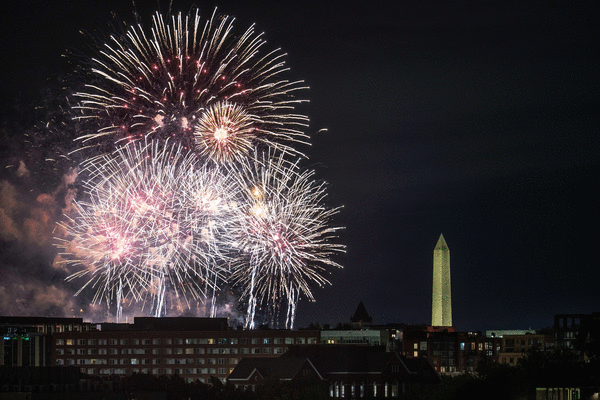
America’s 250th birthday is as good a time as any to remind ourselves that we are in fact both: a (small “d”) democratic republic. Both halves are necessary to the health of our continuing national experiment.
A republic is a form of government that is structured around the rule of law rather than autocracy or heredity; democracy is the process by which citizens choose those who will lead the republic.
The two principles aren’t remotely in conflict with each other. In fact, in America, they are reliant upon one another.
But the democracy half of that composite is the one that has most nurtured what Lincoln called our “better angels.” Democracy, more than the (small “r”) republican aspect of our government, is what has enabled us to somewhat grow into what the Founders, in their historically limited way, expressed as their ideal: a nation where “all men are created equal.”
Even setting aside its specified disenfranchisement of the female half of the population, the phrase today is jarring for its un specified disenfranchisement of millions more who were at that time, through their enslavement, denied those “certain unalienable Rights” that were otherwise “endowed by their Creator.”
The Founders were hypocrites, then? Well, yes. Clearly. But perhaps also, they were visionaries — men who recognized the value of expressing ideals that, by any sober accounting, didn’t reflect the reality of their time. Ideals that, to some extent, future times would grow into.
As (to some extent) we have.
Slavery is gone; women’s enfranchisement is a century-old norm. That these have become universally embraced developments speaks to the beauty of the Founders’ ideals.
Other belatedly realized ideals include today’s widely accepted premise that poverty shouldn’t be a barrier to citizenship (once upon a time, only property owners could vote); that government has a duty to its citizens beyond merely enforcing borders (thank you, New Deal); that who we love is no one else’s business and certainly not the business of lawmakers.
Yet the democracy half of that composite has taken a beating lately, as evidenced by the willingness of even some putatively serious elected officials these days to troll against the very word.
Breathless declarations that we’re more divided today than at any time since the Civil War are plainly ahistorical (1960s, anyone?). But divided we are. The Pew Research Center last year reported that more than 80% of both Democrats and Republicans viewed the opposing party in personally negative ways; as recently as 10 years ago, both numbers were well below 50%.
No one is suggesting all that animus, in both directions, is completely unjustified.
Some of our leaders are trying to make it harder to vote, invoking nonexistent vote fraud and other red herrings to undermine Americans’ most precious right for the sake of consolidating power.
At the same time, some of our up-and-coming politicians are embracing a polar opposite but also dangerous worldview that diminishes the importance of free enterprise — a concept that, as we all learned (or should have) during the Cold War, is inseparable from the concept of political freedom.
It’s random but appropriate that our 250th national birthday should come during a midterm election year. The November elections are an opportunity for Americans of all political stripes to exercise that most precious of our rights — the right to democracy. Which in turn directs our republic.
We are a republic. And we are a democracy. The motives of any politician who suggests otherwise should be viewed as suspect.
Republic, or democracy? It’s a phony choice. Franklin’s conditional “if you can keep it” is the more important point here. This democratic republic of ours doesn’t run on autopilot. If, in our 250th year, we fail to keep both hands on the wheel — fail out of fear, frustration or plain old laziness — we risk running it off the road.
_____
©2026 STLtoday.com. Distributed by Tribune Content Agency, LLC.

















































Comments