Commentary: The troubling takeaway when experts game out election threats
Published in Op Eds
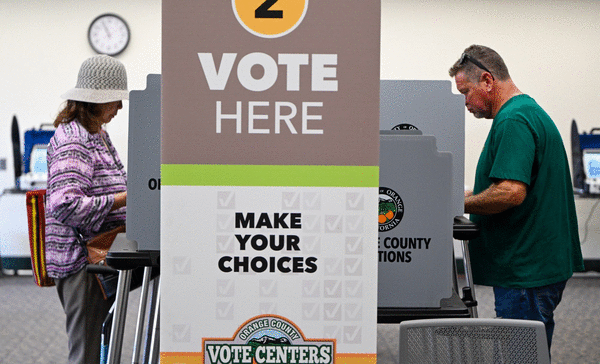
To test whether our nation’s founding principles remain strong enough to make it another 250 years, PBS surprised a group of nine prominent Americans with a hypothetical worst-case scenario for the midterm elections.
We started by assembling notables who were willing to go on national TV to game out a gripping story in which our democracy is tested. We found a news content creator with millions of followers (Aaron Parnas). A community activist (Brittany Packnett Cunningham). A billionaire (Mark Cuban). A former governor (Chris Christie), senator (Claire McCaskill) and secretary of Defense (Mark Esper). A congressman (Dan Crenshaw), an election expert (Utah Lt. Gov. Deidre Henderson) and a legal expert (Melissa Murray). Four Republicans, four Democrats, one independent.
We placed the participants in roles that rhyme with their real-life experiences and then confronted them with a series of election threats. AI-generated disinformation to confuse voters? Check. Federal efforts to override state election procedures? Check. Military in the streets on election day, violent protests, Justice Department efforts to seize ballots before they can be counted? Check, check, check.
Such “tabletop” exercises have long been used in the military and in natural disaster planning, arenas in which split-second decisions can make the difference between a catastrophe and a crisis averted. Sadly, the same high stakes are now all too plausible with American elections.
Moreover, playing out a worst-case democracy scenario on national TV can have the additional benefit of modeling civic dialogue. If sparring partners like Christie (a Republican) and McCaskill (a Democrat) can show that it’s possible to work together through an electoral crisis, then perhaps Americans will be just a little more willing to talk with neighbors who cast different ballots in November.
So, how did Cuban, Esper, Christie and the others respond when faced with difficult dilemmas in the middle of a hotly contested election in which both parties work desperately — and not always lawfully — to win control over Congress?
To start, our participants sometimes found surprising agreement on politically contentious issues. McCaskill and Cuban, for example, were open to joining with Republicans on the panel to support sensible voter ID requirements. In the wake of President Trump’s controversial SAVE Act, Americans might view voter ID as a binary issue, but there’s a vast middle ground to be explored.
Participants also acknowledged, sometimes fearfully, that so much uncertainty owes to our rapidly changing era of information. Young people, in particular, do not receive news through the traditional media. So the influence of independent journalists and content creators like Parnas is likely to grow — as is their duty to report responsibly, with democracy on the line.
The group also sensed that current threats to our democracy reflect a deeper problem: widening economic inequality. As Cuban put it, if people can’t afford healthcare or putting gas in their tanks, it’s going to be awfully hard for them to care about democracy.
By far the most harrowing chapters of our hypothetical story unfolded when the military was asked to enter a large city in a purple state two days before an election, on the theory that it was necessary to protect against a foreign attack.
I put former Trump secretary of Defense Mark Esper in the role of an Army general and asked whether he would lead such a troop deployment. Esper agonized over the order, expressing a laudable desire to keep the military out of U.S. cities. But he ultimately explained that he had little choice but to follow the order if lawyers assured him of its legality. For anyone hoping the military will save us from democratic erosion, the exchange was a dose of cold reality.
Finally, I asked participants how they’d respond if the Department of Justice secured a search warrant to seize a state’s ballots before they could be fully counted. This is a major fear among election watchers. If ballots are seized before the counting process concludes, that would disrupt the chain of custody and fatally undermine election integrity. Yet the Trump administration already gestured at this tactic when it seized 2020 ballots from Fulton County in Georgia.
In our scenario, state officials (including Christie) decided to file an emergency lawsuit to block the seizure of the uncounted ballots. But lawsuits take time — and even a few hours can mean the difference between ballots being seized or secured.
So other participants took matters into their own hands, joining in a peaceful citizen blockade around the counting facility to buy time for a judge to rule. The ultimate lesson of our exercise might be about the importance of ordinary Americans engaging in direct, civic action to ensure our democracy’s survival.
Zooming back out to real life, some participants suggested that our scenario would never happen because there are too many guardrails along the way. But the most revealing moment came from Utah’s Republican lieutenant governor, who’s responsible for elections. For Henderson, the situations we explored are as real and urgent as they come. Indeed, election officials in her state had already tabletopped these worst-case scenarios; they have even predrafted lawsuits ready to file on election day in case of interference.
The exercise may have been fictional, in other words, but it was far from fantastical. And as we approach one of the most consequential midterm elections in recent memory, may we all hope that the democracy dilemmas we posed never come to pass.
____
Aaron Tang is the host of the PBS series “Breaking the Deadlock” and a law professor at UC Davis. The episode described in this essay, “How to Fix an Election,” will air on PBS on Tuesday. X: @ AaronTangLaw
_____
©2026 Los Angeles Times. Visit at latimes.com. Distributed by Tribune Content Agency, LLC.

















































Comments