LZ Granderson: How fearmongering sets policy, from 'marihuana' to solar to AI
Published in Op Eds
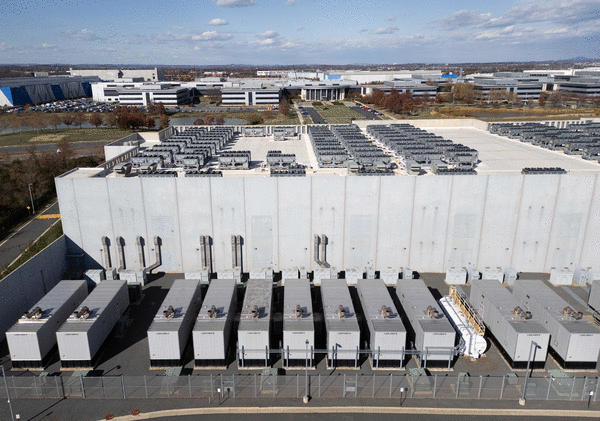
In the race to build — or stop the construction of — data centers across the country, it's important to remember no government is spending more on artificial intelligence than America. In fact, according to the Brookings Institute, the number of AI contracts within the federal government has risen from 472 in 2022 to more than 1,700 in 2026.
Most of the spending — $90 billion — is by the Department of Defense, however other departments — Commerce, Health and Human Services, NASA — are spending tens of millions. So regardless of how one may feel about AI, we are all tied to its use.
Site locations and the economic benefits of data centers can be debated, but there's no getting around the fact that they are the physical embodiment of what AI does. The more computational power a model needs, the more square footage needs to be built.
What makes me most uneasy isn't the size of the buildings or the energy usage. It's not knowing whether we're looking at disruptive technology that will ultimately help all of society, or a disruption that exists mainly to make the richest people on the planet even more money? I wrestle with that question because our history is peppered with examples of the latter.
The world's first trillionaire, for example, became a household name in part because the demand for electric cars skyrocketed a short time after electric cars all but left the market. Confused? Yeah, me too. General Motors spent years developing its EV1, then abruptly discontinued the model, citing production costs. Was it really that or the oil industry, through lobbyist and campaign donations, undermining the car's success to protect its own interest? Or was it us, the public, who did not want to change? Who knows for sure?
One thing I do know is that Larry Burns, the former vice president for research and development for General Motors who killed the automaker's electric car, said if he could turn back time, they would not have stopped investing in the emerging technology.
I'm reminded of those 32 solar panels President Jimmy Carter had installed on the White House back in 1979. They did not make it past the next administration. Today, China owns more than 80% of the solar market — from every stage of production. The United States didn't just sacrifice its chance to corner a future clean energy market back when we were its pioneers; we also gave up all the manufacturing and supply chain jobs that would have gone with that dominance.
We didn't lose that race. We forfeited it.
Go back further, to 1937 and the Marihuana Tax Act. It wasn't built on science. It was built on fear, newspaper sensationalism and — some historians argue — the interests of industries that didn't want hemp fiber competing with their own products. The science separated the THC from the fiber, but the story elected officials told the public didn't. Had hemp, the building material, and marijuana, the drug, not shared the same fate, perhaps it would be the U.S. and not Europe leading in industrial hemp production. Unfortunately, because of the stigma associated with the plant, industrial hemp production was illegal for 80 years until the 2018 Farm Bill.
Today, while American hemp farmers fought decades of federal confusion just to get back into the field, Belgium's IsoHemp runs an automated factory producing millions of "hempcrete" blocks a year, and Europe's industrial hemp construction market is projected to grow nearly sixfold by 2033.
"There are so many historical uses for the fiber, from rope to textiles, that it's really difficult to comprehend just how harmful prohibition was to the science of the industry," said Mattie Mead, who founded Hempitecture in 2013. Based in Idaho, Mead's company produces insulation and structural building material incorporating hemp fibers and a lime-based binder. Using hemp in building construction provides an alternative to fiberglass, helps reduce carbon, and naturally keeps buildings cooler in the summer and warmer in winter, reducing energy costs.
"Things are a lot better now than when we first started, but there's still a lot of stigma and misinformation out there," Mead said. "It's like the public has to unlearn the myths and untruths first before they can see how the technology helps."
The same can be said about data centers and A.I.
So much about the technology has been draped in doomsday scenarios and Terminator movies. It's hard sometimes to separate the impossible from the improbable. Even more difficult if you can't tell if the technology is meant for the good of all or just aiming to be good for someone's bottom line. Maybe, unlike in the "marihuana" prohibition era, the scary warnings are valid. But now just as then, we need to separate fact from myth before setting policy.
____
YouTube: @LZGrandersonShow
____
©2026 Los Angeles Times. Visit at latimes.com. Distributed by Tribune Content Agency, LLC.



















































Comments