Commentary: July 4th and the American faith we've watched slip away
Published in Op Eds
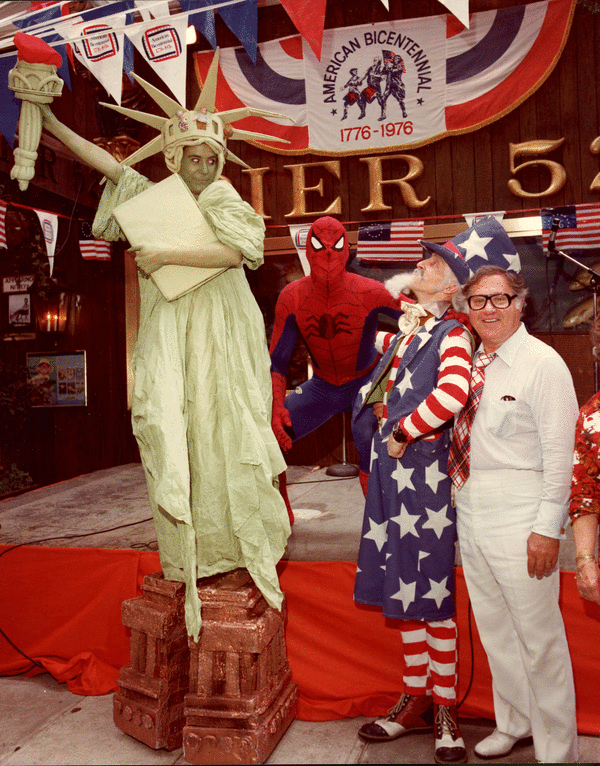
I was a girl in Philadelphia in the summer when America turned 200. The birthplace of America was electric in a way I've never forgotten — crowds stretching from the art museum steps down to the Delaware River, each city block corded off for parades, cookouts, celebrations, and the kind of noise that felt like belonging.
It was also, I know now, a particular kind of American moment — one that required something beyond good weather and a long weekend. It required a belief that the country and its highest office still belonged to all of us.
Back in 1976, we were not, by any measure, a country at ease. Unemployment hovered near 7.5 percent. Inflation had only recently retreated from double digits. The man who'd held the presidency before Gerald Ford had resigned in disgrace two years earlier.
We had every reason to feel hollowed out. And yet. There was something unbroken in that crowd. Whatever people thought of their government, and plenty thought very little of it, they believed the country was still theirs.
That feeling had a name. It was civic trust, the quiet, background assumption that whatever failures or corruptions touched the men in office, the office itself still pointed toward something larger than any one man's ambition.
On the eve of this Fourth of July, I find myself back in that memory, and I cannot shake the distance between then and now.
The surface numbers are, in some ways, better than in 1976. Unemployment currently sits at around 4.2 percent. Inflation, while persistent, is nowhere near the double-digit nightmare of the late seventies.
But numbers have never been the whole story, and this year the story underneath is one I don't know how to celebrate around.
Since taking office, President Donald Trump's personal wealth has grown by at least $1.4 billion. He accepted a Boeing 747 worth roughly $400 million from the Qatari government. He launched a cryptocurrency venture that, according to a House Judiciary Committee report, generated as much as $11.6 billion in holdings— while his administration was quietly dismantling federal oversight of the industry.
And then, last month, he did something that may be without precedent in the history of American self-dealing. Trump sued his own Internal Revenue Service over the unauthorized release of his tax returns — and then, before the case could even be heard on the merits, his Justice Department settled it on his behalf.
The price of settlement: a Department of Justice addendum declaring the federal government “ forever barred and precluded” from auditing any tax return filed by Trump, his sons, his family, or more than 500 affiliated business entities before May 18, 2026.
An ongoing IRS audit that could have resulted in a $100 million penalty against the Trump Organization simply vanished. Legal experts called it unprecedented. Senate Democrats called it a potential violation of federal law.
When asked about his family's financial entanglements, Trump told the New York Times: “I found out nobody cared, and I'm allowed to.”
In 1976, that sentence would have ended a presidency. It ended one —in fact, just two years before—though the crime was different.
What Richard Nixon understood, to his ruin, was that there were still lines. That the office did not belong to the man who held it. Gerald Ford, whatever his failures, knew this. Jimmy Carter, who would take the oath six months after that Philadelphia summer, put his peanut farm in a blind trust.
The question of self-dealing was essentially rhetorical, because the expectation that a president served the country — not himself — was foundational.
What's been taken from us isn't a policy position. It's not something the next election can simply restore, though elections still matter enormously.
What's been taken is the assumption of good faith — the idea, however naïve it may now seem, that the person holding the most powerful office on earth was pointed, even imperfectly, toward the public good rather than his own balance sheet.
The fireworks will still go up on the 250th birthday. Family, friends, and neighbors will gather. There will be plenty of flags flying.
But I keep thinking about that girl in Philadelphia, pressed into a crowd of strangers who all felt, despite everything, like they were celebrating something they shared.
I'm not sure I know what we share now, except, perhaps, the grief of knowing what we've lost, and the long work of getting it back.
____
Lynn Schmidt is a columnist and Editorial Board member with the St. Louis Post-Dispatch. She holds a master's of science in political science as well as a bachelor's of science in nursing.
____
©2026 The Fulcrum. Visit at thefulcrum.us. Distributed by Tribune Content Agency, LLC.
















































Comments