Commentary: As debate rages over an Iran deal, let's acknowledge how much Americans have already lost
Published in Op Eds
Before Washington debates whether the latest agreement with Iran is a victory or a mistake, Americans should ask a more basic question: What happens if diplomacy fails?
Immediately after the 60-day ceasefire deal was announced, the political arguments began. Republican Sen. Bill Cassidy of Louisiana called the agreement a “tremendous foreign policy blunder.” Republican Sen. Ted Cruz of Texas warned that giving Iran major financial relief would be “utterly indefensible.” Democrats have raised concerns about congressional oversight and whether diplomacy should have come before escalation.
Those deliberations are fair. They should happen. America should have serious debates before, during and after any military action.
Yet they often crowd out discussion of the people who absorb the consequences when diplomacy fails and military action begins.
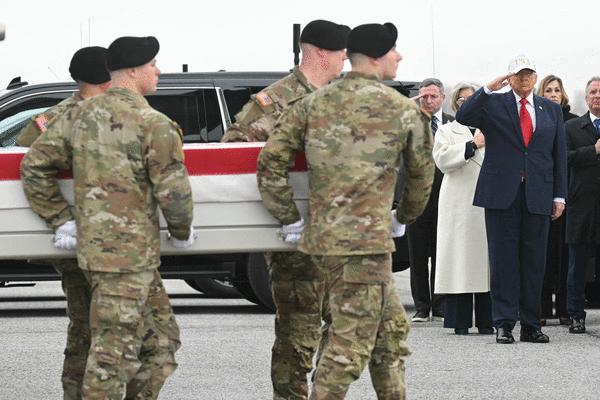
My family does not see casualty reports the way most people do. When my brother, Sgt. Maj. Jerry Patton, was killed in service to our country, war stopped being something my mother watched on the evening news. It became personal.
Every Gold Star family understands that moment when national policy becomes painfully local.
That is why I struggle when politicians talk about military action as if it were a chess match. The debate often centers on leverage, deterrence, sanctions, enrichment levels and strategy. Those things matter.
But if the agreement collapses, the alternatives are not theoretical. They could involve strikes on Iranian military or nuclear facilities, retaliation against American forces throughout the region, the closing of shipping lanes and a broader conflict that will once again place U.S. service members in harm’s way.
While Washington decides who won the talking-points battle, we should first reckon with what has already been lost. Some costs are easy to calculate. When the Strait of Hormuz closed, energy markets reacted quickly. Families felt it at the gas pump. Transportation companies paid more to move goods. Airlines, farmers and small businesses absorbed higher costs. Those costs have found their way into households across the country.
The hardest costs aren’t measured in dollars. They’re measured in people. Across the Middle East, families have buried loved ones. Communities have been displaced. U.S. men and women in uniform have once again carried out missions decided in conference and situation rooms thousands of miles away. The warfare has already left 13 Americans dead and more than 380 wounded.
During my own military service, I watched young Americans deploy again and again to places most citizens knew little about. Some came home with medals. Some came home with scars. Some didn’t come home at all. After you’ve seen what war asks of the people sent to fight it, it’s hard to read a headline and think about only politics.
I have sat with soldiers after deployments. Like countless military spouses, my wife carried the burden of raising our family alone for long periods while I was away from home. I have watched parents scan headlines from overseas because their son or daughter was somewhere in the region. I have attended memorial services and seen the lifelong burden carried by families whose loss never fades with time.
Behind every combat fatality is a family whose life has been divided into two parts: before the knock on the door and after it. Those consequences do not disappear when a ceasefire is signed. Years later, they show up in waiting rooms at Veterans Affairs facilities. They show up at military reunions when someone notices who is not there anymore. They show up at the kitchen table when veterans try to explain experiences that do not fit neatly into words.
Those are the tariffs we rarely discuss when diplomacy fails.
Military force is sometimes necessary. There are threats that must be confronted. There are enemies who cannot be wished away. American weakness can invite danger. But strength also requires judgment. When peace negotiations fail, it requires Congress to do its job, and it demands that presidents explain why force is necessary, what the mission is and how it ends.
If a final agreement is reached, history will decide whether the agreement with Iran was wise or flawed. Sensible people can disagree on that. What should not be up for debate is that when diplomacy fails and military force follows, the consequences extend far beyond the battlefield. They are not counted in talking points or policy papers, but in lives.
____
Scott W. Patton is a combat veteran and Gold Star family member.
___
©2026 Chicago Tribune. Visit at chicagotribune.com. Distributed by Tribune Content Agency, LLC.



















































Comments