Commentary: Graduates cheered Steve Wozniak's affirmation of humans over AI. Leaders, pay attention
Published in Op Eds
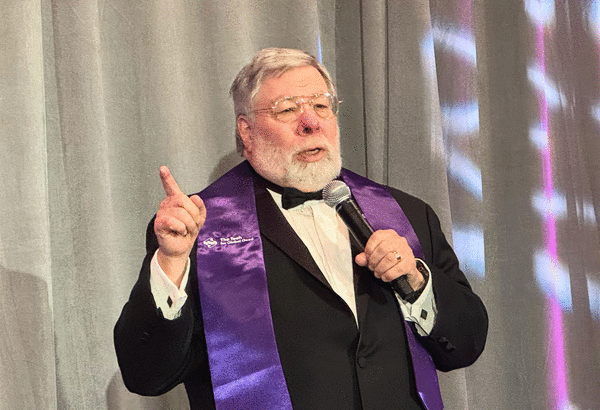
I was seated onstage at Grand Valley State University’s commencement when Apple co-founder Steve Wozniak leaned into the microphone and reframed the entire conversation about artificial intelligence in six words.
“You all have AI — actual intelligence.”
The arena erupted. Not polite applause — genuine, full-throated cheering from thousands of graduates who had spent years being told AI was coming for their futures. What Wozniak gave them was something conspicuously missing from most public conversation about AI and work: a direct affirmation that human intelligence isn’t a liability to be managed. It’s the point.
That moment didn’t happen in isolation. This spring’s commencement season produced a striking pattern. At the University of Central Florida, a speaker promoting AI was booed so overwhelmingly she stopped mid-speech. A CEO who told Middle Tennessee State University students to “deal with” AI was jeered, then he taunted them — which made it worse. Former Google CEO Eric Schmidt was interrupted by roars of displeasure at the University of Arizona after invoking AI’s inevitability.
Most coverage has framed this as Gen Z anxiety or ingratitude. I think it’s a clearer signal than that: A generation is telling us, with unusual directness, that the story they keep being told about their future is wrong. And the data is starting to agree with them.
The Federal Reserve Bank of New York’s 2025 labor market analysis found that recent philosophy graduates have lower unemployment rates than computer science graduates. Art history majors are more likely to be employed than computer engineering majors. McKinsey calls the pattern “reverse skill bias”: Unlike prior automation waves, generative AI disproportionately displaces higher-educated knowledge workers. The jobs generations of students were steered toward are among the most exposed.
The “learn to code” consensus that shaped a decade of education policy was a reasonable forecast. The labor market has now revised it.
What Wozniak understood — and what the booed speakers kept missing — is the distinction between labor and talent. “Labor” is the industrial-era conception of human contribution: transactional, task-based, substitutable. It’s what gets automated. “Talent” is something different: judgment in novel situations, ethical reasoning under pressure, the ability to build trust across cultural difference, the contextual intelligence to ask the right question rather than just optimize toward the assigned one.
These aren’t skills AI is developing. They’re the capacities that become more valuable as AI becomes more capable.
The market is already moving. Goldman Sachs’ chief information officer has suggested pairing computer science with philosophy is worth serious consideration. Microsoft’s CEO has noted engineers now use AI to write 20% to 30% of their code — which raises the obvious question of what differentiates the engineers who remain. The answer is consistently human: judgment, communication, the ability to define problems worth solving.
The graduates booing this spring aren’t anti-technology. They grew up with it. What they’re rejecting is a specific posture: the one that treats their human capacities as a problem to be solved, their uncertainty as ignorance to correct, their future as something happening to them rather than something they’ll shape. That posture is the labor model in action — humans as inputs to optimize. They’re not wrong to push back.
For business leaders and employers, the lesson isn’t complicated. The talent pipeline you’re drawing from is full of people who already understand that their value isn’t in competing with AI — it’s in complementing it. Your hiring criteria, your development programs and your management assumptions should reflect that. If you’re still screening primarily for technical task-competency and treating judgment, adaptability and relational intelligence as soft bonuses, you’re optimizing for the wrong century.
Wozniak built one of the most consequential technologies of the modern era. When he tells graduates that their actual intelligence is the thing that matters, he’s not being sentimental. He’s being precise — and the thousands of young people who cheered him knew it.
The question for the rest of us is whether we’ve caught up.
____
Philomena V. Mantella is president of Grand Valley State University in Allendale, Michigan.
_____
©2026 Chicago Tribune. Visit at chicagotribune.com. Distributed by Tribune Content Agency, LLC.





















































Comments