Mark Gongloff: Data centers are stewing in their own pollution
Published in Op Eds
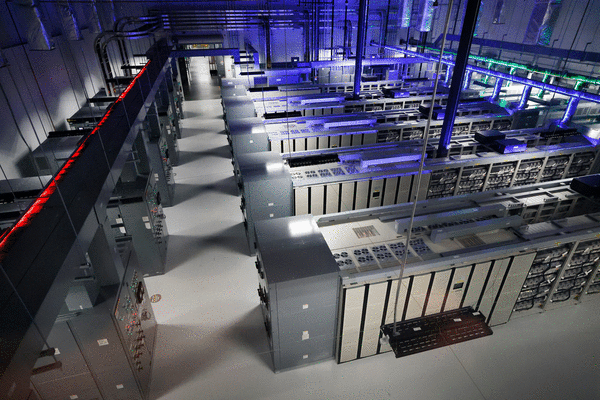
When “data centers” and “climate change” are in the same sentence, it’s usually about how the former are fueling the latter with their thirst for energy. But the latter can also make life expensively miserable for the former. Maybe it’s not a great idea to pollute a planet if you have to share its atmosphere.
About 6% of nearly 3,000 data centers planned around the world are in places that will immediately put them at high risk of damage because of extreme weather, according to a new study by the risk-analytics firm XDI Pty Ltd. “High risk,” in this case, means these data centers could essentially be uninsurable without hardening themselves against fires, floods or whatever else their local environment will throw at them.
This is XDI’s follow-up to its report last year estimating that about 7% of nearly 9,000 built and planned data centers will be at high risk of climate damage by 2050. An additional 20% will be at “moderate” risk, meaning they’ll be able to get insurance, but it will be costly.
At this point, many of you will be saying, “So what?” or “Good!” or “I want those things killed with fire anyway.” Hatred of data centers is one of the few issues that unite left and right in the U.S., with 71% of Americans at least somewhat opposed to having one near their house, according to a recent poll by the climate news outlet Heatmap. The number of groups working to shut down development doubled in the first quarter of this year, according to Data Center Watch. I’d personally prefer we make it 1997 again, when you could occasionally have a little internet, as a treat, instead of 2026, when the internet follows you everywhere you go, muttering hallucinations.
But for some reason the powers that be have decreed artificial intelligence a civilizational imperative, requiring the hurried construction of swarms of data centers, on Earth and in space. Some $7 trillion will be invested in this enterprise by 2030, the consulting firm McKinsey estimates. So now your 401(k) hangs on every whisper from the mouths of people like Jensen Huang, the chief executive officer of Nvidia Corp. Ford Motor Co. added $11 billion in value virtually overnight on the mere promise of an AI side gig.
Like it or not, the global economy has more or less become a foundry for data centers the way some people think hot dogs are just delivery systems for mustard. And if we’re going to insist on making these things, then there’s an argument for building them to withstand a hotter, more dangerous atmosphere. At least that way, we won’t have to waste capital building them again.
“We want a data ecosystem that’s substantial, but that needs to be climate ready if it’s going to navigate a world where climate change is already underway,” Karl Mallon, XDI’s founder and head of science and technology, said in a webinar this month. “The results we’ve gotten previously on built infrastructure and now with planned infrastructure suggest we aren’t adequately preparing for climate change.”
XDI’s headline high-risk numbers obscure some local hot spots where trouble is especially concentrated, such as China’s Jiangsu province. Nearly two-thirds of the existing and planned data centers there will face high climate risks by 2050, mainly from coastal flooding, according to XDI’s 2025 study. Insurance costs there could rise eightfold by 2100, XDI estimates. In New Jersey, 20% of the data centers there are or will be in a flood zone, and insurance costs could jump 1,000% there by century’s end. In Southeast Asia, one in five planned data centers face high climate risks right now, according to XDI’s new study.
These numbers may be conservative. A recent analysis by the reinsurance firm MS Amlin found that half of all planned U.S. data centers were being built in places at high risk of severe convective storms, which deliver torrential rains, high winds, hail and tornadoes.
And such violent events are actually the least of the problem, Mallon pointed out. Extreme heat is already a headache for many data centers, raising the chances electricity will go away, depriving customers of their sweet, sweet AI. This compounds the problems in places like the U.S. Midwest and Great Plains, which are already vulnerable to those floods, storms and fires.
Far worse are the indirect impacts of such disasters, which include disruption of local infrastructure, customers and suppliers. In a modeling run of European data-center operators, XDI found these second-order effects made the financial hit of climate disasters 10 times worse. Hardening operations to withstand those catastrophes is imperative for lowering risk. But even if you build an impregnable wall around your data center, climate change will still find a way to get you.
That makes it even more imperative for data-center operators to lighten their heavy environmental footprints. For all the climate risks they face, they’re generating plenty of their own. The biggest computer farms in the works today could use 2 million households’ worth of power, the International Energy Agency has suggested. Run-of-the-mill ones use the power of 100,000 households, which is about the size of Norfolk, Virginia. Data centers will add to the energy demand of Japan by 2030, the IEA estimates.
Since 2017, the pace of data-center electricity consumption has grown four times faster than underlying use. The frantic scramble to build these centers has propped up demand for fossil fuels that should have been fading with gains in renewable supply. Many centers use diesel generators when the power fails. Data centers and crypto will make humanity’s carbon emissions 28% higher in 2030 than they would otherwise have been, according to a new study in Environmental Research Letters. These greenhouse gases will make the planet even hotter, further amplifying extreme-weather risks.
Already, constant pollution from gas-powered data centers is a health threat to people living nearby. So is the constant noise. Despite their need for cooling water, most of the new centers going up are being built in already water-strapped places like Arizona.
AI supporters are right that the technology has the potential to help humanity fight and adapt to climate change. It’s already good at crunching data to study the climate, predict the weather and allocate scarce resources. But for AI’s good to outweigh the very long list of bad, its build-out will have to be thoughtful and carefully regulated, scarce qualities in the AI-bubble era. This boom may ignore market gravity, but it still must obey the laws of physics.
_____
This column reflects the personal views of the author and does not necessarily reflect the opinion of the editorial board or Bloomberg LP and its owners.
Mark Gongloff is a Bloomberg Opinion editor and columnist covering climate change. He previously worked for Fortune.com, the Huffington Post and the Wall Street Journal.
_____
©2026 Bloomberg L.P. Visit bloomberg.com/opinion. Distributed by Tribune Content Agency, LLC.





















































Comments