Noah Feldman: The absurd gun case that unified the Supreme Court
Published in Op Eds
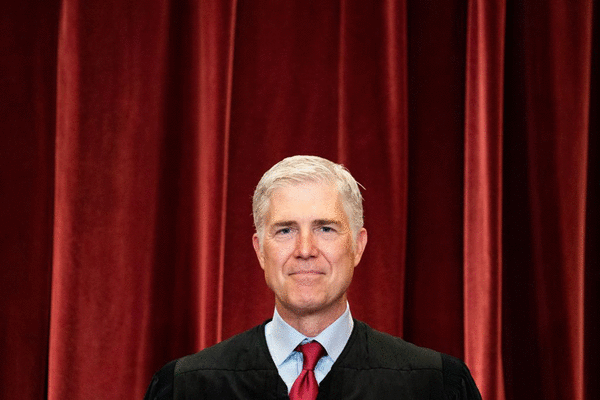
Think the Supreme Court is hopelessly divided? As it turns out, there is an issue that can produce unanimity among the justices: Using marijuana every other day isn’t a sufficient reason for the government to deprive Americans of their constitutional right to bear arms.
The 9-0 opinion correctly applies the radically originalist framework for gun rights adopted by the Supreme Court in the 2022 case of New York State Rifle & Pistol Association, Inc. v. Bruen. That framework remains a genuinely silly way to apply the Second Amendment, as this decision unintentionally demonstrates. Yet the opinion also shows that at least some of the time, conservative and liberal justices are capable of converging on a sensible resolution of a constitutional issue, even when it involves potentially controversial subjects like guns and drugs.
Under Bruen, when Congress limits gun rights, the government must demonstrate an analogy between the restriction on bearing arms and some founding-era legal practice. The court tweaked that rule in a follow-up case called United States v. Rahimi, when it ruled that the Second Amendment is not “preserved in amber” and the analogy need not be precise.
If that sounds like a rule so flexible as to be almost meaningless, that’s because it is. Originalism is a terrific theory for Supreme Court dissents in which some justice complains that the court has invented new constitutional rights. It’s terrible for majority opinions in which the court is supposed to lay down a consistent rule that legislatures can actually follow. Whether a given gun law is a sufficiently close analogy to laws made for the era of the musket is not a rule capable of creating a predictable legal regime.
Case in point: The federal law making gun possession a crime for anyone who is an “unlawful user of ” or “addicted to” a “controlled substance.” In the case the court just decided, United States v. Hemani, the defendant was an otherwise law-abiding Texas resident who was subject to a warrant-based search. He told the police where his gun was and let them know that he had some marijuana in the house. When asked how frequently he used it, he responded that he did about every other day. That was enough for the arrest and federal charge.
Writing for the court, Justice Neil Gorsuch rejected the government’s argument that three kinds of founding-era laws were closely analogous to the “unlawful user” law. All three laws involved habitual drunkards. Back in the day, they could be jailed, civilly committed to asylums, or required to post so-called surety bonds that they would forfeit if they got drunk again. In invalidating the comparisons, Gorsuch focused on the purpose of the laws aimed at the habitual drunkards of the 18th century. Those folks were not a little tipsy, he pointed out, but stone-cold drunk much of the time in a culture where nearly everybody drank and many people drank enough to count as alcoholic by today’s medical definitions. The laws regulating habitual drunkards were intended not to protect the general public against serious danger, but to protect civil order and decorum.
Gorsuch’s opinion is sensible enough as far as it goes: The analogies offered by the government are pretty bad. There can be more than one explanation, however, for why they are bad. Justice Samuel Alito, arguably the archest of the court’s arch-conservatives, wrote a separate opinion emphasizing that what he disliked about the government’s analogy was not that the habitual-drunkard laws did not focus on dangerousness. Rather, he reasoned, the problem was that marijuana — which he noted remains illegal under federal law — has become commonplace. “Marijuana use today is like alcohol use at the founding,” he wrote. “It is widespread and increasingly considered socially acceptable in many quarters. And from a practical standpoint, law enforcement widely tolerates the use of marijuana.”
Unusually, Justice Elena Kagan, one of the court’s stalwart liberals, joined Alito’s opinion. She was the only justice to do so. Perhaps Kagan liked his opinion because it did not focus on the intent or purpose of either the habitual-drunkard statutes or on the contemporary congressional drug regulation. Kagan is not a fan of examining legislative intent or legislative purpose.
Yet it is also a distinct possibility that Kagan, an inveterate bridge builder, joined Alito because this is a rare occasion when she can. Kagan believes strongly in promoting the unity and legitimacy of the court. From that perspective, liberals should join conservative justices’ opinions when their conscience allows them to do so, in order to seek as much consensus as is humanly possible.
On the merits, Alito’s opinion is right, as is Gorsuch’s — provided you accept the framework of the Bruen precedent. The trouble is that, as the differing Gorsuch and Alito emphases show, any analogy can be attacked on the grounds that it doesn’t exactly match historical circumstances. Originalism commits the justices to the highly doubtful proposition that it is possible to accept some historical analogies as “close enough for government work,” while rejecting others as stretched too thin — all without revealing the court’s underlying normative commitments.
Justice Ketanji Brown Jackson, joined by Justice Sonia Sotomayor, concurred separately to say that it would be better for the court to use a more familiar fundamental-rights framework in Second Amendment cases, one in which the court considered the relationship between the means Congress adopted and the ends it sought to achieve. Today’s conservatives strongly disfavor that approach because it requires the justices to explain their own beliefs about what ends are important and what means are necessary. But that sort of honesty is far superior to relying on analogies that mask rather than reveal the court’s genuine commitments.
The bottom line is that the conservative justices want to protect guns, while the liberal justices (and perhaps an increasing number of realistic conservatives) recognize that marijuana use just isn’t that big a deal. That confluence produced today’s 9-0 decision. That doesn’t mean, however, that historical analogy is a good way to decide hard questions of constitutional liberties. For that job, the country would be much better off with a court that says what it really thinks.
____
This column reflects the personal views of the author and does not necessarily reflect the opinion of the editorial board or Bloomberg LP and its owners.
Noah Feldman is a Bloomberg Opinion columnist. A professor of law at Harvard University, he is author, most recently, of “To Be a Jew Today: A New Guide to God, Israel, and the Jewish People."
©2026 Bloomberg L.P. Visit bloomberg.com/opinion. Distributed by Tribune Content Agency, LLC.





















































Comments