Commentary: The overlooked threat of democratic neutrality in America
Published in Op Eds
Have you ever voted for a politician who said we should censor the media or ignore court rulings? What about a candidate who encouraged or joked about political violence? Or someone who prioritized your party over the Constitution? You might have felt uncomfortable about it, but you agreed with them on some substantive issues, so you held your nose and voted for them anyway.
If so, then you might be a “democratic neutral”: You don’t outright support undemocratic practices, but you’re just as much to blame for the democratic decline in the United States.
It is easy to point fingers at authoritarian elected officials and their extremist supporters, election deniers and insurrectionists. They are the ones actively fighting for autocracy, so they must be the problem. But there simply aren’t that many people who want an autocratic America. In our recent paper in Nature Human Behaviour, we find that the real problem is much bigger and lies much closer to home.
Based on three surveys of more than 45,000 Americans, we estimate that about half of the U.S. population expresses what we call “democratic neutrality” — an unwillingness to support or oppose policies and practices that undermine democracy. And critically, this neutrality exists at similar rates on both sides of the aisle, among Republicans and Democrats, as well as nonpartisans. Our research is the first to identify neutrality as a common — and overlooked — threat to democracy.
People are neutral toward democracy for a variety of reasons. Some Americans tolerate politicians undermining democracy if it means those politicians also enact policies they like. Some Americans are ambivalent. Others are indifferent or uncertain about anti-democratic policies. Still others actually support these policies but feel social pressure to say they don’t, so they feign neutrality.
Regardless of why Americans express neutrality, those who do so are just as likely to vote for authoritarian politicians as the relatively small number of Americans (less than 1 in 5) who explicitly support undemocratic practices.
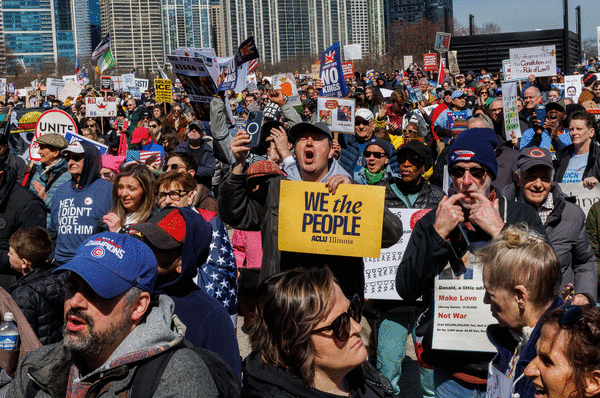
Are you one of these democratic neutrals? Maybe you profess commitment to democracy. You might have even been one of the more than 8 million Americans marching in recent No Kings Day protests. But if you’ve accepted politicians in your party violating democratic norms, for whatever reason, then you are undermining our democracy.
Perhaps you’re too principled to vote for anti-democratic candidates, but chances are someone you’re close to — your spouse, parent, friend or child — is not. And American democracy is declining because of it.
The threat posed by democratic neutrality means that we must stop blaming fringe extremists and the few outwardly authoritarian politicians for America’s democratic troubles. The true culprits are the millions of Americans who simply remain neutral when democracy is threatened. Neutrality is not a passive stance. It is a choice that perpetuates the very problems it seeks to avoid. As Theodore Roosevelt warned, “To be neutral between right and wrong is to serve wrong.”
As we celebrate the country’s 250th anniversary, now is the time for all Americans to reject democratic neutrality and take a stand for our democracy. With primaries for the approaching 2026 midterm elections already underway, Americans must vote for candidates who will protect and promote American democracy.
Preventing further democratic erosion requires each and every one of us to vote against candidates who undermine American democracy, even (and especially) if they are candidates from our own party. If Americans continue to remain neutral as politicians violate fundamental tenets of democracy, it will not survive.
____
Matthew E.K. Hall is a professor of constitutional studies and the director of the Rooney Democracy Institute at the University of Notre Dame. B. Tyler Leigh is a research fellow at the Rooney Democracy Institute. Brittany C. Solomon is an assistant professor of administrative leadership at Notre Dame’s Mendoza College of Business.
_____
©2026 Chicago Tribune. Visit at chicagotribune.com. Distributed by Tribune Content Agency, LLC.
















































Comments