Commentary: Six years after George Floyd's murder, a hard-won shift in public safety is under threat
Published in Op Eds
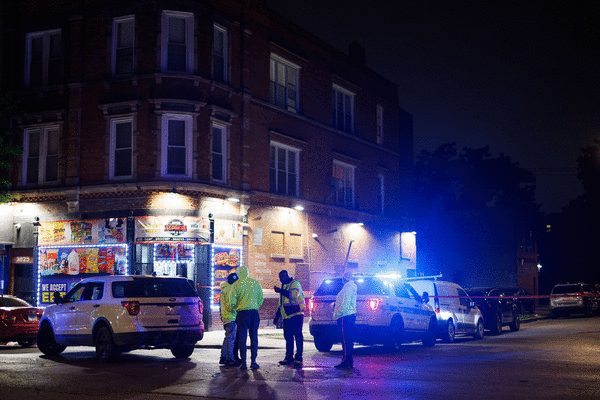
Six years ago, in the midst of a national reckoning over race, policing and public safety ignited by the murder of George Floyd, few people would have predicted where the country would find itself today.
Following sharp declines in violent crime, many communities across the nation are now safer than they’ve ever been before. But even fewer would have predicted how we got here — or how quickly we might now be at risk of undermining that progress.
Not long ago, the outlook was grim. In the years following 2020, cities nationwide experienced alarming increases in homicides, shootings and other crime as the COVID-19 pandemic upended daily life, destabilized local economies and deepened distrust in public institutions.
As a career law enforcement professional, I watched the national debate over public safety after Floyd’s murder quickly harden into a false binary. On one side were demands to respond to rising crime by doubling down on traditional enforcement and expanding police budgets. On the other were calls to shift resources away from policing and toward social supports and services.
In practice, many communities charted a path somewhere in between. Police continued to play a critical role in public safety, but state and local governments also invested heavily in community-based approaches through federal COVID-19 recovery dollars, increased local spending and public-private partnerships. That funding expanded violence interruption programs, behavioral health response teams, youth outreach initiatives, victim support services, hospital-based intervention programs and other community-centered safety strategies. In many places, law enforcement officials championed these efforts, recognizing them as an asset — not a threat — to the shared goal of keeping communities safe.
Now, many of those same programs are facing an uncertain future as federal, state and local leaders retreat from the investments that helped communities stabilize after the pandemic. As COVID-19-era funding expires, policymakers are redirecting resources away from these community-centered approaches and toward more politically familiar enforcement-first responses. If this trend continues, it could threaten to undercut the public safety gains communities have fought hard to achieve.
We are already seeing the impact of these shifting priorities. Across the country, community-based organizations are being forced to reduce staffing and capacity. Violence prevention groups in Chicago, New York, Oakland, California, and other cities have warned that they may have to scale back operations despite promising declines in shootings and homicides. Shootings in Chicago crept up over the first quarter of 2026. And with violence historically rising during the summer months, there is a looming possibility of further backsliding.
The warning signs are equally clear at the federal level. The Department of Justice has already canceled hundreds of grants supporting violence prevention, victim services, youth programming, addiction treatment and other community-based safety efforts while redirecting resources toward more traditional enforcement priorities. Organizations that relied on this funding are now paring back the work many communities have come to depend on.
I’ve spent more than two decades in law enforcement. This policy direction suggests a fundamental misunderstanding of how public safety is actually created and sustained.
One of the most important lessons I learned in policing is that real, sustainable public safety cannot be built through enforcement alone. Safe communities depend on a broader ecosystem of responses, where police co-exist with violence prevention workers, behavioral health responders, outreach teams, service providers and neighborhood organizations that help address problems before they escalate.
For too long, law enforcement has been treated as the default response to every societal ill. Those of us who have worn the badge understand its limits. We cannot effectively solve issues connected to addiction, mental illness, homelessness, trauma, poverty or instability — nor should we be expected to.
The investments of the past several years reflected the beginning of a long-overdue recognition that public safety must extend beyond policing. Many communities started reinforcing systems that uplifted prevention, treatment, crisis response and community-based support as essential tools for reducing harm before it occurs.
The irony is that many law enforcement professionals have spent years advocating for exactly the kinds of partnerships now at risk. Police officers routinely respond to service calls involving social problems we are not equipped to handle. In many cases, our presence only increases the likelihood of violence or other negative outcomes. When we invest in violence prevention workers, community responder programs and support services, it strengthens public safety and acts as a force multiplier for police, freeing up officers to focus on more serious crime.
This is why the current moment carries both promise and danger.
During this period of significant safety, the country has an opportunity to finally move beyond the false choices that dominated the public safety debate after 2020 and build a more durable, effective framework for keeping communities safe. We can acknowledge the value of policing while also recognizing that safer communities require a wider network of response, support and intervention. We can back law enforcement while also investing in approaches that reduce violence before it occurs. And as many police officers will attest, those investments make policing more effective, not less.
The past several years have shown what becomes possible when communities treat public safety as a shared responsibility rather than a task assigned almost exclusively to law enforcement. At a moment when many cities are experiencing remarkable reductions in crime, the question now is whether policymakers will build on that progress — or retreat into the same shortsighted approaches that left too many communities struggling in the first place.
____
Retired Lt. Diane Goldstein is a 21-year police veteran and executive director of the Law Enforcement Action Partnership, known as LEAP, a nonprofit group of police, judges and other law enforcement professionals who support policies that improve public safety and police-community relations.
_____
©2026 Chicago Tribune. Visit at chicagotribune.com. Distributed by Tribune Content Agency, LLC.




















































Comments