LZ Granderson: The Social Security crisis should be dominating the Senate campaign
Published in Op Eds
The No. 1 anti-poverty program for the elderly. The No. 1 anti-poverty program for children. The program more veterans rely on for disability benefits than any other agency in the country.
The way Rep. John Larson (D-Conn.) described the importance of Social Security during a congressional hearing this week, you'd think the solvency of the 90-year-old program would be a front and center topic this election cycle. The public recently learned that beneficiaries could see a 22% cut starting in 2032 if Congress doesn't act. And as Larson noted, we're not just talking about retirees. Children whose parents died young, disabled workers and military families are also among the more than 70 million Americans receiving benefits.
This is a serious national problem, yet this primary season continues to be about the personal lives of the candidates — especially when it comes to the Senate.
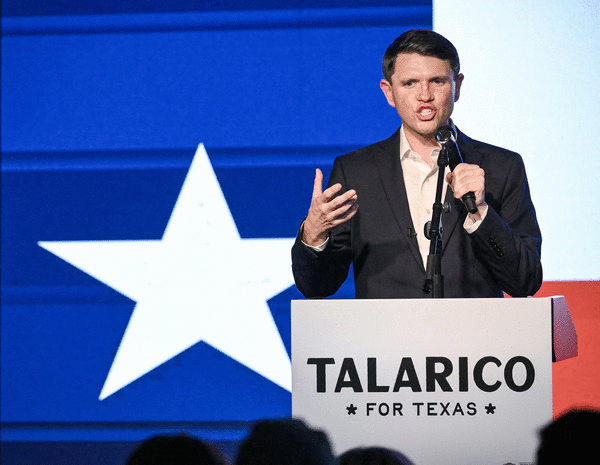
Whether it's the allegations against Graham Platner in Maine; the improprieties of Ken Paxton in Texas; or the surge of photos featuring his opponent, James Talarico, in front of a plate of barbecue to combat rumors he's a vegan, it feels as if we know more about how candidates live their lives than we do their plans to help us live ours.
Part of that has to do with the nature of politics. Mudslinging has been around ever since water met dirt. And though voters complain about negative attack ads, campaigns continue to use them because they typically work. For decades, we have watched both parties accuse the other of not caring for seniors and of having policies that undermine entitlements such as Social Security. However, given this week's report, it would appear we no longer have the time for theatrics. In 2025, a Bank of America Institute analysis found that nearly 1 in 4 Americans spent more than 95% of their salary on necessities, leaving very little for savings.
Given that, I wonder how many can afford to lose 22% of their income in a handful of years?
This is what Texas residents should be asking Paxton and Talarico. They're in the state with the third-highest number of Social Security recipients. And according to AARP, the Lone Star State already ranks 34th when it comes to benefits covering cost of living. With affordable housing and energy prices being a concern for everyone, the loss of hundreds of Social Security dollars could force some recipients out onto the streets, recreating the same conditions that necessitated the creation of the program in the first place.
But politicians don't want to touch this issue because the solutions are not the kind of things people want to hear — for example, delaying retirement until we're 70.
The House was built to address immediate needs, but in what the Romans called "the council of elders," the Senate was designed to think more long term. Federalist Paper No. 63 described the chamber as "a defense to the people against their own temporary errors and delusions." That was the thinking behind the three Senate classes rotating on six-year terms. If you do the math, the 33 senators we are electing in November will be among the decision makers when Social Security becomes insolvent in 2032.
Voters have the chance this year to put the forward-thinking, courageous individuals into that chamber who will tackle a challenging problem even if the solutions are unpopular. If there are any such candidates on the ballot.
The character of a candidate is an indication of how they will govern, so examining their personal lives makes sense. However, it is becoming increasingly clear that to be a Republican in Congress during the Trump administration means 100% support of the president's agenda, or facing ostracization or even a primary challenge. Last year, Larson said cuts the administration made to Social Security staff (roughly 7,000 positions) as well as the closures of regional offices were part of a plan to privatize the program.
"What Americans of all political stripes know is that Social Security is a guarantee that has never missed a payment," he said. "No matter how much the Trump administration and their billionaire buddies salivate over the $2.7 trillion in the Social Security trust funds, Democrats on the Ways and Means Committee will … never let them get their hands on the people's money."
In turn, Republicans said replacing people with updated technology has made the department more efficient. Officially the party says the changes are not part of some scheme to privatize. However, it must be pointed out that a century ago, when former President Franklin D. Roosevelt signed the federal safety net into law largely because the Great Depression had exacerbated poverty for the elderly, the conservative party did not like it.
And many in the party still don't like it.
Which is fine. Policy debates are the heartbeat of a democracy. We should be having the debates. And we need to hear more about the solutions the Senate candidates offer. Is it raising the retirement age, and if so, by how much? Is it lifting the payroll tax cap or privatizing? What Talarico or Paxton eats for lunch on a Tuesday ultimately doesn't affect folks in places such as Mississippi or Michigan. What could is their thoughts on the looming Social Security crisis that will start in 2032. It is not part of the conversation we're having in 2026.
____
©2026 Los Angeles Times. Visit at latimes.com. Distributed by Tribune Content Agency, LLC.


















































Comments