Commentary: James Comey's case will play out in a murky area of the law
Published in Op Eds
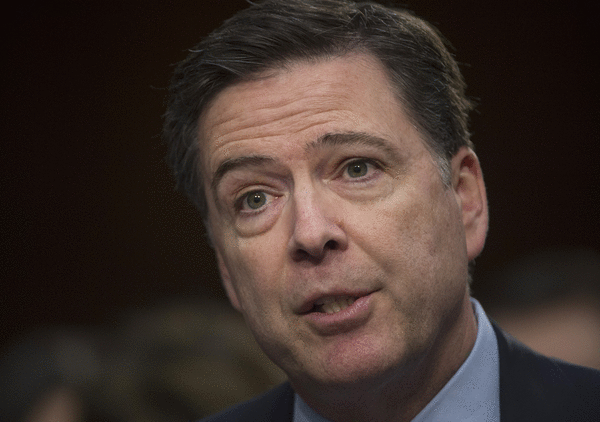
In the case of United States vs. James Brien Comey Jr., the U.S. president’s security is pitted against the bedrock right to free speech enjoyed by Americans.
Two federal charges have been lodged against former FBI Director Comey and are based on his Instagram post that depicted seashells spelling out “86 47,” which many people thought to be using “86” as the restaurant shorthand for getting rid of something and “47” as the number for Trump’s second presidency.
Comey’s post was interpreted by the U.S. Department of Justice as a threat to harm President Donald Trump. The indictment alleges Comey violated two federal laws: one that makes it a crime to “knowingly and willfully” threaten the president of the United States and one that criminalizes “communication containing any threat to kidnap any person or any threat to injure the person of another.”
Comey’s argument against the charges is likely to be twofold: He lacked the requisite intent that the prosecutor needs to prove his case, and even if he had the intent required by the statute, his speech is protected by the 1st Amendment. U.S. District Judge Louise Flanagan set Oct. 21 as the Comey case trial date.
The charges against Comey exist in a legal gray area that includes the 1st Amendment and a series of court decisions over five decades that have gone back and forth over what dangers constitute speech that can be punished.
In Comey’s case, the act of speech itself may not be the focus, but rather whether the defendant had criminal intent when he posted the image. Comey has consistently maintained that he didn’t know “86 47” could imply violence against the president. He has stated he came across the shells that spelled out “86 47” while walking on a beach in North Carolina, took a picture and posted it on Instagram.
Comey later removed the image from Instagram and posted a statement that read, “I posted earlier a picture of some shells I saw today on a beach walk, which I assumed were a political message. I didn’t realize some folks associate those numbers with violence. It never occurred to me but I oppose violence of any kind so I took the post down.”
To convict Comey, the prosecutor must prove that he did, in fact, know when he posted it that “86 47” could have a violent meaning.
Comey’s career as a federal prosecutor and his tenure as the FBI director may work against him here. It’s more than plausible that Comey encountered the threatening version of the term “86” in his career. It’s also more than plausible that the term appears in documents, records and court filings that Comey has drafted and signed over his career, all of which could be used against him at trial.
But even if the Justice Department can prove Comey did, in fact, know the threatening nature of “86 47,” its case against him is not a slam dunk.
And that’s because of the 1st Amendment.
Comey is likely to argue that his Instagram post was protected speech and therefore could not legally be criminalized.
Criminal defendants can always argue that otherwise valid and constitutional laws are unconstitutional as applied to them and their particular case. Comey is likely to argue this in his defense, but it won’t be straightforward.
The 1st Amendment is not absolute. That’s where those five decades of case law come in.
In Chaplinsky vs. New Hampshire from 1942, Justice Frank Murphy wrote that it’s “well understood that the right to free speech is not absolute at all times and under all circumstances.”
In 1969, the U.S. Supreme Court held in Watts vs. United States that while “true threats” are not protected by the 1st Amendment, political hyperbole remains protected speech. The Supreme Court defines true threats as statements in which the speaker means to communicate a serious expression of intent to commit an act of unlawful violence against a particular individual or group of individuals, but the speaker need not actually intend to carry out the threat.
Watts vs. United States involved a threat against President Lyndon Johnson during his term. In that case, Robert Watts expressed his strong opposition to the military draft at a public rally, saying, “If they ever make me carry a rifle, the first man I want to get in my sights is L.B.J.” He was charged and convicted under one of the same statutes used in Comey’s case.
The Supreme Court reversed the conviction, ultimately agreeing with Watts, who had maintained that his statement was “a kind of very crude offensive method of stating a political opposition to the President.”
As the court explained, quoting an earlier decision on press freedom, “For we must interpret the language Congress chose ‘against the background of a profound national commitment to the principle that debate on public issues should be uninhibited, robust, and wide-open, and that it may well include vehement, caustic, and sometimes unpleasantly sharp attacks on government and public officials.’”
Since Watts, countless defendants have faced similar charges for threatening the president. Many have been convicted.
In the 1970s, Eugene Hart was convicted of threatening the president after his brother reported Hart’s plan to assassinate President Nixon. An appellate court affirmed his conviction, concluding that Hart’s verbal threat coupled with his detailed assassination plan couldn’t have been “uttered in jest or in the nature of a hyperbole.”
In the 1980s, David Hoffman was convicted of threatening President Reagan when he mailed a letter to the White House stating, “Ronnie, Listen Chump! Resign or You’ll Get Your Brains Blown Out.” And in 1999, Donald Adams was convicted of threatening the president when he approached the White House gates telling Secret Service officers, “I want to kill the president.”
But in those cases and others, the defendants took concrete steps that demonstrated their sincerity and awareness of the threatening nature of their speech. In my estimation, both are absent in Comey’s case.
____
Wayne Unger is an associate professor of law at Quinnipiac University. This article was produced in collaboration with the Conversation.
_____
©2026 Los Angeles Times. Visit at latimes.com. Distributed by Tribune Content Agency, LLC.
















































Comments