Commentary: Why do the Republicans have the celebrity candidates?
Published in Op Eds
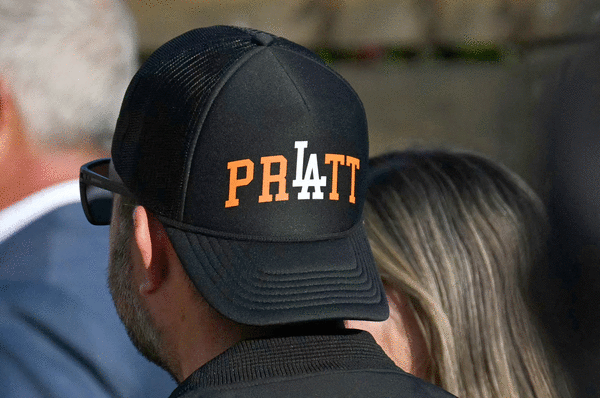
Until recently, American politics operated on a simple premise: Aspiring politicians must suck up to party bosses, run for local office, earn supporters, master policy details and only then earn a shot at higher office.
That model has collapsed.
Today’s rising stars take a different escalator — television, social media, podcasts, activism, entertainment or the internet — that goes straight to the top.
Their chief currency is not institutional support but the attention economy.
Which helps explain why Los Angeles now finds itself facing the possibility that Spencer Pratt could make a mayoral runoff.
Pratt, if you’ve been living under a rock, was one of the villains on the reality show “The Hills.” He’s also a Republican in a city that is not exactly known for electing Republicans, which means the odds of him actually becoming mayor remain very long.
But he’s breaking through, and not just because he’s what passes for being famous in the year 2026.
He talks like an actual person. He sounds angry about things many residents are angry about: crime, homeless “zombies” who abuse dogs, wildfires, government dysfunction and the growing suspicion that the incumbent mayor, Karen Bass, is an empty pantsuit.
To be fair, Pratt is aided by the fact that Bass (who is still the clear frontrunner) is having a hard time persuading many Angelenos that everything is fine when they can see flames, tents and the potholes, despite all those government reports explaining why none of those things are anybody’s fault.
Pratt has been able to point these things out, not just because he’s personally a victim of the Palisades fire but also because he possesses qualities that conventional politicians can’t buy: passion and authenticity.
Democrats have their own version of this phenomenon. Think Rep. Alexandria Ocasio-Cortez, New York City Mayor Zohran Mamdani or controversial Maine Senate hopeful Graham Platner.
Sure, their ideologies are different from Pratt’s. So are their backgrounds. What they share is an ability to command attention and outmaneuver better-qualified establishment politicians.
And more of them are coming.
After Pratt’s strong showing on Tuesday, Politico’s Alexander Burns published a provocative piece titled, “The Biggest Threat to JD Vance Is Spencer Pratt.”
Burns’ point is that Pratt-like candidates are likely the wave of the future, and that his success will likely inspire imitators — possibly even presidential contenders: “Thousands of Americans have bigger public platforms than Pratt did at the start of his race. All of them have access to the same AI hype tools his campaign uses.”
Attention is now the key to political power. The ability to dominate a news cycle is more valuable than the ability to draft a white paper. A viral video can reach more voters than a year’s worth of carefully crafted position statements.
Sara Longwell, the publisher of the Bulwark, frequently conducts focus groups to test the public’s mood. She recently revealed that provocative right-wing influencer and podcaster Candace Owens keeps being organically mentioned as a possible presidential candidate.
And even if Owens never runs for the Republican nomination in 2028, her fellow podcaster, Tucker Carlson, just might.
Which brings us back to Burns’ Politico piece: If there is “a challenge to an orderly handover of Republican leadership in 2028,” he writes, “it is far less likely to come from one of the usual suspects — [Marco] Rubio, Ted Cruz, Glenn Youngkin and so on — than from a Pratt-like fireball aimed at Washington.”
He’s right, but I’m left wondering why the assumption is that this can only happen in the GOP. Why is it that the Democratic version hasn’t sprung from the entertainment industry?
Shouldn’t Gavin Newsom be looking over his shoulder just as much as JD Vance?
Democrats possess a vastly larger reserve of celebrities, yet that never seems to translate into successful candidacies. Why did Paul Newman, Oprah Winfrey, Tom Hanks, The Rock, George Clooney, Matthew McConaughey, et al. take a pass on running for president?
Why has it been the Republican celebrities (see Ronald Reagan and Arnold Schwarzenegger) — and now reality-TV stars (see Pratt and Trump) — who have emerged as political candidates?
One theory is that Republicans were simply more vulnerable to a hostile takeover because their institutional defenses were weaker.
In dark-blue California, at least, that certainly rings true.
Perhaps Democrats are, paradoxically, too rigidly hierarchical — too skilled at gatekeeping and incumbent protection — for their own good. Strong institutions may be excellent at preventing chaos right up until the moment they desperately need someone chaotic enough to rescue them.
Because if there’s one thing Democrats could use at the moment, it’s a charismatic figure to rise from these streets (or at least from a podcast studio) to solve their problems. Someone who could magically erase the perception that they’re preachy, uncool and permanently trapped as the nation’s cultural hall monitor.
Unfortunately, the gods rarely send a deus ex machina when requested. More often, it seems, they send a deeply flawed reality-TV star.
____
Matt K. Lewis is the author of “ Filthy Rich Politicians” and “ Too Dumb to Fail.”
©2026 Los Angeles Times. Visit at latimes.com. Distributed by Tribune Content Agency, LLC.
















































Comments