Commentary: I witnessed our Ebola response in 2014. We are now seeing the costs of US aid withdrawal
Published in Op Eds
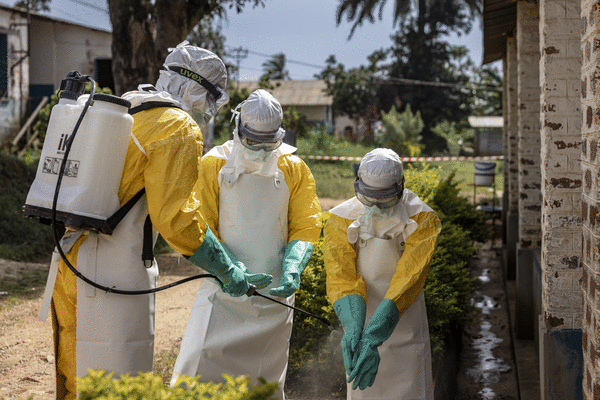
In September 2014, I was working as a watch officer in the U.S. State Department’s Operations Center, the 24/7 nerve center that monitors world events and responds to global crises. This meant I had a front row seat to the expansive U.S. government response to the Ebola epidemic that rocked West Africa that year. It was the biggest outbreak of Ebola so far with more than 11,000 deaths reported.
I was on the watch floor when we found out that an American doctor working on the response had contracted the disease in Sierra Leone, and the U.S. government was arranging to evacuate him back to the United States for treatment. That doctor happened to be my friend Ian Crozier. I’d been emailing with him about the crisis only days before. He would not have survived without the specialized care and facilities he was able to access at home.
As the current Ebola epidemic unfolds, I can’t help but wonder what might have happened, to him and the world, if the United States had different leadership then. In a break with past practice, the current administration isn’t even bringing affected Americans back home for treatment.
The withdrawal from the World Health Organization during the second administration of President Donald Trump; massive cuts to foreign aid; dismantling of the U.S. Agency for International Development, our country’s flagship foreign assistance agency; and gutting of global health staff at the Centers for Disease Control and Prevention have put us and the world at far greater risk from epidemics like this one.
U.S. foreign aid funded detection and containment capabilities through community health workers in the region. It funded healthcare infrastructure, such as clinics, labs and testing facilities, and basic supplies, such as gloves, masks and other essential protection for healthcare workers. It funded nongovernmental organizations that worked in remote places to monitor, treat and manage illness. When USAID was dismantled, much of the global healthcare infrastructure across Africa died with it, leaving communities in vulnerable areas with little ability to effectively detect or contain infectious disease.
By withdrawing our funding, expertise and participation from the WHO, the United States also severely eroded the capacity of the global institution best positioned to respond to epidemics.
Even this administration seemed to understand that Ebola prevention should be an “America First” priority. During a Cabinet meeting last year, Elon Musk noted that Ebola prevention funding was “accidentally” canceled by his so-called Department of Government Efficiency, but assured the president and the public that it was quickly restored. “I think we all want Ebola prevention,” he said. But that “mistake” was not in fact corrected. Funding for healthcare response in the region was gutted, and many experts in high-risk outbreaks were pushed out of the government, leaving America ill prepared to act.
In 2014, the U.S. response involved billions of dollars, the deployment of nearly 200 USAID and the CDC experts, and 1,800 Defense Department personnel. The U.S. government worked closely with the WHO and countries across the affected region and the world. Existing U.S.-funded healthcare programs meant the human and physical infrastructure was already in place to enable early detection and facilitate effective response.
Even that highly coordinated international response had many shortcomings, but the lessons learned should have positioned the world to respond better to this crisis today. Instead, the global response has been delayed and hobbled. About 900 suspected cases and 220 suspected deaths have been tracked so far, but no one understands its real scale yet. Most prior Ebola outbreaks ended before they reached this level.
This epidemic faces other serious complications. No approved vaccines or therapeutic treatments exist yet for this Ebola strain, and its long incubation period — two to three weeks rather than two to three days — facilitates the spread, since people who appear healthy can carry it longer and farther without detection.
The front lines of the epidemic are also the front lines of a war, making it harder to treat, and the region’s porous borders make it harder to contain. At least three health facilities have been attacked so far, leading infected patients to flee. The rapid influx of new resources and officials in a region raised deep suspicion in the local population, and that suspicion itself remains an obstacle to treatment and containment of the disease.
This outbreak has spread from the Democratic Republic of Congo to Uganda, and officials fear it may have already traveled beyond those two, since eight countries border the affected region. The Africa CDC is doing its best to organize a robust response, but its aim to raise $319 million seems paltry compared with what similar outbreaks have needed in the past.
But the past was a very different operating environment for global healthcare. The question is whether this outbreak will serve as a warning that triggers the U.S. government to reinvest in global health while it still can, or if that warning will come too late.
_____
_____
©2026 Chicago Tribune. Visit at chicagotribune.com. Distributed by Tribune Content Agency, LLC.



















































Comments