Commentary: Every worker deserves paid leave
Published in Op Eds
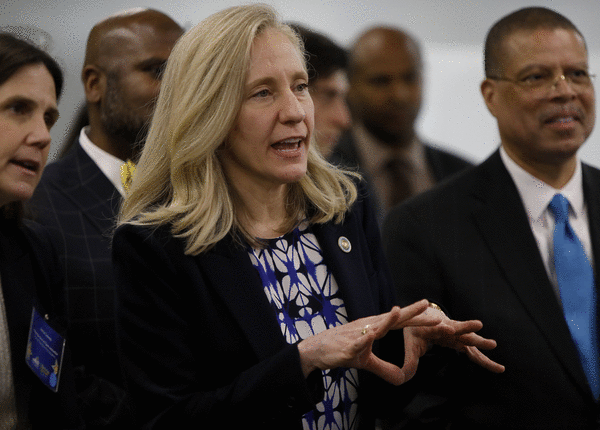
Virginia just made history as the first Southern state to provide workers with paid family and medical leave to tend to their serious medical needs, welcome a child into their lives, or care for an ill family member.
The new legislation has been described as a win for the state’s new Democratic governor, Abigail D. Spanberger, who was voted into office as part of last fall’s “blue wave” elections. But the truth is that policies like paid leave are broadly popular with voters across the political spectrum. What just happened in Virginia should therefore serve as a template for other such efforts, as political leaders seek to win on bread-and-butter issues related to affordability.
The United States, sadly, is one of the only nations in the world that does not guarantee employees even one paid day of parental or medical leave, leaving the matter up to individual states. Virginia now joins 13 other states and the District of Columbia that have enacted such programs.
Virginia’s program will provide up to 12 weeks of benefits over a 12-month period, beginning in 2028. Nearly all public and private sector employees (91%) are covered. The self-employed can also opt in, receiving 80% of their average weekly net earnings. Employers and employees will contribute equally to a Family and Medical Leave Insurance Trust Fund that will pay these benefits. And workers have the right to return to a job with their employer at the end of the leave.
This is good news for Virginians. But passing paid leave programs one state at a time has made for slow progress on this issue nationwide: Since California enacted its program 23 years ago, paid family and medical leave is only available to about 34% of private sector workers.
There is no question that these worker-friendly policies have clear benefits. A 2011 study that I coauthored surveyed workers and employers before and after implementation of California’s paid family leave program. Unsurprisingly, it found positive effects of the program for working families. But the same was true for employers; most reported that paid leave had either a “positive effect” or “no noticeable effect” on productivity (89%), profitability/performance (91%), turnover (96%), and employee morale (99%).
So what is stopping us from enacting paid leave everywhere? It certainly isn’t public opinion. Recent polling shows that a national paid family and medical leave program is supported by more than three-quarters (76%) of Americans. Even a clear majority of Republicans (62%) agree that Congress should get to work on this.
In fact, there are many issues where the public shows support for what are usually considered to be progressive or left-leaning ideas. As the Center for Economic and Policy Research shows in its Majority Agenda compendium, there are a range of issues — from health care to affordable housing to fair scheduling laws — where bold policy solutions are favored overwhelmingly by Americans.
Just about everyone will face a medical crisis or other need that will require them to take off from work at some point in their working lives. A national program that guarantees pay during a family or medical leave and a right to return to a job is long overdue. Virginia points the way to such a program.
____
Eileen Appelbaum is senior economist and co-director of the Center for Economic and Policy Research (CEPR), a public policy think tank based in Washington, DC. This column was produced for Progressive Perspectives, a project of The Progressive magazine, and distributed by Tribune News Service.
___
©2026 Tribune Content Agency, LLC.





















































Comments