Robin Abcarian: Americans want to rebuild the wall between church and state
Published in Op Eds
My family’s faith tradition is what you might call All Over The Place.
My father, an Armenian American from Fresno, identified with Zorba the Greek, who lived life passionately and with wonder, but was highly skeptical of religion and religious institutions.
My mother, a WASPy Mayflower descendant, was a member of the Vedanta Society, an interfaith spiritual group rooted in Hinduism. Until she met my father in Berkeley in the early 1950s, she had intended to become a Vedanta nun.
As a compromise of sorts, they raised their four children in the Unitarian Universalist Church; we attended the famous “Onion” in the Valley. Unitarianism, it’s been said, is a religion for people who don’t believe in God.
But God or no God, my mother left us with an important lesson: all religions are equal, and all spiritual paths lead to the same place.
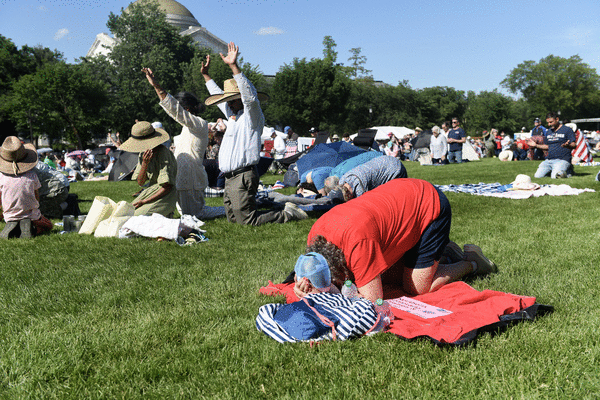
That, unfortunately, does not appear to be a sentiment shared by the thousands of conservative evangelical Christians who streamed into the National Mall recently for a daylong prayer rally to “rededicate” our country as “one nation under God.”
The gathering, ostensibly to celebrate the 250th anniversary of the country’s founding, was dominated by Christian nationalist leaders, and included some Trump Cabinet members, such as Secretary of State Marco Rubio and Defense Secretary Pete Hegseth, who is the subject of religious discrimination complaints from active troops for his constant invocation of Jesus Christ, and for Hegseth’s “voluntary” monthly prayer meetings at the Pentagon.
House Speaker Mike Johnson also attended the rally, as did the Rev. Franklin Graham and the Rev. Robert Jeffress, who has embraced the label “Christian nationalist.”
“If being a Christian nationalist means loving Jesus Christ and loving America,” Jeffress said, “count me in.” (Actually, that is not what it means at all. More on that in a moment.)
The rally was yet another spectacle designed to persuade Americans that ours is a Christian nation, that Christianity should be privileged in American public and private life and that Christians are under relentless attack in the United States.
In reality, conservative evangelical Christians are working hard to impose their beliefs on the rest of us. They want to install the Ten Commandments on the walls of public school classrooms and in court houses. They are trying to use public funds for religious charter schools. They are trying, in so many ways, to dismantle the country’s hallowed separation of church and state, and in the process, to rewrite history.
In April, for example, Texas Lt. Gov. Dan Patrick, who chairs President Donald Trump’s Religious Liberty Commission, decried the separation of church and state as the “biggest lie that’s been told in America.” (Actually, the biggest lie that’s been told in America is that Trump won the 2020 election.)
Although the phrase “separation of church and state” appears nowhere in the Constitution (and neither does the word “God,” for that matter), the founders were clear that government and religion were not to commingle.
We owe the “wall” metaphor to Thomas Jefferson, who while president in 1802 used it in a letter to Baptists in Danbury, Conn., concerned about the state infringing on their religious freedom. “I contemplate with sovereign reverence that act of the whole American people which declared that their legislature should ‘make no law respecting an establishment of religion, or prohibiting the free exercise thereof,’ thus building a wall of separation between Church & State,” Jefferson wrote.
Earlier this month, the Pew Research Center examined how Americans feel about religion’s influence in government and public life.
More than half of those surveyed — 52% — agreed that “conservative Christians have gone too far in trying to push their religious values in the government and public schools.” To be fair, nearly half — 48% — said that “liberals who are not religious have gone too far in trying to keep religious values out of the government and public schools.”
Naturally, the dividing line turns out to be a partisan one. But one thing large majorities of both Republicans and Democrats agree on is that churches and other houses of worship should butt out of politics.
As for Christian nationalism, Pew found, Democrats generally frown on it, while Republicans view it favorably or have never heard of it.
So what, exactly, is Christian nationalism?
As many scholars and researchers have written, Christian nationalism is not a religion. It’s a political ideology that, upon examination, has very little to do with real Christian or democratic values. “It accurately describes American nationalists who believe American identity is inextricable from Christianity,” wrote Georgetown political scientist Paul D. Miller in Christianity Today. In his February 2021 piece, Miller noted that many of the Jan. 6 insurrectionists sported Christian signs, slogans and symbols.
As Constitutional law attorney Andrew Seidel of the Freedom From Religion Foundation told the House committee investigating the Jan. 6 attack, on that day, “Christian Nationalism ripped off its mask, showing that it is... a violent, exclusionary movement bent on seizing power here and now.”
Americans don’t need to rededicate themselves to the idea that we are one nation under God. We need to rededicate ourselves to the importance of keeping that big beautiful wall between church and state, one of the very best things about this 250-year-old experiment.
_____
©2026 Los Angeles Times. Visit at latimes.com. Distributed by Tribune Content Agency, LLC.



















































Comments