John Rash: From Soviet posters to Russian posts, propaganda endures
Published in Op Eds
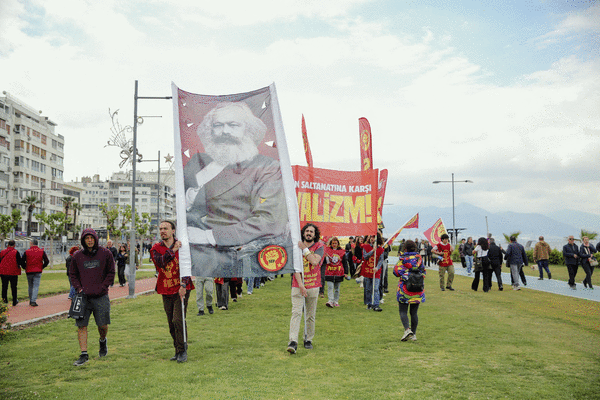
Every culture has art or artifacts that become symbols, like Russia’s “stacking” or “nesting” dolls known as Matryoshka.
Every country has symbols, too. For the Soviet Union it was posters.
“The entire path that the Soviet Union walked is shown through the lens of poster design,” explained Maria Zavialova, the curator and head of exhibitions and collections at the Museum of Russian Art in Minneapolis.
Walking through the gallery showcasing “Poster Art of the Soviet Era,” Zavialova said that “unlike what we think about the Soviet Union as this monolith and behemoth of this cold, huge state that is solid and never changes, it (was) very dynamic.”
That’s evident in posters the museum describes as “breathtakingly artistic and unapologetically ideological.”
Indeed, “Soviet poster art is not neutral,” Maria Doan, the president of the Minnesota branch of the Ukrainian National Women’s League of America, said in an email interview. “It was a core instrument of state propaganda, designed to shape perception, justify power, and erase inconvenient truths.”
Some early versions borrowed existing imagery, including an appeal to join the Red Army with a pointing soldier, evoking the iconic Uncle Sam “I Want You” recruiting poster. Another, belying official atheism, features the imagery of a Red Army soldier in the guise of St. George slaying the dragon (perhaps of capitalism).
“The artists knew they had to appeal to the masses, and that’s what they were familiar with,” said Zavialova as she showed the transition to more avant-garde works — “completely new art for a completely new nation.”
The early government, she said, “did not know if they would survive another month, so there was no overwhelming universal control system.” Soviet history “is often misunderstood, so looking at the first seven years we need to realize how radical and experimental it was, especially in art.”
The era of no overwhelming control system in art and especially governance came to a decided (and deadly) end under Stalin (whose reputation is undergoing a perverse resurgence in modern Moscow). Millions were killed not just in the Great Patriotic War (World War II) but by the dictatorship itself, including the heinous Holodomor, the man-made famine inflicted on Ukrainians, who were then Soviet citizens.
Some Stalin-era posters appealed to wartime patriotism. And some to darker domestic undercurrents, including one imploring “Do Not Be Afraid to Criticize a Job Badly Done.” Such a report could prove fatal — the fate that befell Zavialova’s grandfather-in-law, who directed a big industrial enterprise in Leningrad before he was criticized, then arrested and executed within three months.
Years later, at age 22, Zavialova underwent her own Orwellian ordeal when she was interrogated by the KGB, the Soviet secret police force, for possessing an English-language version of Nobel Laureate Alexander Solzhenitsyn’s epic “The Gulag Archipelago.” While life did not imitate art — Zavialova was not imprisoned — the incident impacted her academic career.
Stalin’s reign of terror became slightly less intense during the Khrushchev era, represented in some posters by a fresh breeze. “They have this literally tangible wind blowing through the images in a more impressionist style,” said Zavialova. “Still, the ideological content is there, and Stalin is out of the picture” (figuratively and literally), “repudiated as we go back to Leninist principles.”
The relatively brief Khrushchev years yielded to the squalid governance (and stolid posters) of the Brezhnev era. But the posters, just like the positions of the party, changed during the Gorbachev glasnost and perestroika era. Including one from 1990 with this warning for the party: “Reform Yourself Before It’s Too Late.” But by then “it was already too late,” Zavialova said. “Things were falling apart.”
Those waning days seem to be reflected in the final few posters that dealt more with social issues than socialism. Including the last one that again deploys the device of a pointing finger. But this one doesn’t warn about the scourge of capitalism, but alcoholism.
Soviet ideas and ideals have ended, said Zavialova. “As far as contemporary Russia, this idea is completely gone; there are oligarchs, there is this inequality of wealth.”
The ideology may be gone. And while today’s methodology is more social-media posting than posters, Kremlin influence operations endure. Some of the insidious internet messages come from easily identifiable sites. But increasingly sights are set on legitimate accounts, as happened recently when several Bluesky accounts were hijacked to spread Moscow’s messages.
“It’s important to understand the broader context of Russian influence operations,” said Darren L. Linvill, who understands it well as the director of Clemson University’s Media Forensics Hub. The Bluesky hack is “part of one particular campaign run by a for-profit organization with obvious connections to the Kremlin.” Pieces of “this broader tableau of Russian influence operations” connect, overlap and mutually support one another “all with the same boss” (Russian leader Vladimir Putin, indicted for war crimes).
Linvill said that researchers commonly call it “Matryoshka.” Yet it’s not innocent, but insidious, especially regarding Ukraine, which is usually the target of Russian propaganda (and munitions).
“What we’re seeing coming out of Russia today,” said Eugene Rumer, director of the Carnegie Endowment for International Peace’s Russia and Eurasia Program, “is just much more in terms of volume and quality.” In fact, Rumer continued, Moscow “has a much easier time spreading their propaganda and disinformation in the West than their Soviet counterparts did, because back in those days media space was much more constricted, controlled; there was a lot more fact-checking.”
In early Soviet days “there were a lot of artists who were true believers that they were building a new society,” Rumer said. “Nowadays, I don’t believe that any Russian artists are really true believers in the Putin system.” (Instead, most artists are now hounded, not honored, by the Kremlin.)
The antidote to today’s toxicity is the truth, concluded Rumer and Linvill, however elusive it is in the thicket of disinformation.
Critical thinking is indeed key, concurred Zavialova, who added that given the modern media landscape it’s less likely to be communicated by poster art, which was the inexpensive expression of its day.
That may be the case. But posters can still pack a punch.
Like the one in immediately identifiable blue-and-yellow colors greeting museum visitors, featuring a dove with a stalk of wheat subtly substituting for an olive branch, with words reflecting the beliefs of the Museum of Russian Art.
“Stand with Ukraine,” it reads. “Courage/compassion/freedom.”
_____
©2026 The Minnesota Star Tribune. Visit at startribune.com. Distributed by Tribune Content Agency, LLC.
















































Comments