COUNTERPOINT: Our wars haven't been worth it, and not just in Iran
Published in Op Eds

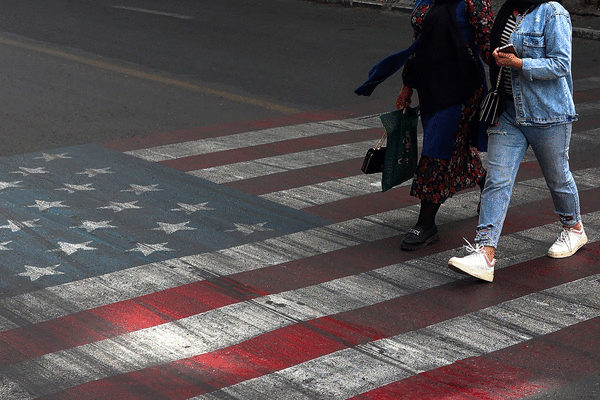


As Memorial Day approaches, polls show nearly two-thirds of U.S. voters oppose the war against Iran. They’re right. After decades of war since 9/11, Americans now largely agree: War isn’t worth it.
The Iran war has killed thousands of Iranians and Lebanese and displaced hundreds of thousands more. People in poor countries around the world are facing fuel shortages, power outages and food insecurity, with much worse to come.
Here in the United States, the war has already up to $50 billion, and the cost is only going up — not just at the gas pump but in opportunity. For that $50 billion, we could have paid for healthcare for 3 million people in this country and gotten about 1.5 million kids into Head Start, according to the IPS National Priorities Project.
Which makes us safer?
President Donald Trump would like us to believe that no price is too high to stop Iran’s “nuclear threat.” But Iran isn’t a nuclear threat. Year after year, including 2026, U.S. intelligence agencies agreed that Iran is not building nuclear weapons.
In 2015, Iran agreed to cut its stockpile of enriched uranium, reduce its reactors and submit to unprecedentedly intrusive U.N. inspections. The United States, in return, agreed to end many of the sanctions that were crippling Iran’s economy.
It worked. Intelligence agencies around the world, including in the United States, agreed that Iran was complying. U.N. inspectors kept a watchful eye on Iran’s reactors, traffic through the Strait of Hormuz flowed freely, and Iran was still not trying to build a nuclear weapon, maintaining that a bomb would violate Islamic law.
However, Trump tore up the agreement in 2018. He didn’t pretend Iran was violating it; he just claimed he could “get a better deal.” He couldn’t.
Instead, Trump joined Israeli Prime Minister Benjamin Netanyahu and ratcheted up threats against Iran. Eventually, those threats turned into reality — first in a short-term bombing campaign in June 2025 and then a full-scale U.S.-Israeli war this year.
Despite repeated ceasefire declarations and claims from the White House that “we’ve won,” the war continues months later. Thousands are dead, gas prices are shockingly high, and the Strait of Hormuz (which was running fine before Trump trampled the nuclear deal) remains largely closed.
It’s easy to say that diplomacy works and war does not. That’s not just a statement of principle — it’s the truth.
Diplomacy is the only strategy that’s ever worked to change Iran’s behavior. It wasn’t because the U.S. asked nicely. It was because the U.S. negotiated seriously, changed its own aggressive behavior, and stopped using its economic, political and strategic power as acts of war against Iran.
Is this war worth the human, economic or environmental costs? Clearly not. You could say the same of Trump’s other second-term conflicts — including his support for Israel’s genocide in Gaza and his attacks on Somalia, Yemen, Venezuela and Nigeria.
In fact, today most Americans would agree that none of the major wars in this country’s recent memory have been worthwhile — not in Vietnam, Central America, Iraq, Afghanistan or Iraq again.
For the $16 trillion the U.S. had spent on the military after 9/11 before the Iran war, we could have made transformative investments in healthcare, education and renewable energy. We could have erased student debt and virtually wiped out child poverty at home and globally.
Instead, our leaders continue to spend money on wars they think will make the United States the undisputed power in the world — wars that instead kill millions of people abroad, endanger U.S. troops and make life harder at home.
Veterans know this. “The U.S. has been at war in one form or another since my deployment in the Persian Gulf, 36 years ago,” said Michael McPhearson, executive director of Veterans for Peace.
“Trillions of tax dollars spent, thousands of U.S. military service members dead, and tens of thousands wounded. The toll on the rest of the world is even more staggering, while warmongers and those who send us to war get richer,” he added.
“It's time to invest in people and life and stop spending money on death and destruction,” McPhearson said.
I agree — and so do most Americans.
____
ABOUT THE WRITER
Phyllis Bennis is a Middle East expert and directs the New Internationalism Project of the Institute for Policy Studies. She wrote this for InsideSources.com.
____
©2026 Tribune Content Agency, LLC



















































Comments