POINT: War can be justified, but only as a last resort
Published in Op Eds

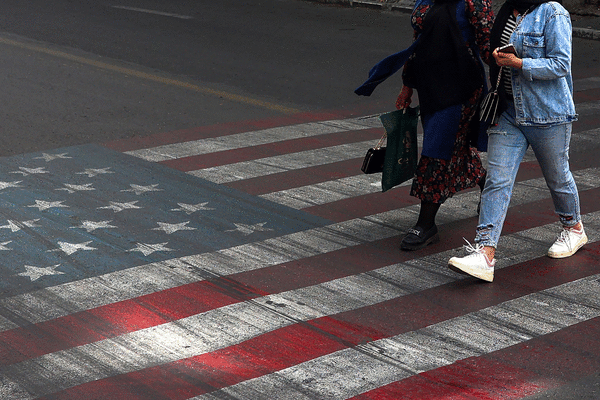


As the United States confronts the growing danger posed by Iran’s terrorist regime, Americans are again faced with hard questions about war and its costs. Iran’s leaders have funded terror, threatened allies, murdered dissidents and destabilized the Middle East for decades.
There are times in history when military force becomes necessary to defend innocent life, preserve liberty and confront genuine evil. America cannot ignore serious threats to its people or its allies. Yet, even when war may be justified, it should never be embraced casually or viewed as desirable.
The necessity of some wars does not diminish their human cost or erase the obligation to exhaust every peaceful alternative first. War reshapes economies, governments, families and futures long after the fighting ends. Even if military action succeeds in achieving important national security goals, Americans should still ask whether diplomacy, deterrence or other forms of pressure could have prevented the conflict before lives were lost. History teaches that wars rarely unfold according to plan, and their consequences often outlast the political leaders who begin them.
The uncomfortable truth is that war is the failure of speech. Long before nations began to fire their missiles, diplomacy had usually broken down, communication had stopped and leaders had abandoned the difficult work of negotiation. Free speech exists because civilized societies understand that words are infinitely preferable to violence. Debate allows grievances and solutions to surface while protecting investment. Dialogue creates opportunities for compromise before conflict escalates beyond control.
Nations that stop talking eventually start fighting. Diplomacy is more difficult. It can often be frustrating because it requires patience, humility, compromise and understanding other cultures that may not function the same way. Military action can appear decisive by comparison. Yet diplomacy has often achieved what wars could not. Negotiations ended the Cold War without direct military confrontation between nuclear superpowers.
Diplomatic agreements have prevented conflicts, freed prisoners, opened economies and reduced tensions that otherwise could have spiraled into catastrophe.
Of course, evil and aggression exist. Sometimes force is unavoidable in the defense of innocent life and liberty. America cannot ignore genuine threats or pretend that hostile regimes pose no danger. There are moments when military action becomes necessary to protect freedom, but reaching this point should come only after exhausting every other conceivable path.
War should always be viewed as a last resort, not a first instinct. A healthy society does not glorify conflict or romanticize military intervention. It recognizes the permanent scars left behind on soldiers, civilians, families and future generations. Every bomb dropped represents not only destruction abroad, but resources diverted from opportunities at home. Every conflict expands government power, increases debt and risks unintended consequences that leaders rarely predict accurately.
The negative effects of war on soldiers, physically and emotionally, hurt their families and future generations. The loss of life, limb and peace of mind affects many long after peace treaties are signed. If not decisively resolved, war creates resentment that fuels retaliatory conflicts. The history of wars should be clearly understood so that we can accurately determine if there are any benefits.
While peace through strength is a virtue, the greatest strength of free societies is not the ability to destroy enemies. The greatest strengths of a free society are its people’s ability to debate, lead, pursue, innovate and build.
America became a beacon to the world not because of military power but because of constitutional liberties that protected free expression and encouraged peaceful political change.
The First Amendment embodies confidence that open dialogue is stronger than intimidation.
At its core, free speech is an act of faith in humanity itself. It reflects the belief that people can resolve differences without killing one another. War represents the breakdown of that faith. Sometimes defensive action is tragically unavoidable, but civilized nations should never lose sight of the principle that words save lives in ways that violence never can.
If the conflict with Iran teaches Americans anything, it should remind us that preserving peace requires more than military readiness. It requires leaders courageous enough to pursue dialogue even when doing so is politically unpopular. It requires citizens willing to reject the seductive idea that force alone can solve every problem. Most important, it requires defending the freedoms that make peaceful resolution possible in the first place.
Speech is not violence, and violence is not speech. One creates pathways toward peace, and the other leaves behind graves, debt, pain and generations struggling to rebuild what words might have preserved.
____
ABOUT THE WRITER
Shaun McCutcheon is a free-speech advocate and an electrical engineer. He wrote this for InsideSources.com.
___
©2026 Tribune Content Agency, LLC



















































Comments