Ronald Brownstein: Redistricting is inverting the founders' vision for the House
Published in Op Eds
To view the rapidly escalating redistricting war between the parties as a typical partisan squabble is to miss the full magnitude of what’s unfolding.
A convergence of events has guaranteed that by 2028, virtually every state, whether red or blue, will move to eliminate congressional seats held by its minority party. The cumulative impact will be to fundamentally invert the role that the founders envisioned for the House of Representatives. That will erode the ability of all voters to cast a meaningful ballot, but will trigger an especially ignominious erasure of Black political power.
Three distinct events have collided to intensify the redistricting wars. First, President Donald Trump’s preferred candidates won primary challenges against most of the Indiana state senators who opposed his calls to gerrymander the state’s Democratic congressional seats. That will decimate (if not eradicate) resistance to his redistricting demands in other Republican states. Second, the Supreme Court eviscerated the Voting Rights Act. That unleashed red Southern states to create more Republican seats by eliminating districts held by Black Democrats. And third, the Virginia Supreme Court blocked Democrats’ attempt to revenge-gerrymander that state. That setback, combined with their outrage over the rapid obliteration of Black districts across the South, has extinguished any remaining hesitation among Democrats about pushing back.
Democrats face more obstacles to redistricting because several blue states established independent commissions to generate fair maps. But party strategists are confident that by 2028, every state under unified Democratic control will unravel those constraints and act to offset the red-state gerrymanders. And though Republicans gained a step for 2026 by acting faster, Democratic states will have more opportunities left to flip seats in the lead up to the 2028 election.
That means any near-term partisan advantage from the redistricting confrontation will likely be fleeting. But the civic damage will be lasting. The redistricting wars are changing the House’s fundamental character. The founders designed the House to be the branch of the federal government most responsive to the public. That’s why members face election every two years. While the Senate, the presidency and the courts were all meant to be insulated from sudden shifts in the popular mood, the House, as James Madison wrote in The Federalist Papers, was intended to operate with “an immediate dependence on, and an intimate sympathy with, the people.”
The House has drifted away from that ideal for decades, as more gerrymandering and the partisan sorting of residential patterns has collapsed the number of genuinely competitive districts.
But the map-drawing frenzy will drive the final stake through the founders’ vision — a deeply ironic result for the self-proclaimed “originalists” in the GOP-appointed Supreme Court majority. Creating so many safe seats means that even big shifts in popular opinion can’t produce more than small changes in the House’s partisan balance.
The gerrymandering is reaching the point where House members, perversely, may be more insulated from evolving public attitudes than senators — who were intended to be somewhat shielded by the requirement that they only face reelection once every six years.
“This unending, no-holds-barred gerrymandering is plainly at odds with the Framers’ vision of the House as a responsive, representative chamber that accurately reflects the electorate,” says Nicholas Stephanopoulos, a Harvard Law School professor of constitutional and election law.
Yuval Levin, director of Social, Cultural, and Constitutional Studies at the conservative American Enterprise Institute, agrees that the relentless mid-decade redistricting, while not unconstitutional, “threatens the underlying logic of the Constitution” with its vision of the House as the most responsive branch. Levin is especially concerned that the redistricting fever, by systematically eliminating moderates elected from swing districts, “threatens to intentionally engineer out of existence the very legislators most likely to broker compromise in a divided country.”
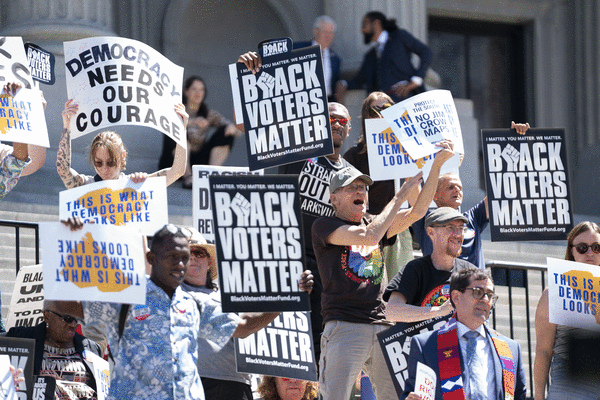
Another inescapable consequence of this struggle is that red states are eliminating Black political representation at an historic pace. Even during the dismantling of Reconstruction and violent retrenchment of Black voting rights during the late 19th century, the most Black-held House seats eliminated in any single election was four (in 1876). Red states could erase half a dozen this year, with further losses in 2028.
The South is growing “younger and more diverse, and the old guard I think is simply afraid of that,” says LaTosha Brown, co-founder of advocacy group Black Voters Matter. “They see this as their moment to do a power grab.”
The only way to interrupt this dangerous cycle is with nationwide reform. In 2021, moderate Democratic Senator Joe Manchin crafted legislation establishing clear national guidelines to bar partisan gerrymandering (after the GOP-appointed Supreme Court justices ruled that federal courts could not interfere). But a Republican filibuster blocked that bill, and similar subsequent Democratic redistricting reform plans were stillborn after the party lost unified control of Congress in 2022.
There’s no chance the GOP would accept a redistricting truce under Trump, and even after 2028 it would still face substantial Republican resistance. That’s partly because the party expects to benefit when the 2030 Census reapportionment adds more House seats for red states, including in Texas and Florida.
National anti-gerrymandering legislation may only be viable the next time Democrats control the White House and both congressional chambers. But, paradoxically, the best way to persuade more Republicans to deescalate post-Trump would be for more blue states to impose their own gerrymanders before 2028. As with the arms race during the Cold War, the threat of mutually assured destruction may be the only way to keep the peace in the escalating redistricting war.
____
This column reflects the personal views of the author and does not necessarily reflect the opinion of the editorial board or Bloomberg LP and its owners.
Ronald Brownstein is a Bloomberg Opinion columnist covering politics and policy. He is a CNN analyst and the author or editor of seven books.
©2026 Bloomberg L.P. Visit bloomberg.com/opinion. Distributed by Tribune Content Agency, LLC.





















































Comments