Commentary: The myth of rally round the flag
Published in Op Eds
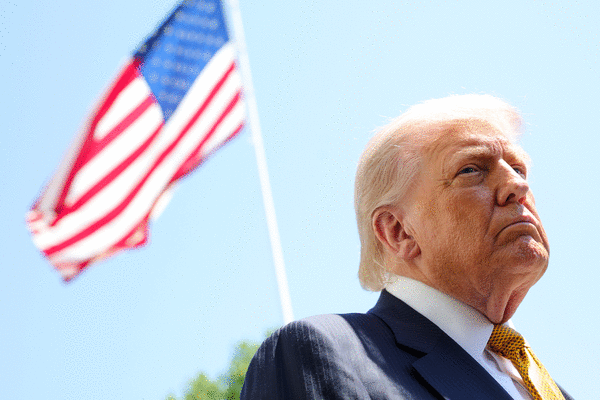
It is commonly held wisdom that the American people unite behind their president in times of crisis. This “rally round the flag” effect describes boosts in presidential popularity that bridge the partisan divide. Public opinion on the war with Iran has so far defied this assumption, indicating the phenomenon may be more myth than reality.
Nearly three months after the United States and Israel launched joint strikes against Iran, a majority of Americans disapprove of how President Donald Trump has handled the conflict. A new poll from the Institute for Global Affairs at Eurasia Group shows deep partisan splits on Trump’s handling of the Iran war.
A rally round the flag effect seems to be largely absent. Democrats are overwhelmingly against the military campaign (90% disapprove), while Republicans are mostly supportive (73%). Independents lean more the way of Democrats: 23% approve and 62% disapprove.
The current war with Iran, much like the 2003 American invasion of Iraq, is a war of choice. The United States faced no imminent threat in either case. But while the Iraq war is widely regarded as an epic blunder today, the American public was much less divided at the time.
Americans were split in the lead-up to Operation Iraqi Freedom but were generally supportive after the invasion. Gallup polls in the months preceding the war showed public support for invading Iraq hovering at a little more than half, with Republicans 75% in favor and Democrats 40% in favor. Overall support surged to 72% after the invasion, including about half of Democrats.
In contrast, the Iran war today is more polarizing and sees very little united support for operations post facto. About half of Americans opposed the United States initiating an attack on Iran in the weeks leading up to the start of the war, according to polling from the University of Maryland, with only 21% in favor. Less than half of Republicans (40%) favored initiating an attack, while 74% of Democrats and 51% of independents opposed.
If anything, the partisan split deepened after the start of the war. For the most part, Republicans rallied behind Trump. But Democrats became even more unified in their opposition and disapproval increased among independents. “Given the fact that we've seen so much polarization in recent years, I'm increasingly convinced that presidents' ability to cue the public and generate rally effects, somewhat artificially in this case, is increasingly restricted to co-partisans,” says Andrew Payne, a research director at Chatham House.
The first scholarly studies of the “rally round the flag” effect began during the Cold War to explain brief fluctuations in presidential popularity. More recent studies have shown that while some crises have had unifying effects, the effect is not fully understood and prolonged involvement in military conflict tends to decrease public support for leaders.
The most notable example of “rally round the flag” came after the terrorist attacks of Sept. 11, 2001. Gallup polling shows President George W. Bush’s approval rating surged 35 points from 51% in the days preceding to 86% in the days immediately following 9/11. His approval was back in the 50s before launching Operation Iraqi Freedom in March 2003 and then spiked up to 71% afterward, before resuming a downward trend.
This boost could mistakenly induce presidents, especially if they are experiencing low approval, to think that initiating a military conflict overseas will lead to greater popularity. Trump, riding high on the apparent success of his Venezuela operation, may have been tempted to pursue a conflict with Iran to distract from various problems at home (something he repeatedly predicted President Barack Obama would do). Iran seemed like the perfect enemy; Americans overwhelmingly hold unfavorable views of the country.
But a key difference between 2003 and today is the lack of effort on behalf of the administration to sell the war to the American people. There was a coordinated campaign leading up to the invasion of Iraq to convince Americans, falsely, that Iraq possessed weapons of mass destruction and Saddam Hussein had links to al-Qaida. The Trump administration’s messaging on its goals in Iran has been muddled and incoherent, inflating the threat of Iran’s nuclear program and at times pointing to regime change.
Americans not only do not understand why the United States is at war with Iran but are living with the adverse consequences. The country is in the midst of an affordability crisis and spiking oil prices have contributed to inflation. Most say it has become harder to pay for basic necessities like housing, food, clothing, and medical care in the past six months and 79% say the war in Iran has affected the cost of living.
What is noteworthy about Trump’s approach to foreign policy in general is his abandonment of the pretense that the United States serves higher ideals, which could make the costs seem worthwhile. Emotions were running high after 9/11, a direct attack against the United States, and the Bush administration sold the wars in Afghanistan and Iraq as necessary to protect the American homeland, fight terrorism abroad, and spread democracy.
Trump makes no such appeals and he is a uniquely polarizing figure. Without the faith that Americans once held in their institutions and the conviction that they are a force for good in the world, public opinion on foreign policy may often be a reaction to Trump himself. For Democrats who deeply oppose the president, there is likely very little he could do to get them on board. What is clear since the start of the war with Iran is that Americans broadly have not rallied behind their president.
There could be many reasons for this. Among them are incoherent messaging, economic turmoil, and the absence of a quick victory as promised. The Iran war shows that the “rally round the flag” effect is highly circumstantial and cannot be manufactured by political leaders hoping to boost domestic support through military confrontation. Time will tell if Trump’s calculus is as disastrous as Bush’s. For now, Americans are not convinced.
____
Eloise Cassier is a research associate at the Institute for Global Affairs at Eurasia Group, where she contributes to projects advancing a more restrained and less interventionist foreign policy. She also produces the None Of The Above podcast.
___
©2026 Tribune Content Agency, LLC.
















































Comments