Editorial: The Supreme Court's spring reckoning
Published in Op Eds
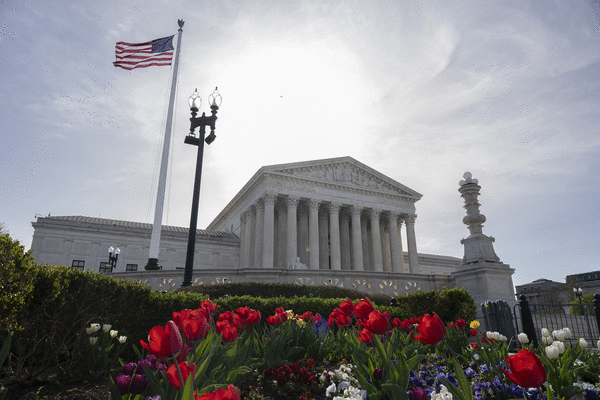
As a new round of opinions begins to arrive in the coming weeks, the U.S. Supreme Court enters its most consequential season. From April through June, the justices release decisions that do more than resolve legal disputes; they shape the country’s direction.
Alexander Hamilton once called the court the “least dangerous” branch, lacking control over the purse or the sword. History proved otherwise. As Alexis de Tocqueville observed, nearly every major political question in America eventually becomes a legal one. The court’s power, exercised through judicial review and lifetime appointments, has made it a central force in public life.
This term reflects that reality. Immigration, free speech, religious liberty and executive authority are all before the court. The outcomes will reverberate far beyond the courtroom.
The Supreme Court is poised to decide on questions over the limits of birthright citizenship, transgender athletes’ participation in sports and the constitutionality of federal limits on campaign spending, among other cases.
The institution is not flawless. From Dred Scott v. Sandford to more recent controversies, the court has stumbled. Yet compared with the blunt force of partisan politics, it still represents something increasingly rare: deliberation, restraint and a commitment, however imperfect, to principle over passion.
That is why its structure has endured. Since 1869, the number of justices has remained at nine despite repeated attempts to alter it for political gain, most notably by President Franklin D. Roosevelt. Americans recognized then, as now, that reshaping the court for advantage risks undermining its legitimacy.
Even small moments matter. When Justice Sonia Sotomayor recently apologized to Justice Brett Kavanaugh for remarks made during arguments, it stood out not for the disagreement but for the accountability. In today’s political climate, that kind of restraint is rare.
The greater concern is what happens when the court is drawn deeper into partisan conflict. A future vacancy, such as a potential retirement by Justice Samuel Alito, would likely ignite another confirmation battle reminiscent of 2016, when Mitch McConnell blocked consideration of Merrick Garland.
That path weakens public confidence and blurs the line between law and politics.
The Supreme Court remains a pillar of the American system, but it is not immune to the pressures surrounding it. As decisions are released in the weeks ahead, the focus should not be on who wins or loses politically, but on whether the institution continues to uphold its core mission.
The court’s authority ultimately rests not on force, but on trust. Preserving that trust is essential not just for the judiciary, but for the stability of the nation itself.
_____
©2026 The Baltimore Sun. Visit at baltimoresun.com. Distributed by Tribune Content Agency, LLC.

















































Comments