Mark Gongloff: A totally real, non-magical way to save $230 billion
Published in Op Eds
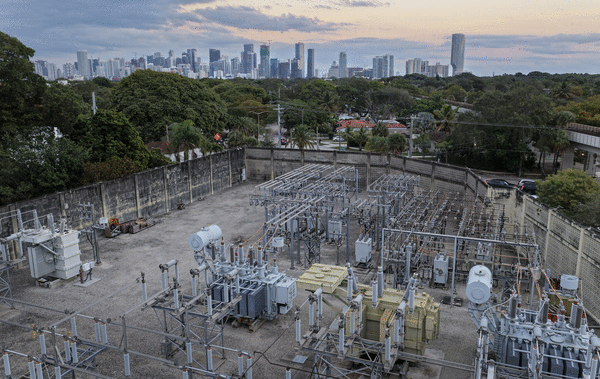
Arthur C. Clarke’s third law says that “any sufficiently advanced technology is indistinguishable from magic.” In an age when war and robots are making energy increasingly scarce, a technological breakthrough that can satisfy the electricity demand of, say, Europe without using a single lump of coal or solar panel sounds magical.
But the technology in question is actually so mundane that my simply naming it will probably put you to sleep, or at least drive you back to TikTok. It’s energy efficiency. Please don’t go.
Because it’s actually kind of exciting, relatively speaking. Merely plugging the leaks in our aging grids, which let about 8% of global electricity output escape into the void, we could save almost $230 billion in energy costs over the next decade, Bloomberg Intelligence analyst Andrew John Stevenson estimates in a new report. Those losses stem from inefficiencies in transmission, distribution, power management and storage, along with weather-related disruptions that are proliferating as a hotter climate grows more chaotic.
That lost 8% of global energy, or 2,500 terawatt-hours, comes close to the 2,747 terawatt-hours the European Union burned last year, Stevenson notes. Newer transmission lines, utility-scale batteries and smart-grid software alone could recover 1,760 terawatt-hours of electricity over the next decade, roughly matching the combined consumption of Japan and Brazil. Using a global average power cost of 13 cents per kilowatt, that’s almost $230 billion in savings.
Efficiency doesn’t always come cheap. China is spending $700 billion to upgrade its grid, the EU is shelling out $675 billion, and India is dropping $36 billion just to install smart meters around the country, Stevenson notes. Global investment in grid efficiency and resilience could add up to $5.8 trillion over the next decade, JPMorgan Chase & Co.’s global head of climate advisory, Sarah Kapnick, recently forecast.
The investment will pay for itself. By 2035, the world will have saved 353 terawatt-hours annually with grid upgrades alone, Stevenson estimates. That will preclude the construction of 141 gigawatts of new capacity, according to estimates by Lazard and the National Renewable Energy Laboratory. That’s more than enough to cover the 134 gigawatts of capacity data centers will need in 2030, according to an S&P Global estimate.
It won’t be a moment too soon: Global investment in data centers soared to $771 billion last year, nearly matching investment in oil and gas ($835 billion) and the most common renewables ($798 billion), according to a new report from the consultancy Rystad Energy. Data-center spending has risen from roughly zero a decade ago, keeping up with the nearly four-fold rise in renewables during that time.
Much of the extra energy generated by the very real renewables boom has been eaten by the robots, in other words, stalling a much-needed decline in fossil-fuel energy. Meanwhile, energy costs are soaring for consumers around the world, driven first by data centers and then by President Donald Trump’s decision to inflict an energy shock on humanity.
Efficiency across not just power grids but in all aspects of society — transportation, offices, factories, homes and everything else — is critical to helping us finally bend the curve of fossil-fuel consumption downward, while slashing those costs. The EnergyStar appliance program alone has saved American consumers $500 billion and averted 4 billion tons of greenhouse-gas emissions since its launch in 1992, according to the Environmental Protection Agency.
It’s telling that one of Trump’s first acts after returning to office was urging his Bizarro-world version of the EPA to kill EnergyStar. A bipartisan outcry prevented that act of self-harm and even made sure the program’s funding got a boost. But Trump and congressional Republicans keep fighting efficiency on every front, for no apparent rational reason other than to force people to give more money to the fossil-fuel companies that help fund their campaigns.
Fortunately, the rest of the world, including most American consumers, doesn’t have to play along. It’s magical thinking to expect people trapped in Trump’s self-made energy emergency to burn increasingly expensive fuels when simply finding ways to *not* burn them can be so much easier.
_____
This column reflects the personal views of the author and does not necessarily reflect the opinion of the editorial board or Bloomberg LP and its owners.
Mark Gongloff is a Bloomberg Opinion editor and columnist covering climate change. He previously worked for Fortune.com, the Huffington Post and the Wall Street Journal.
_____
©2026 Bloomberg L.P. Visit bloomberg.com/opinion. Distributed by Tribune Content Agency, LLC.




















































Comments