Clive Crook: Humans can decide whether AI kills or creates jobs
Published in Op Eds
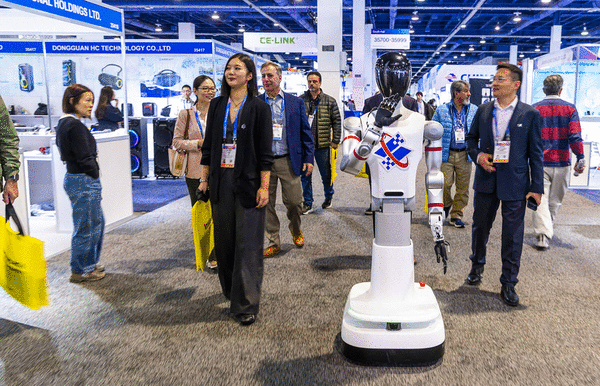
Does artificial intelligence herald soaring prosperity or mass unemployment, political breakdown and Orwellian subjection? Nobody, not even AI, can honestly say.
Forced to guess, I’d predict some of both. The point is, the outcome isn’t predetermined. What happens depends on choices that we humans (for the moment) will be making.
Economists grappling with this issue inevitably come back to the same core question: Will AI complement labor or substitute for it? The first implies strong and steady demand for labor together with rising wages; the second might mean structural unemployment, stagnant wages, higher returns to capital and worsening inequality.
Previous economic revolutions, driven by mechanization and electrification, ended up being vastly more beneficial for labor than contemporary pessimists predicted. Technological progress displaced labor on an enormous scale but created entirely new jobs as well — tasks in which technology augmented labor, sustaining the demand for workers and driving up wages. Many of the tasks modern workers carry out today were scarcely even imaginable a century ago.
AI’s economic impact, like that of its predecessors, will turn in the same way on automation versus augmentation. AI-driven automation replaces human labor; AI-driven augmentation creates new tasks that require it. The net effect of technologies that do both can be hugely beneficial for labor, so long as enough new tasks emerge. Historically, that’s been the pattern.
Research has started to shed some light on whether that pattern will repeat.
A new paper by David Autor and co-authors looks closely at the distinction between new work and more work. It minutely examines and adjusts Census and other data to track the emergence of new tasks and their impact. It finds that new work is disproportionately carried out by younger and relatively well-educated workers, pays a wage premium that diminishes over time (presumably because it requires initial investment in new skills, which gradually become less scarce), and emerges in places where demand is strong (creating opportunities for specialization that benefit existing workers). “Thus, new work serves as a countervailing force to automation not only because it expands the set of tasks performed by labor, but also because it generates new demand for scarce human expertise.”
The question is how to strengthen this countervailing force in the deployment of AI. Are there ways to improve the balance between automation and augmentation — that is, to enlarge the set of new tasks and generate new demand for human skills?
Daron Acemoglu and others have questioned whether the U.S. is as good at this as it used to be, and whether AI as currently conceived might be compounding the problem. For a start, AI is making automation cheaper than before. And it’s striking that the leading AI innovators seem interested in squeezing as many humans as possible out of the production process, not necessarily to cut costs but almost as an end in itself.
For sure, AI is also generating some new demand for scarce human expertise (witness the ferocious competition among the biggest tech companies for AI specialists). As yet, though, this augmentation seems confined to narrow domains.
More generally, because the U.S. tax system taxes labor more heavily than capital, it favors automation. (Orthodox economics says taxing capital lightly, if at all, makes sense, because it promotes investment and hence growth. But if investment is unduly focused on displacing workers, the logic breaks down.) Diminishing public support for R&D quite likely pushes the same way, because it tilts the balance of innovation away from the longer-term possibilities that are more likely to yield new tasks and toward short-term profit-seeking, which again favors automation.
The case for more public spending on basic R&D is open and shut. But brute-force methods of boosting augmentation — for instance by taxing automation — could easily backfire. It’s vital to remember that higher overall productivity is essential for rising prosperity, and automation, despite its drawbacks, delivers higher productivity. The right approach is to promote augmentation alongside: Encourage the creation of new tasks and the new human skills they will require.
The core of such an agenda should be efforts to improve workers’ mobility, not just from place to place but more importantly from task to task. The goal should be new jobs — including jobs that deploy AI as a productivity-enhancing tool for humans with new skills. Pending the arrival of artificial general intelligence, which is still far off, skilled humans plus AI are capable of delivering far better results than humans without AI, or AI without humans.
Reforming education and training to help people use AI productively is win-win. Needless to say, AI can and should be used for this very purpose. Greater mobility also demands the dismantling of barriers that stop new jobs from appearing. In the U.S., licensing rules restrict entry into countless occupations, from hairdressers to doctors. People equipped with the right training and AI tools could do all manner of middle- and high-skilled tasks they’re currently forbidden to take on. The evidence is clear that occupational licensing has gone way too far in the U.S. In some cases it might be as much to blame for squeezing low and middle incomes as automation.
New work, new tasks: That’s the key to making AI deliver the broadest possible benefits. Amid all the uncertainties, economists are paying close attention, and many businesses are aiming to use AI to improve their products and services rather than simply cut payroll. But better policy also has an important role to play. Sadly, our politicians so far show little sign of catching on.
_____
This column reflects the personal views of the author and does not necessarily reflect the opinion of the editorial board or Bloomberg LP and its owners.
Clive Crook is a Bloomberg Opinion columnist and member of the editorial board covering economics. Previously, he was deputy editor of the Economist and chief Washington commentator for the Financial Times.
_____
©2026 Bloomberg L.P. Visit bloomberg.com/opinion. Distributed by Tribune Content Agency, LLC.



















































Comments