Commentary: Russia racks up the wins thanks to the United States
Published in Op Eds
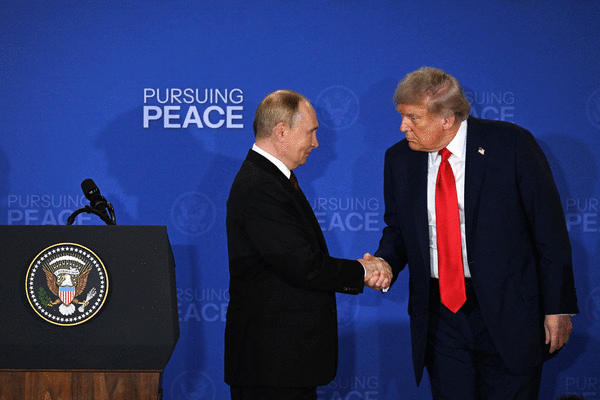
President Donald Trump said this week that he is strongly considering pulling the United States out of NATO. This isn’t the first time he has lambasted the defensive alliance. For what it’s worth, Congress passed a law in 2023 explicitly preventing a president from unilaterally withdrawing from the bloc. But whether or not the United States formally leaves NATO might be a matter of semantics at this point, since Trump has raised sufficient doubt about America’s commitment that NATO’s deterrent power may be irreparably harmed anyway.
Powerful alliances have always been a source of the United States’ strength. It is a gut punch to our European allies that have, at America’s urging, closely integrated their defenses with our own. But it is a triumph for Russian President Vladimir Putin, for whom the demise of NATO has been a strategic priority for decades.
Some think Trump just wants to punish Europe for not supporting his war of choice with Iran or volunteering to fix the Strait of Hormuz crisis that he created, even though nothing in the NATO alliance commits our allies to such folly. But this move follows a disturbing pattern we’ve seen throughout his presidency. Trump keeps making foreign policy proclamations and decisions that serve Putin’s interests rather than our own. This should be a five-alarm fire for U.S. national security.
While Trump angrily derides our allies for not helping him fight Iran, he has refused to condemn or criticize Putin for actively aiding Iran’s attacks on U.S. troops. We have known for weeks now that Russia is giving Iran real-time targeting information on precise locations of U.S. forces and other military assets in the Middle East. This has already had serious consequences. Russian forces reportedly took satellite images of the U.S. air base in Saudi Arabia shortly before an Iranian attack last week that injured a dozen American troops and destroyed expensive aircraft. Russia is also sending Iran drones with better navigating capabilities than their own that are being used against U.S. targets.
When asked about Russia’s assistance to Iran, Trump has been flippant, stating only that it doesn’t matter and hasn’t affected U.S. operations. I expect the soldiers on the receiving end of these strikes feel somewhat differently. Putin apparently denied it in a call with Trump last month, and administration officials have said, inexplicably, that we should just believe Putin, even though European intelligence and apparently our own confirm it.
Not only has the Trump administration failed to condemn Russia’s support to Iran, but it also even eased sanctions on Russian oil, giving Putin a windfall at a time when economic pressure was starting to pinch. This will undoubtedly give Moscow a boost in its attacks on Ukraine. In case you’d forgotten, Russia is the indisputable bad guy in that war.
Not that one would think so listening to Trump, who continues to blame Ukraine for Russia’s war and to press Ukrainian President Volodymyr Zelenskyy to give up even more territory to Russia in exchange for peace. Not coincidentally, this is the current Russian position too.
Trump hasn’t been a fan of Ukraine for quite some time now, so his alignment with Putin on Russia’s war is no longer surprising. But Trump is giving Putin a pass even when it affects his own priorities. On Tuesday, a Russian tanker full of crude oil docked at port in Cuba, scooting past the oil blockade that the U.S. government had imposed on the country for months. The blockade is meant to impose severe hardship on the Cuban population, to force the Cuban regime from power or make it supplicant to the United States in return for relief. Trump signed an executive order in January threatening crushing tariffs on any country that provided oil to Cuba, and the United States already intercepted a tanker from Venezuela in December and one from Colombia in February. It threatened Mexico when it tried as well. This policy apparently doesn’t apply to Russia though.
The exception might make sense in response to some concession, from either Russia or Cuba, but no such reason has been given. In fact, the White House confirmed that its policy toward Cuba hasn’t changed. Even if you don’t agree with the blockade or why Trump is using it, allowing this random exception undermines the policy aims the Trump administration has put forward.
These are just the most recent examples, but there are many more. The through line is astonishing. Trump seems constitutionally incapable of doing or saying anything that contradicts or undermines Russia’s autocratic leader, regardless of the stakes or harms to U.S. interests. We have to start asking seriously: Why is Trump pursuing a foreign policy that always defers to Putin? In this case, the most obvious answer might just be right.
____
Elizabeth Shackelford is a senior adviser with the Institute for Global Affairs at Eurasia Group and a foreign affairs columnist for the Chicago Tribune. She is also a lecturer with the Dickey Center at Dartmouth College. She was previously a U.S. diplomat and is the author of “The Dissent Channel: American Diplomacy in a Dishonest Age.”
___
©2026 Chicago Tribune. Visit at chicagotribune.com. Distributed by Tribune Content Agency, LLC.















































Comments