Editorial: In war, strength without strategy is weakness
Published in Op Eds
There are moments when a president must project resolve. The American people expect it. Adversaries watch for it. Allies depend on it. But resolve without clarity is not leadership; it is risk.
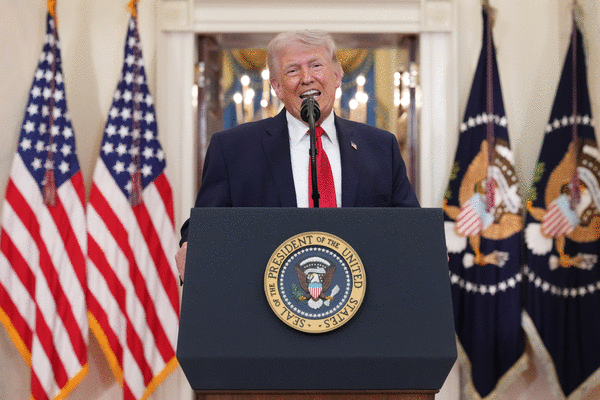
President Donald Trump’s recent address on Iran was forceful in tone, but thin in substance. It leaned heavily on certainty and dominance yet offered little in the way of strategy, restraint or defined purpose. That absence should concern every American, especially those who have long supported a doctrine of strength guided by discipline.
What was most striking was not what the president said, but what he did not say.
There was no articulated endgame. No clear conditions for success. No indication of what de-escalation would look like or how it might be achieved. History reminds us that conflicts entered without defined objectives rarely end cleanly. Iraq and Afghanistan were not failures of strength; they were failures of clarity.
Iran is not a conventional adversary. It does not fight on predictable terms. Its power lies in asymmetry, proxies and patience. Escalation in this environment does not remain contained. It spreads across borders, across alliances and into the global economy. The Strait of Hormuz alone carries a significant share of the world’s oil. Any disruption there reverberates quickly into American households, affecting fuel, food and financial stability.
Yet none of this complexity was acknowledged.
Instead, the message conveyed was one of absolute control — “we have all the cards.” That language may reassure in the moment, but it risks underestimating both the adversary and the consequences. Strength is not measured by how confidently we speak, but by how carefully we assess what comes next.
For many who have championed an “America First” philosophy, this moment presents a tension. That doctrine has long emphasized avoiding prolonged foreign entanglements and focusing on domestic resilience. Expanding the scope of military confrontation abroad challenges that principle.
Equally concerning was the absence of diplomacy. Negotiation is not surrender. It is a tool of power. To remove it from the equation is to limit options when options matter most.
This is not a call for weakness. It is a call for discipline.
The U.S. must always be prepared to act. But it must be equally prepared to define why, to what end, and at what cost.
Because in matters of war, strength without strategy is not strength; it is exposure.
_____
©2026 The Baltimore Sun. Visit at baltimoresun.com. Distributed by Tribune Content Agency, LLC.




















































Comments