David M. Drucker: Trump's coalition may not survive 2028
Published in Op Eds
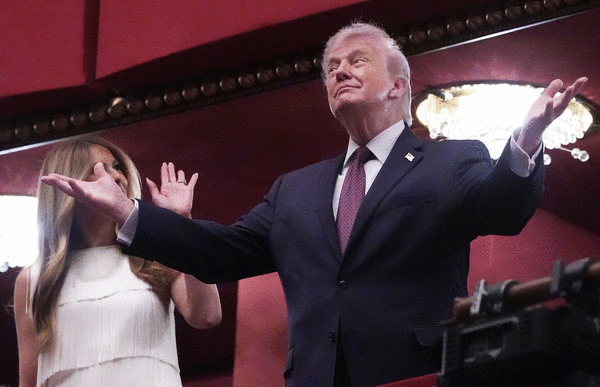
The Republican crack-up is coming — not over the Iran war and not today. But the ongoing conflict in the Middle East is a harbinger of what’s to come for the GOP in 2028.
Let’s stipulate the caveats. Events, domestic and overseas, will leave their stamp on the next presidential campaign, and whom the Democratic and Republican parties nominate matters. But one certainty exists: President Donald Trump is constitutionally prohibited from seeking a third term; he will not lead the Republican ticket. And the broad, unruly coalition that carried the 79-year-old political unicorn to a second White House stint in 2024 is unlikely to transfer to the GOP’s next presidential nominee, whoever lands the gig.
Some political observers, citing the Iran war, have argued a rift is already here. They’re wrong.
Poll after poll (after poll) shows Republican voters back Trump’s decision to join Israel on a military operation to neutralize Tehran. For decades, the fanatical regime has been the globe’s largest state sponsor of terrorism, threatening the national security of the U.S. and its allies. (After all, the Iranian proxy Hamas provoked Israel with the deadly Oct. 7 attack on innocent civilians.) But the loud complaints about the Iran war emanating from the far right are not insignificant — for instance, from podcasters Tucker Carlson and Megyn Kelly and political journals like The American Conservative. I’ll explain.
Trump is unique.
He’s managed to consolidate — under one Republican roof — conservative hawks who believe in projecting American power abroad as well as right-wing populists, both noninterventionists and isolationists who question Washington’s trillion-dollar defense budget. Grumbling about the Iran war from this corner of Trump’s coalition can therefore best be understood as the loose thread that foreshadows a fabric’s unraveling: It signals the challenge ahead for Vice President JD Vance, Secretary of State Marco Rubio, or whomever becomes the GOP’s standard bearer.
“Once Trump is not on the top of the ballot in 2028, it remains highly unlikely his coalition will [shift] to any successor, much like what happened with President Obama’s coalition on the left,” Jeffrey Brauer, a professor of political science at Keystone College, told me. “MAGA continues to mean whatever Trump does or says, even when it’s contrary to campaign promises, such as staying out of wars or bringing the cost of living down. No other current Republican has that same political magic.”
The example of Barack Obama, a populist of sorts like Trump, is apt.
The 44th president built a movement that united all factions of the center-left. Democratic pragmatists saw Obama as one of them, as did left-wing progressives. The promise of the nation’s first Black chief executive also attracted voting blocs that didn’t regularly participate in elections as well as those who showed up every four years, like clockwork, but hadn’t supported a Democrat in such high numbers. Among these disparate groups were non-White voters, especially Hispanics and Asians, plus women, young adults, the college educated and the working class.
The presumption among many Democratic insiders heading into 2016 was that Obama’s “coalition of the ascendant” would transfer to the party’s next nominee. But as Hillary Clinton discovered on Election Day, it didn’t. Clinton did not elicit the same enthusiasm, nor the same level of support, that powered Obama to victory twice. As a Washington Post analysis shows, Trump won more than 200 counties that backed Obama both times.
Another study, compiled by the Center for Politics at the University of Virginia, found that “just over” 13% of Trump voters were Obama voters in 2012.
That’s a big deal in an era when presidential contests are typically decided by razor-thin margins in states that rule the Electoral College. And that brings me to the Trump coalition — or lack thereof — without the 45th and 47th president on the ballot.
“Beyond MAGA,” is an exhaustive analysis of the voters who returned Trump to the White House in 2024, based on 18,000 interviews. In it, the principal author Stephen Hawkins and his team identified four categories of Trump voters: MAGA Hardliners, Anti-Woke Conservatives, Mainline Republicans and the Reluctant Right. These “reluctant” voters — 20% of the president’s support in 2024, according to the study — are among the reasons why the next GOP nominee is going to struggle to maintain Trump’s coalition. “That’s where the concentration of skeptical voters is growing,” said Hawkins, the global director of research for More in Common, the nonprofit behind the report. “That’s the group to watch.”
But Hawkins emphasized that numbers tell only part of the story.
“Trump is not just the embodiment of a set of policy preferences. He’s a character that people have a strong emotional attachment to. He makes them feel good about who they are, their position in society. He makes them feel respected and seen, and he’s the opponent of the people that they dislike,” he said. “That relationship is very hard to just kind of pass from one [candidate] to the other.”
The unique consortium of voters who made Trump’s second inauguration possible may fray for all sorts of fundamental reasons. The president’s job approval rating sits at 41%. His handling of the economy is rated even worse, at 38%. Even on immigration, usually Trump’s strong suit, he is underwater by a net negative 8.5 percentage points. No doubt the outcome of the Iran war will matter, too, and voters are already judging that endeavor about the same as Trump’s job performance, at 40%.
But the Trump coalition is likely headed for some sort of breakup in 2028 because Republicans are going to have a devil of a time finding another leader capable of being so many things to so many people.
____
This column reflects the personal views of the author and does not necessarily reflect the opinion of the editorial board or Bloomberg LP and its owners.
David M. Drucker is a columnist covering politics and policy. He is also a senior writer for The Dispatch and the author of "In Trump's Shadow: The Battle for 2024 and the Future of the GOP."
©2026 Bloomberg L.P. Visit bloomberg.com/opinion. Distributed by Tribune Content Agency, LLC.



















































Comments