Commentary: 'Eat real food' is great advice, but it's only part of the equation
Published in Op Eds
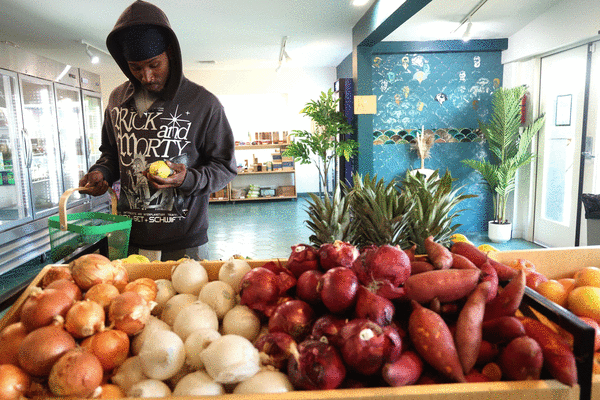
“Eat real food.” That new message, a key pillar of the 2025-2030 Dietary Guidelines for Americans, isn’t controversial. Nutritionists, scientists, politicians and lunchbox-packing parents all generally agree that’s a solid goal.
You’ve heard this statistic before: More than half of the calories Americans consume — 53% for adults and 62% for children — now come from ultra-processed foods, according to the Centers for Disease Control and Prevention. The new guidelines, issued in January by the U.S. Department of Health and Human Services and the Department of Agriculture, directly address this problem. They emphasize a return to whole foods, prioritizing protein while discouraging the consumption of highly processed foods and refined carbohydrates. They also reflect growing scientific consensus that overall diet quality, rather than single nutrients alone, is central to preventing and reversing chronic diseases.
But strong guidelines are only one part of the solution.
Here’s the challenge: While “Eat real food” isn’t difficult to understand, it is difficult to actually do. It’s difficult at 6 p.m., after a double shift, when there’s a fast-food meal available at the drive-through for under 10 bucks. It’s difficult when the closest grocery store stocks three times as many processed options as fresh produce items. It’s difficult on a government-assisted Supplemental Nutrition Assistance Program (SNAP) budget when, calorie-for-calorie, highly processed foods are often the cheapest choice on the shelf. And it’s difficult if you haven’t learned to cook healthy meals that your family will actually eat.
It is essential to articulate and to implement what it will actually take for these new guidelines to truly result in better health outcomes for all.
Over the last three years, our group of eight researchers led the Teaching Kitchen Collaborative’s Multisite Trial, the largest coordinated effort to date studying whether hands-on culinary education can actually improve health and wellness outcomes. Across sites at UCLA, UC Irvine, UTHealth Houston School of Public Health, Dartmouth Health and coordinated through the Harvard T.H. Chan School of Public Health, we conducted a randomized clinical trial of 171 people (not so different from the rigorous design used to test new drugs) to see whether teaching people to cook could improve health habits linked to reducing their risk of heart disease or diabetes.
Early data from our multisite trial show that participants who engaged in culinary education cooked more whole foods, from scratch, and reported improved diet quality.
If the goal of the dietary guidelines is to help reverse chronic disease trends — which now cost the United States more than$4.4 trillion annually in health care spending — and increase the consumption of whole foods, then federal policy must align with that vision.
Policymakers must ensure that whole foods are more accessible — in cost, in convenience and in publicly funded programs and institutions such as schools, SNAP and health care systems. People must also be empowered with the skills needed to put these guidelines into practice, transforming nutrition recommendations from aspirational instruction into meals on the table.
The healthy choice needs to be the easy choice. We believe it’s possible — and that teaching kitchens are an essential piece of this puzzle.
Our experience as part of the Teaching Kitchen Collaborative, a nonprofit membership organization representing more than 80 teaching kitchens nationwide, confirms what a growing body of research shows: People learn hands-on skills and make lasting dietary changes when they’re equipped with the skills to cook food they can afford, that their families will eat and that fit into real schedules.
These teaching kitchens, now embedded in hospitals, clinics, universities, community organizations and workplaces, are where anyone can learn to cook delicious, affordable and healthy meals.
As researchers, we work with data and measurements. We would encourage this administration to consider the following ways to measure the success of their new guidelines:
Are foods available at public schools more nutrient-dense?
Are SNAP benefits and incentives structured to make fruits, vegetables, whole grains and other minimally processed foods the affordable choice?
Are federal subsidies and procurement policies more strongly aligned with these goals?
Are health care systems reimbursed for hands-on cooking education as prevention and management of chronic diseases?
Are families empowered with the skills and support necessary to prepare healthy meals on real budgets and within realistic time constraints?
And, critically: Are we building the essential infrastructure in early care and education, K-12 schools, community organizations and health care settings for teaching Americans the skills they need to act on this guidance?
Teaching kitchens (built-in, pop-up and virtual) are part of that essential infrastructure. The evidence for hands-on culinary education as a public health intervention is growing and, at this moment, the new Dietary Guidelines present a genuine opportunity for changing the trajectory of chronic disease. The real question is whether, by 2030, Americans across income levels and ZIP Codes are actually eating healthier, and feeling better, than they do today.
“Eat real food” is the right message. But the real work is in building a country where that’s actually possible for everyone.
____
Jennifer Massa is the lead research scientist in the Culinary Nutrition Group in the Department of Nutrition at the Harvard T.H. Chan School of Public Health.
©2026 Los Angeles Times. Visit at latimes.com. Distributed by Tribune Content Agency, LLC.





















































Comments