Commentary: Empowering independent voters can fix primary elections
Published in Op Eds
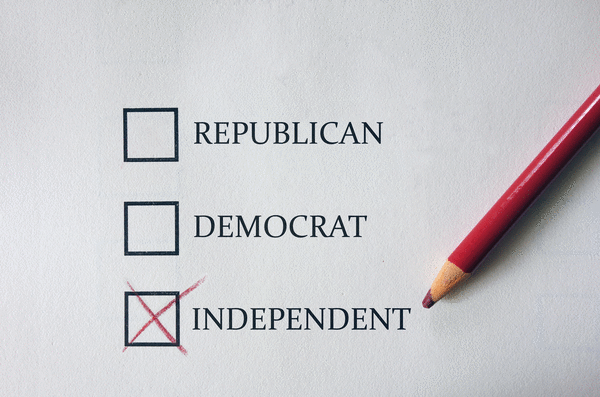
Not long ago, almost no one talked about the rules and culture of primary elections. Today, there is a growing recognition that the way we run primary elections isn’t working. They’re too partisan. Too low turnout. Too dominated by ideological activists. My organization, Open Primaries, has spent years pushing this conversation into the mainstream.
But we won’t fix primaries purely by tweaking rules. Their dysfunction is a symptom of a larger problem: the systemic exclusion of independent voters from our political life. To truly reform them, we have to start with an honest discussion about why so many Americans are leaving the parties — and what it would take to empower them as full participants in our democracy.
As Gallup reported last month, independents are now, at 45%, the largest group of voters in the country. They are a majority of Gen Z voters (56%) and millennial voters (54%) alike. They are the largest group of registered voters in ten states — blue states like Massachusetts, red states like Alaska, and purple states like North Carolina. They are liberal, conservative, moderate, and everything in between.
And growing. Every week, 10,000 Americans change their voter registration status from Democrat or Republican to independent.
Yet independent voters in America are treated as second-class citizens. Their very existence is downplayed by political scientists who insist they are actually “partisan leaners.” They are denied meaningful participation in candidate selection, shut out of debates, marginalized in media coverage, ignored in policymaking, and locked out of primaries. They are told: join a party, or have your influence diminished.
It simply will not be possible to achieve lasting reform of primary elections without an honest discussion of and attention to the role of independent voters in our democracy.
To mark this moment on the 250th anniversary of our country’s founding, when independents are surging, and Americans across the political spectrum are demanding a new path forward, Open Primaries has released the Declaration of Independents: a broad call for full voter empowerment. It asserts that independents deserve equal participation across the full spectrum of political activity — not just primaries, but debates, ballots, media coverage, policymaking, and candidate access itself.
As the Declaration declares: "We hold it to be self-evident that voters should be equal in voice, equal in dignity, and equal in political rights; that no citizen’s participation should depend upon allegiance to a party; and that government exists to serve the people, not the factions that compete to control it."
Closed primaries remain the most visible symptom of this inequality. The most partisan candidates are rewarded because “base” voters dominate — and independents are legally barred from voting in many states. Primaries are low-turnout affairs by design. Candidates know all this, and they campaign and govern accordingly. Policies, messaging, and campaign promises are all calibrated to cater to the few at the expense of the many. The result is polarization, dogmatic agendas, and politics that prioritize party loyalty over the public good.
But primaries are only one part of the exclusion. Ballot-access rules favor party nominees, imposing steep hurdles on independent candidates. Debate rules and media coverage reinforce a red-versus-blue framework. Redistricting maps maximize partisan advantage (and have all but eliminated general election competition). Fundraising networks, endorsements, and political infrastructure overwhelmingly favor party-affiliated actors. Across every level of politics, independents are treated as peripheral- their voices heard only when convenient, their influence constrained by rules designed to protect partisan power.
This is structural, not accidental. Rules have been written and defended by party insiders to preserve institutional control. The system rewards loyalty to parties over loyalty to principles. And still, every week, 10,000 Americans leave the parties not out of apathy, but out of principle. Many reject a system that demands adherence to labels and frames every issue as a tribal conflict. Independence allows voters to judge candidates on merit, weigh issues individually, and put the common good above partisan identity.
For that choice, they are penalized.
The Declaration of Independents charts the path forward: full empowerment for independents across elections, campaigns, and political life. It is a blueprint for a democracy that values principles over labels, inclusion over exclusion, and citizens above all else. Give independents equal voice, equal access, and real influence over candidates, policies, and government, and elections, campaigns, and governance finally serve the people - not the factions that claim to represent them.
Primary elections in America today are not working because voters are unequal.
And we must address that inequality if we are going to breathe more health into our democracy.
____
Jeremy Gruber, JD, is the senior vice president of Open Primaries, a national election reform organization and the author of “Let All Voters Vote: Independents and the Expansion of Voting Rights in the United States.”
_____
©2026 The Fulcrum. Visit at thefulcrum.us. Distributed by Tribune Content Agency, LLC.


















































Comments