Commentary: Grover Cleveland and the lost art of saying no
Published in Op Eds
In high school, I put useless trivia knowledge to work on the quiz bowl team. I wasn’t the fastest on the buzzer, but I learned quickly which names and facts came up repeatedly.
Grover Cleveland was one of those names.
He was the only president to serve nonconsecutive terms. Of course, this was before Donald Trump’s return to office.
Cleveland was always good for a point or two. Beyond that, I did not think much about him.
He was another name to memorize, somewhere between Presidents Millard Fillmore and Chester Arthur. If anything, I remembered Cleveland more for his thick, signature mustache more than his presidency.
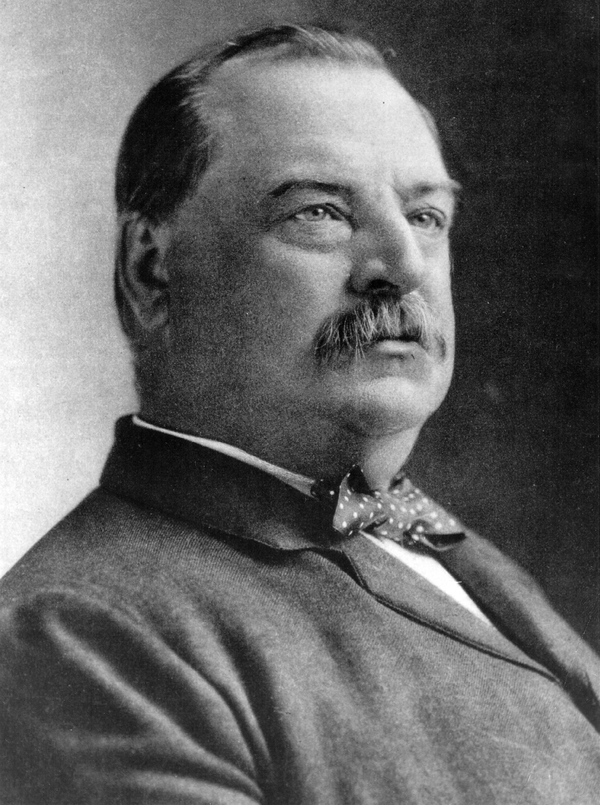
Portrait of Grover Cleveland, president of the United States. (New York Daily News archive) That is probably true for most Americans. Cleveland lives in the margins of history books, remembered more for the fact that he served two nonconsecutive terms than for how he governed. He was not a wartime hero, nor did he leave behind a sweeping program that bore his name.
But the more you learn about him, the harder it is to ignore how unusual he was.
Cleveland believed government should do less, spend less and stay within its limits. That was not just campaign rhetoric. It was how he approached the office.
To Cleveland, saying no was not a weakness. It was often the point.
You can see that clearly in 1887.
Congress passed a bill to send federal seed to drought-stricken farmers in Texas during a severe economic slump. Lawmakers stepped in to help. Cleveland vetoed the legislation.
His explanation was blunt: “I can find no warrant for such an appropriation in the Constitution.”
He did not question that farmers were struggling. He simply believed the Constitution did not authorize federal involvement. To him, good intentions did not erase constitutional limits. That mindset defined his presidency.
Cleveland rose from mayor of Buffalo to governor of New York to the White House in just a few years. But what set him apart was not the speed of his ascent. It was how he governed once he arrived.
He treated public office as a public trust, not a steppingstone or a reward system.
At a time when political machines dominated state and city politics, Cleveland challenged patronage and favoritism. Taking on Tammany Hall was risky, but he pushed back. Even his friends were not immune.
He denied his former law partner and supporter, Wilson Bissell, a Cabinet post and a consulship. Personal loyalty did not come before public duty.
That kind of independence is hard to imagine in modern Washington. Politics still run on loyalty and access. The names and parties change, but the instincts remain.
Cleveland’s most lasting mark came from his use of the veto pen. By the end of his two terms, he had vetoed more than 500 bills, more than double the total issued by all the presidents before him combined. Many were spending measures he believed exceeded constitutional authority.
In his view, wasting public money was not merely bad policy; it was a “ crime against the citizen.”
He did not see the presidency as a vehicle for constant action. He saw it as a guardrail.
His job was not to hand out federal help whenever pressure mounted. It was to protect the Constitution and the taxpayer, even when doing so was unpopular.
Cleveland won the popular vote three times and, for more than a century, was the only president to serve nonconsecutive terms. Still, he rarely receives the recognition given to more celebrated leaders.
There are no towering monuments to him. No HBO miniseries or films with A-list actors. Restraint, it turns out, does not make for dramatic storytelling.
March 18 would have marked Cleveland’s 189th birthday. It will likely pass with little fanfare, as it usually does. Little notice beyond a few historians. Just another date on the calendar.
For years, Cleveland was just a trivia answer to me. A name, a fact and a president with a killer mustache.
Now I see something else: restraint. Discipline. The willingness to say no when it would have been easier to go along.
Washington could use a few more Grover Clevelands.
____
Jacob Lane is a Republican strategist based in Illinois.
___
©2026 Chicago Tribune. Visit at chicagotribune.com. Distributed by Tribune Content Agency, LLC.

















































Comments