Abby McCloskey: Staggering US deficits call for a debt-to-GDP limit
Published in Op Eds
I recently went to the doctor about a minor health issue. “Is what I’m experiencing normal?” I asked her. “No, it’s never normal,” she said, “but it happens to almost everybody.” I thought: That pretty much sums up the problem of national debt.
After all, it’s been normal for America to run up the federal deficit since the mid-1980s. In fact, it’s become normal for almost every developed country to carry burdensome debt. But what’s considered normal should not be confused with how a healthy government should work.
We need a guardrail against things getting worse, lest the prognosis turn lethal.
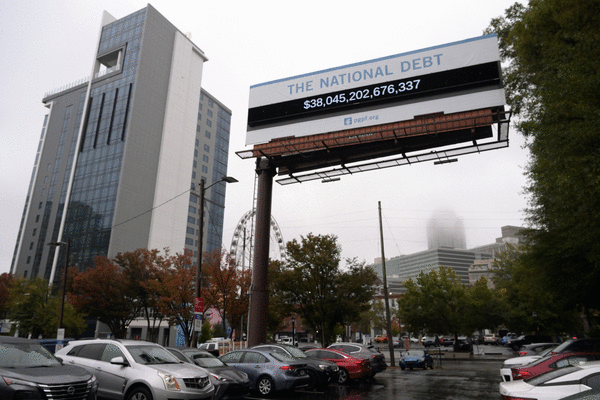
Debt held by the public is now the size of our entire economy (101% of GDP), and projected to rise to 120% of GDP in 2036, according to the Congressional Budget Office. This easily surpasses the previous record of 106% just after World War II. America’s deficit is worse than expected just a year ago — to the tune of $100 billion.
When you consider that as recently as 2001 we were running a budget surplus, you have to wonder: At what point will Americans question what they’ve gotten for going so deeply into the red?
For the cure, there are only bad and worse options. No one wants to stomach the necessary higher taxes and less spending. This was clear when a proposal from a bipartisan commission appointed by President Barack Obama — the Simpson-Bowles Commission — failed to get across the line. That plan included incremental and necessary reforms to both entitlements and tax structures that would, over decades, create a glide path back to healthy territory. We didn’t take the medicine.
Numerous other suggestions have been put forward since, but none hold up to even the lightest scrutiny.
For example, there’s the grow-your-way-out-of-it option. Brookings economist Jessica Riedl’s calculations show it would require 5-6% growth for decades — something the American economy has never sustained — to grow our way out of our debt.
The tax-the-rich-and-corporations option is no better. Riedl notes that you could tax every small business and millionaire at 100% and you wouldn’t come close to closing the budget gap. Worse, our budgetary problems would grow as job creators fled.
Fiscal health won’t come from tariffs. Higher tariffs were on track to reduce deficits by an estimated $3 trillion over 10 years, but this wasn’t even enough to cover the $4.7 trillion price tag of the One Big Beautiful Bill Act, let alone existing spending.
Inflate your way out of it? We could devalue our currency and thus make the debt relatively smaller. But the American people recently had a taste of higher inflation and shunned the politicians responsible for it.
Then there’s the cut-fraud-waste-and-abuse option. Much blame for the debt has been laid at the base of our bloated federal bureaucracy. While there are certainly savings to be had, the salaries and benefits of the entire federal civilian workforce hover around 1% of GDP. DOGE only slightly slowed federal spending. And believe it or not, no one is standing by knowingly watching billions of taxpayer dollars go to the wrong people.
Cut the military budget? Argue all you want about the war in Iran, but defense spending is less than 15% of the federal budget. It’s hard to persuade Americans it should go lower when the world feels less stable, not safer.
In light of these bad options, America's politicians have settled on the worst one: ignore the problem. To be sure, the U.S. has a unique advantage in that we can run up our bills and people will keep buying our debt. There’s nowhere else that’s as pro-growth and as safe to store cash.
But in their 2023 book, “Why Empires Fall: Rome, America, and the Future of the West,” authors Peter Heather and John Rapley remind us that fiscal imbalance is the death knell for empires. As taxes squeeze the next generation to keep providing services and pay off swelling interest payments, economic rewards increasingly go to a smaller group.
Basic services like safety, health and education become unreliable. The whole system becomes more and more unstable. It’s a doom loop that’s hard to escape because to cut services or raise taxes only exacerbates the instability.
To forestall this prospect, Congress should pass a law that the federal debt cannot exceed 100% of GDP. This would enable flexibility for each Congress and White House to adjust the spending and tax levels as priorities change over time. It would stabilize interest payments, end the debt-limit charades, and force politicians to make tradeoffs before passing their own pet priorities.
Combined with automatic stabilizers — wherein preset spending cuts and tax hikes occur in the wake of a congressional impasse — it would end costly government shutdowns. And it could be designed so that only a supermajority could override the limit, preserving a degree of financial flexibility in true emergencies.
Just because something has become normal doesn’t mean it actually is.
____
This column reflects the personal views of the author and does not necessarily reflect the opinion of the editorial board or Bloomberg LP and its owners.
Abby McCloskey is a columnist, podcast host, and consultant. She directed domestic policy on two presidential campaigns and was director of economic policy at the American Enterprise Institute.
©2026 Bloomberg L.P. Visit bloomberg.com/opinion. Distributed by Tribune Content Agency, LLC.





















































Comments