Stephen Mihm: The 'admin night' TikTok trend is a symptom of a toxic culture
Published in Op Eds
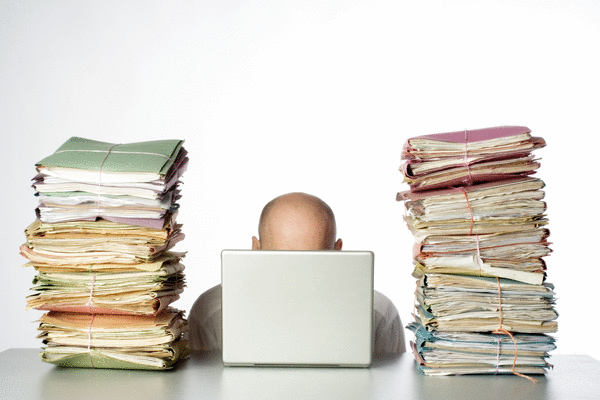
The first images that come to mind when you hear “Admin night” might be of a fun evening out for office support staff, but the trend is significantly less entertaining. As one primer on the practice put it, it’s a “great productivity hack.” Instead of happy hour, friends gather for a night of doing their taxes, answering emails and otherwise catching up on work.
Many participants have praised the events as a way to make mundane tasks feel less boring while boosting social time. That may be true, but this hack is also the latest expression of America’s unhealthy relationship with work and its complicated discomfort with leisure. Remember the invention of “workations” — the deliberate combination of work and vacation time?
The U.S. needs to shift away from its workaholic culture, but old habits are hard to break. And this is indeed an old one. Some of the nation’s founders would likely have loved admin night. Take Benjamin Franklin. An exemplar of the American work ethic, he achieved fame for his clever, if moralizing, dicta pushing frugality, sobriety and industry. “Leisure is time for doing something useful,” he once wrote. “This leisure the diligent man will obtain, but the lazy man never.”
America’s reputation as the home of a bunch of grinds persisted. When the British novelist Fanny Trollope visited in the 1830s, she found a nation that put labor ahead of relaxing. “How often did our homely adage recur to me, ‘All work and no play would make a dull boy.’” The average American, she tut-tutted, “is a very dull boy.”
It’s indisputable that Americans worked a great deal in the 19th century. Economic historians have concluded that laborers in the nascent industrial economy routinely clocked upward of 70 hours a week in the 1830s, typically working six days a week.
Eventually, though, the country took the global lead in setting aside more and more time for play. It’s time for us to rediscover that tradition.
While some of the change was a result of government regulation by individual states as well as agreements forged by unions, it mirrored a larger cultural shift that some employers embraced as well. For example, Henry Ford once quipped: “A workman would have little use for an automobile if he had to be at the shops from dawn to dusk.” In 1914, he capped the workday in his factories at eight hours. Twelve years later, he reduced the workweek from six days to five.
As the workday shrank, American workers began to partake of leisure on a far greater scale than in the past, with everything from vaudeville to movies to spectator sports becoming more popular, particularly in urban areas.
These trends, already well established by the 1920s, accelerated during the New Deal, particularly after Congress passed the Fair Labor Standards Act, which limited the workweek to 40 hours. This gave many Americans — particularly members of the White working class — an easier work life than their counterparts in Europe through the 1960s.
Then things went in reverse, and we lost our bragging rights. The economist and sociologist Juliet Schor was one of the first to try to explain what happened. In The Overworked American: The Unexpected Decline of Leisure (1992), Schor amassed a formidable amount of data showing that Americans had seen their working hours increase since the 1970s. The word “workaholic” entered popular parlance at this time.
Schor blamed this trend on a host of factors. They included the decline of union power and progressive employment policies; a culture of consumption that encouraged “keeping up with the Joneses”; and declining wages, which forced workers to take second and third shifts or get gig jobs. She estimated that Americans were working an additional 160 hours a year by the time she published her book — a trend that continues into our present century. Europe, by contrast, became known for six-week summer vacations and other unthinkable luxuries.
Something else happened along the way: Work began to infiltrate people’s personal lives. Until the 1970s, this distinction remained sharp. It was impossible for industrial workers to bring their work home, while white-collar workers, many of them dependent on secretaries and typists, couldn’t continue working outside the office.
The advent of what’s called the “information economy” changed all that. Networked computers, email, modems, word-processing programs and, eventually, the internet and portable laptops transformed knowledge work. It was now possible for employees to take work home with them — and in fact, take it anywhere.
What has all of this gotten us? Admin nights and other hacks that sacrifice time-honored after-work rituals like happy hour at the altar of productivity.
Before we celebrate the latest efficiency fixes, it’s worth reflecting on why we need them in the first place. These hacks may be genuinely helpful, but they can also quietly legitimize an unhealthy work culture by implying the burden is on individuals to adapt rather than on the culture to confront its dysfunction and change.
Franklin was right when he wrote that “time is money.” But time is also finite — and we’re reaching the limits of what’s feasible, healthy or sustainable.
____
This column reflects the personal views of the author and does not necessarily reflect the opinion of the editorial board or Bloomberg LP and its owners.
Stephen Mihm, a professor of history at the University of Georgia, is coauthor of “Crisis Economics: A Crash Course in the Future of Finance.”
_____
©2026 Bloomberg L.P. Visit bloomberg.com/opinion. Distributed by Tribune Content Agency, LLC.




















































Comments